CategoriesNews Construction Developments Economy Real Estate Investment

RDA Launches Comprehensive Assets Management Drive to Shield Vacant Properties

RAWALPINDI: The Rawalpindi Development Authority (RDA) has introduced a new Assets Management initiative aimed at protecting public land, generating sustainable revenue, and making better use of long-neglected properties across its housing schemes.

The initiative was formally unveiled at a high-level briefing held at the RDA Conference Room, chaired by the Commissioner of Rawalpindi and the Director General of RDA. Senior officials from finance, planning, engineering, and estate management departments attended the session, reflecting the broad institutional commitment behind the programme.

Director Estate Management Maleeha Iesar led the presentation, outlining a three-part strategy focused on: preventing illegal encroachment on RDA-owned land; developing vacant properties to create steady income for the Authority; and improving land use across 13 housing schemes currently under RDA’s ownership.

The initiative comes in response to growing concerns over the gradual encroachment of open spaces within established housing colonies, a problem that has steadily reduced both public utility and the Authority’s land assets over the years.

In response to the briefing, the Commissioner and DG RDA directed all department heads to extend full support to the Estate Management Directorate. They also ordered the prompt preparation and submission of design drawings for proposed construction on identified sites, emphasising the need for swift action across all relevant departments.

The meeting concluded with unanimous agreement among all officials to move forward with the plan. Authorities indicated that construction and development activities are expected to begin once the designs receive formal approval.
Officials noted that this initiative signals a broader shift in RDA’s approach, moving from simply owning land to actively managing and developing it. The programme is also expected to serve as a model for urban land management across Punjab.

RDA Launches Comprehensive Assets Management Drive to Shield Vacant Properties
Sources:
CategoriesSpecial Report Construction Developments Property Laws Real Estate Investment Urban Developments & Planning

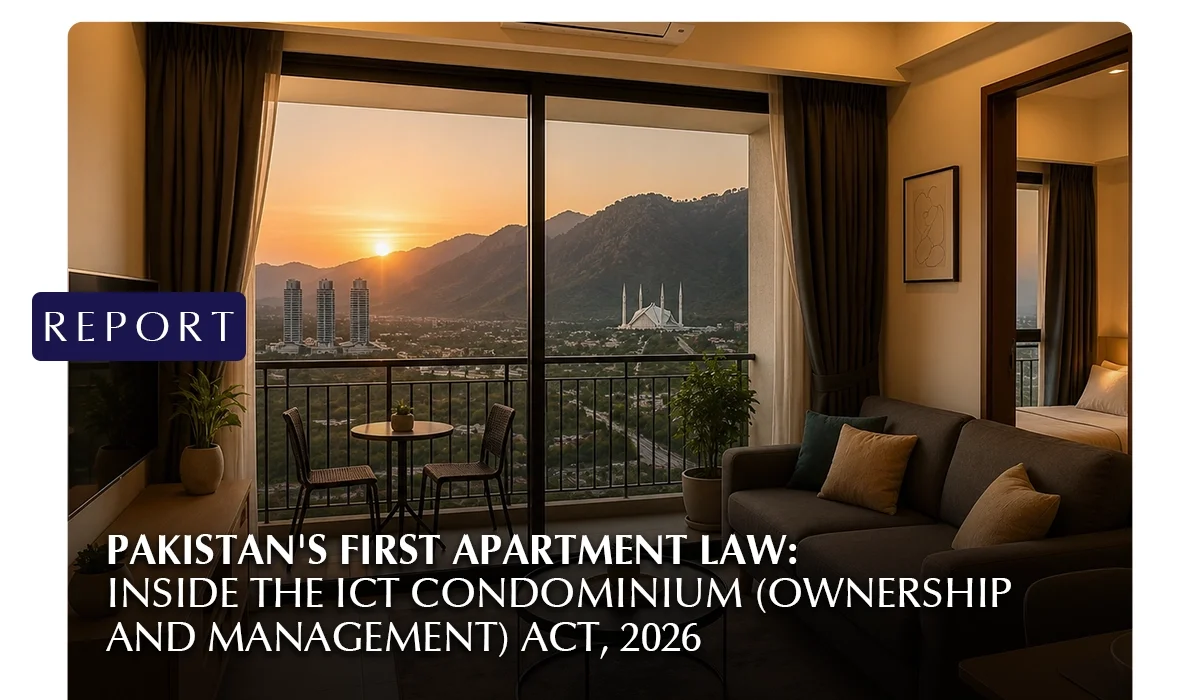
Pakistan’s First Apartment Law: Inside the ICT Condominium (Ownership and Management) Act, 2026

ISLAMABAD — For more than twenty years, people who bought apartments in Islamabad did so without any dedicated law to protect their ownership. Unlike those who bought a plot or a house, apartment buyers had no independent title in their own name.

Their rights were tied to whatever lease the developer held with the Capital Development Authority (CDA). If that lease was cancelled for any reason, buyers could find themselves with no legal recourse, regardless of how much money they had paid.

Pakistan’s parliament has finally moved to pass the Islamabad Capital Territory Condominium (Ownership and Management) Act, 2026, the first dedicated condominium law for the federal capital.

What the Law Actually Does

At its core, the Act does three things: it gives apartment owners a proper legal title, it creates a formal body to manage shared buildings, and it sets up a system to resolve disputes.

On ownership: Every unit sold in a condominium complex now confers exclusive ownership rights on the buyer. A formal Deed of Ownership containing details of the unit, common areas, value, and ownership percentage must be executed and registered with the Authority.

Builders are legally bound to provide this deed within three months of a sale. Critically, the buyer’s share in common areas, lobbies, staircases, car parking, and rooftops automatically transfers along with the unit. It cannot be separated.

On lease-hold properties: Many apartments in Islamabad sit on land that developers leased from the CDA rather than owned outright. The law now requires those developers to execute individual subleases for each unit and register them with the CDA. 

Once 50% of units are handed over to buyers, the developer must formally transfer the lease rights to the Association of Owners.

On collective management: The law makes it mandatory to form an Association of Owners for every condominium complex. This body, a minimum of five elected members, each serving a three-year term, takes on responsibility for maintaining the building, managing shared facilities, collecting maintenance contributions, and insuring the complex against fire, earthquakes, riots, and bomb blasts. Crucially, each unit owner gets one vote regardless of how many units they hold, preventing wealthier investors from dominating building decisions.

On enforcement: A federal Regulator will be designated by the government to receive complaints, inspect buildings, and issue binding decisions in disputes. If the Association of Owners fails to perform its duties, aggrieved owners or tenants can approach the Regulator directly. The Regulator’s decisions in unresolved disputes are final.

Pakistan’s Housing Crisis

Pakistan faces a housing shortage estimated at around 10 million units, while rapid urbanisation has intensified pressure on infrastructure, services, and farmland surrounding major cities. UN-Habitat notes that Pakistan’s urban population nearly doubled from 43 million to 75 million between 1998 and 2017.

Pakistan has historically relied on low-rise, plot-based housing development, unlike neighbouring India and many Gulf states, where vertical urban expansion has become more common in major cities.

Prime Minister Shehbaz Sharif, chairing a high-level meeting on housing sector reforms in May 2026, said the government would encourage high-rise buildings and vertical expansion in major cities as part of broader urban planning reforms, and directed authorities to digitise and automate housing-related processes to improve transparency and attract investment.

Officials also proposed mandatory registration with the Securities and Exchange Commission of Pakistan (SECP) for entities operating in the housing and development sector, alongside a proposed one-window system to protect the rights of developers, buyers, and other stakeholders.

The condominium law fits squarely within this direction. If vertical growth is to be encouraged, legal certainty for apartment buyers is not optional; it is a precondition.

Analyst Perspectives

Experts broadly welcome the legislation but point to significant implementation challenges. Investment advisors highlight 2026 as a turning point for property investment in Pakistan, with urban expansion, infrastructure projects, and growing overseas demand pointing toward market growth, but note that success depends on choosing developers who deliver on promises and provide international-standard living environments.

A recurring concern raised by observers is whether the Regulator, whose appointment is left to the Federal Government’s discretion, will be sufficiently independent and adequately resourced. The law grants the Regulator wide inspection and enforcement powers, but its effectiveness will depend entirely on how seriously the government treats that appointment. 

Similarly, the Association of Owners model only works if residents are willing and able to organise themselves, something that may prove difficult in buildings where a large share of units are held by absentee investors rather than resident owners.

Conclusion

The ICT Condominium Act, 2026, is a meaningful step forward for Pakistan’s urban property sector. It fills a legal vacuum that left apartment buyers in an unacceptably weak position for decades.

By establishing clear ownership titles, mandating owners’ associations, and creating a formal complaints mechanism, it lays the foundation for a healthier apartment market in the federal capital. The law has been written. The harder work begins now.

For more news on real estate and Special Reports, visit Chakor Ventures.

References

Mehsud, R. (2026, May 14). Pakistan weighs high-rise housing push to curb urban sprawl, protect farmland. Arab News. https://www.arabnews.com/node/2643548

National Assembly of Pakistan. (2026). Islamabad Capital Territory Condominium (Ownership and Management) Act, 2026 [Bill text, as passed by the National Assembly].

Siddiqui, S. (2026, May 19). Bill on flats, shared building ownership tabled in the Senate. Bloom Pakistan. https://bloompakistan.com/bill-on-flats-shared-building-ownership-tabled-in-senate/

Nadeem ul Haque, N. (2026, May 6). Property title risks for apartments in Islamabad. Substack. https://nadeemulhaque.substack.com/p/property-title-risks-for-apartments

Wasay, A. (2026, January 26). National Assembly committee defers ICT condominium bill over officials’ absence. TechJuice. https://www.techjuice.pk/national-assembly-committee-defers-ict-condominium-bill-over-officials-absence/

CategoriesReal Estate Investment News Property Property Taxes Real Estate

FBR Revises Property Valuations for DHA Lahore and Rawalpindi; Eight Cities Now Covered Under Updated Tax Framework

ISLAMABAD — The Federal Board of Revenue has updated the official valuations of properties in Defence Housing Authority areas of Lahore and Rawalpindi, through two separate orders issued on Tuesday. The revisions will directly affect the amount of tax that buyers and sellers are required to pay when a property changes hands in these localities.

The updates were formalised through Statutory Regulatory Orders S.R.O. 876(I)/2026 for Lahore and S.R.O. 877(I)/2026 for Rawalpindi, both signed by Muhammad Amin Qureshi, Secretary Rules and SRO, Revenue Division. They amend valuations originally set in October 2024 and bring the total number of cities where the FBR has revised property benchmarks in recent months to eight, following similar exercises carried out for Islamabad and other major urban centres.

Understanding the FBR Rate

When a property is sold in Pakistan, the government uses an official benchmark value set by the FBR to calculate withholding tax, which is a tax collected at the point of the transaction. This FBR rate is separate from both the actual price agreed between buyer and seller and the Deputy Commissioner rate set by provincial governments for stamp duty purposes.

The purpose of periodically revising these benchmarks is to keep them closer to real market values. When official values are too far below what properties actually trade for, the withholding tax collected ends up being lower than it should be, effectively allowing significant portions of high-value transactions to go under-taxed. There are multiple online property tax calculators which help you calculate your property taxes.

Lahore: What the New Rates Say

The Lahore order revises valuations for DHA Phases VI through XIII, all administratively located within Nishtar Town. Rates here are expressed in rupees per marla, the standard unit of land measurement in Punjab.

The most valuable commercial address in the entire Lahore table is the Broadway strip in DHA Phase VIII, the main commercial avenue running through sub-sectors A, B, C and D, officially valued at Rs. 4,988,970 per marla. This figure forms the basis of withholding tax calculations for any commercial plot or shop sold along that stretch.

Among residential areas, DHA Phase XI Rahbar, Sector I carries the highest valuation at Rs. 967,960 per marla, reflecting its established infrastructure and sustained demand. At the lower end, DHA Phase XIII, formerly known as DHA City and located furthest from the city centre, is valued at Rs. 204,960 per marla, consistent with its earlier stage of development.

DHA Phase VI, one of Lahore’s most established residential addresses, is valued at Rs. 1,132,460 per marla for most residential blocks. The C, M and N Blocks carry a lower residential rate of Rs. 761,460 per marla, though their commercial land value rises sharply to Rs. 4,369,410 per marla, reflecting heavy commercial activity in those areas.

A significant addition in this notification is the first-ever official valuation assigned to One Central DHA, a newer development that previously had no FBR benchmark. It has now been entered into the official table at Rs. 760,000 per marla for residential open plots and Rs. 3,100,000 per marla for commercial plots. This means transactions in One Central DHA will now carry a formally calculated withholding tax obligation for the first time.

Across all DHA Lahore entries, built structures, that is, houses or commercial buildings as opposed to bare land, are assessed at a uniform Rs. 1,750 per square foot for residential and Rs. 2,800 per square foot for commercial, regardless of which phase they are located in.

Rawalpindi: A Different Scale, Similar Intent

The Rawalpindi order covers DHA Phases I through V and DHA Valley. An important distinction: unlike Lahore, where rates are expressed per marla, Rawalpindi valuations in this notification are given in rupees per square foot. This reflects a difference in how property is traditionally measured and administered across the two cities.

The highest commercial valuation in Rawalpindi’s table belongs to DHA Phase II, at Rs. 17,677 per square foot for commercial open plots, the single largest figure in the Rawalpindi notification. DHA Phase I follows at Rs. 15,427 per square foot for commercial land.

On the residential side, DHA Phase II again leads at Rs. 2,878 per square foot, while DHA Valley, the most peripheral of the listed localities, sits at just Rs. 466 per square foot for residential open plots. The gap between these two figures illustrates how sharply official land values decline as the distance from the city’s established core increases.

DHA Phases II Extension, III and IV share an identical commercial open plot rate of Rs. 5,946 per square foot, indicating that the FBR considers their commercial potential broadly equivalent. Their residential rates, however, vary: Phase IV at Rs. 1,322 per square foot, Phase III at Rs. 1,011 per square foot and Phase II Extension at Rs. 778 per square foot, differences that broadly reflect each area’s level of development and infrastructure maturity.

Built structure rates across Rawalpindi DHA phases are set at Rs. 1,470 per square foot for commercial and Rs. 735 per square foot for residential in most phases, with DHA Valley’s residential superstructure rate marginally higher at Rs. 770 per square foot.

The Broader Context

Pakistan’s property market has long operated with a well-documented gap between declared transaction values and actual market prices. For years, it was common practice for buyers and sellers to register a property at a fraction of its true value, reducing their tax liability significantly.

FBR valuation revisions are one of the primary tools available to narrow that gap and, with it, improve tax collection from a sector that has historically contributed far less to the national treasury than its scale would suggest.

These revisions also carry relevance beyond individual transactions. Pakistan’s economic reform commitments, including those made under its ongoing programme with the International Monetary Fund, have consistently identified the real estate sector as an area requiring greater documentation and tax compliance. The gradual extension of revised FBR benchmarks to more cities and localities is part of the government’s response to those obligations.

For buyers and sellers in the affected DHA areas, the immediate effect is straightforward: withholding tax at the point of transaction will now be calculated on a revised official value, which in most cases will be closer to actual market prices than the figures it replaces.

Those accustomed to a significant gap between the FBR rate and the market price should account for a narrower margin when planning the financial aspects of a property transaction.

For more news on real estate and Special Reports, visit Chakor Ventures.

References

Federal Board of Revenue, Government of Pakistan. (2026, May 19). S.R.O. 876(I)/2026: Revision of valuation of immovable properties Nishtar Town, Lahore [Statutory notification]. Revenue Division, Islamabad. File No. 2(17)R&S/2017.

Federal Board of Revenue, Government of Pakistan. (2026, May 19). S.R.O. 877(I)/2026: Revision of valuation of immovable properties Rawalpindi [Statutory notification]. Revenue Division, Islamabad. File No. 2(31)R&S/2024.

Akhter, S. (2026, May 19). FBR revises property valuation tables for Nishtar Town Lahore. Pkrevenue.com. https://pkrevenue.com/fbr-revises-property-valuation-tables-for-nishtar-town-lahore/

Government of Pakistan. (2001). Income Tax Ordinance, 2001 (XLIX of 2001), Section 68(4). National Assembly of Pakistan.

Federal Board of Revenue, Government of Pakistan. (2024, October 29). S.R.O. 1722(I)/2024: Valuation of immovable properties Lahore [Statutory notification]. Revenue Division, Islamabad.

Federal Board of Revenue, Government of Pakistan. (2024, October 29). S.R.O. 1728(I)/2024: Valuation of immovable properties Rawalpindi [Statutory notification]. Revenue Division, Islamabad.

CategoriesNews Budget Economy Property Property Taxes Real Estate Real Estate Investment

FPCCI seeks property tax relief to revive real estate, construction sectors

ISLAMABAD: The Federation of Pakistan Chambers of Commerce and Industry (FPCCI) has proposed major property tax reforms for the federal budget FY2026-27 to help revive Pakistan’s real estate and construction sectors.

According to FPCCI’s budget proposals, the current tax structure has made property transactions more expensive and slowed investment in the sector. The chamber has suggested reducing withholding tax under Section 236C on the sale of immovable property to a uniform 1% across all transaction values. At present, the rate can go as high as 5.5% on higher-value transactions and is charged on the gross transaction value, regardless of actual profit or loss.

FPCCI also proposed reducing advance tax under Section 236K on property purchases to a flat 1%, while abolishing advance tax on the first property purchase by a filer. The body said simpler and lower tax rates could encourage proper documentation, reduce under-reporting, and improve transparency in the property market.

The chamber further called for abolishing the tax on deemed income under Section 7E, saying it taxes assumed income from immovable property instead of actual earnings. It also recommended withdrawing Section 7F, under which builders and developers are taxed on 10% of gross receipts, regardless of their actual income.

FPCCI said balanced taxation could attract investment and support allied industries such as cement, steel, transport, and labour, helping generate wider economic activity.

For more news on real estate and special reports, visit Chakor Ventures.

Sources:

CategoriesNews Budget Economy Investment Tax

IMF Seeks Rs500bn New Taxes, Rs15.264trn FBR Target for FY2026–27

ISLAMABAD: Pakistan is facing mounting pressure from the International Monetary Fund (IMF) to introduce major tax reforms ahead of budget negotiations for fiscal year 2026–27. According to recent reports, the IMF has asked the government to generate nearly Rs500 billion through additional tax measures while setting an ambitious Federal Board of Revenue (FBR) tax collection target of Rs15.264 trillion.

A key part of the IMF’s proposal is the removal of all sales tax exemptions to create a more uniform taxation system. While the standard sales tax rate could be reduced from 22.8 percent to 18 percent, the withdrawal of exemptions is expected to widen the tax net and increase revenue collection. The IMF is also seeking around Rs778 billion through stricter enforcement measures.

The discussions include the expansion of the Third Schedule, which may bring products such as infant formula, dairy items, cooking oil, and other essential goods into a revised tax structure. This move alone is expected to generate around Rs100 billion in revenue.

In another major reform, authorities are considering making digital invoicing mandatory from July 1, 2026. Under the proposal, only digitally issued invoices would be accepted for tax purposes, a step projected to add another Rs100 billion to national revenue while improving transparency in business transactions.

The government is also reviewing a simplified taxation scheme for retailers and shopkeepers with annual turnover between Rs200 million and Rs250 million, potentially linked to electricity bills for easier collection.

Meanwhile, discussions on the controversial super tax suggest that an immediate withdrawal is unlikely, though a phased elimination over the next three years remains under consideration.

For more news on real estate and special reports, visit Chakor Ventures.

Sources:

CategoriesBudget Economy Investment News Special Report Tax

Pakistan and IMF Chart Course for Budget 2026–27: A Critical Analysis

Pakistan and IMF Chart Course for Budget 2026–27: A Critical Analysis

By News Desk | May 14, 2026

Pakistan’s Finance Minister Senator Muhammad Aurangzeb met with a visiting International Monetary Fund (IMF) mission on May 13, 2026, in Islamabad for high-level discussions on the country’s macroeconomic outlook, the upcoming federal budget for fiscal year 2026–27, and the broader structural reform agenda. The meeting comes at a pivotal moment: the IMF had just approved a fresh disbursement of approximately $1.3 billion five days earlier, and Pakistan is navigating a complex economic environment shaped by external debt pressures, a volatile global commodity landscape, and the ongoing fallout from the Middle East conflict.

The Meeting: What Was Discussed

The talks, held between Minister Aurangzeb and IMF Mission Chief Ms Iva Petrova, covered four broad areas: macroeconomic stabilisation, upcoming budget preparations, structural reform priorities, and Pakistan’s engagement with international development partners.

According to the Ministry of Finance, both sides exchanged views on “maintaining reform momentum, preserving macroeconomic stability, and advancing structural reforms to promote investment, productivity, and export-led growth.” 

The minister highlighted improvements in Pakistan’s external sector, citing month-on-month and year-on-year growth in remittances and exports as evidence of strengthening macroeconomic fundamentals.

Aurangzeb framed the government’s reform agenda as a long-term and technically grounded one designed to break Pakistan’s historical pattern of boom-and-bust economic cycles. He stressed the importance of structural reforms, productivity enhancement, deregulation, and improved export competitiveness. He also briefed the delegation on Pakistan’s economic cooperation with China and efforts to attract long-term foreign investment.

The meeting was attended by key institutional heads, including State Bank of Pakistan (SBP) Governor Jameel Ahmad, Finance Division Secretary Imdad Ullah Bosal, and Federal Board of Revenue (FBR) Chairman Rashid Mahmood Langrial.

The $1.3 Billion Disbursement: Context and Significance

The meeting followed the SBP’s announcement that it had received SDR 914 million, approximately US$1.3 billion under two IMF programmes: the Extended Fund Facility (EFF) and the Resilience and Sustainability Facility (RSF). This brings total disbursements under both arrangements to SDR 3,348 billion, or roughly $4.8 billion.

The IMF Executive Board had approved the disbursement on May 8, 2026, following the successful completion of the third review under Pakistan’s 37-month EFF arrangement, which was first approved on September 25, 2024. 

An additional SDR 154 million (approximately $220 million) was disbursed under the RSF, the climate-focused facility approved on May 9, 2025, aimed at helping Pakistan build resilience against natural disasters.

The funds were credited to SBP accounts on May 12, 2026, and will be reflected in Pakistan’s official foreign exchange reserve figures for the week ending May 15, 2026.

IMF Deputy Managing Director Nigel Clarke, speaking after the Executive Board meeting, offered a pointed message alongside the approval: “Pakistan needs to maintain strong macroeconomic policies while accelerating reform efforts, which are critical to managing external shocks and fostering higher sustainable medium-term growth.” Clarke specifically flagged that shocks from the Middle East conflict underline the continued urgency of structural reforms.

IMF’s Formal Assessment

In its end-of-mission statement from March 2026, following the third EFF review, the IMF noted that “programme implementation under the EFF remained broadly aligned with the authorities’ commitments through end-February 2026.” The Fund acknowledged progress on fiscal consolidation, monetary policy tightening, and energy sector reforms, while also noting that discussions on deepening structural reforms were still ongoing.

Pakistan has committed under the programme to maintaining a primary budget surplus of 1.6% of GDP for FY2026, moving toward a 2% surplus target by FY2027. The IMF has maintained these targets firmly, declining to ease them despite weak tax collection performance by the FBR earlier in the year.

IMF Mission Chief Iva Petrova acknowledged that Pakistan’s authorities “remain committed to pursuing sound and prudent macroeconomic policies to preserve the recent gains in macro-financial stabilisation, while deepening structural reforms to accelerate growth and strengthening social protection to mitigate the impact of volatile energy prices on the most vulnerable.”

Budget 2026–27: What to Expect

According to sources cited by Business Recorder, the government is unlikely to introduce new taxes in the upcoming budget, instead aiming to meet its revenue targets through enforcement and administrative measures estimated at Rs 778–780 billion. The budget is expected to offer some relief to the salaried class, with Aurangzeb reportedly seeking to lower tax rates and raise the taxable income threshold in recognition of salaried workers’ disproportionate contribution to tax revenue.

The IMF delegation is also expected to consult with the Ministry of Energy and other departments on structural reforms in the power sector and state-owned enterprises (SOEs), aligning expenditure planning and revenue targets ahead of the formal budget presentation.

Expert Opinions: Cautious Optimism Mixed With Structural Concerns

While the IMF approval has been broadly welcomed as a confidence-building signal, independent economists have urged caution.

Analysts cited by Energy Update noted that “the IMF approval will provide short-term stability to financial markets while reinforcing investor confidence in Pakistan’s economic reform agenda and long-term fiscal sustainability.” However, they stopped short of calling the situation structurally resolved.

Economist Sajid Amin, commenting on the FY2025–26 budget earlier in the cycle, which set the framework now being built upon, offered a pointed critique: “Overall, I feel the budget falls short on structural and bold reforms; it is a stabilisation budget formed to meet revenue targets. The objective or principle guiding the budget is the incoming IMF tranche.” His view reflects a broader concern that Pakistan’s fiscal decisions are being shaped primarily by programme compliance rather than domestic economic strategy.

Economist Ali Hasnain echoed this, describing the prior budget as “relatively disciplined but within the status quo,” while warning that tariff reductions favouring import-dependent industries such as auto and mobile manufacturing do little for export competitiveness and remain “a road to nowhere.”

Perhaps most critically, economist and policy analyst Dr. Nadeem ul Haque, writing in a review of Pakistan’s economic press coverage, challenged the broader reform narrative head-on: “Pakistan has been in and out of IMF programs for four decades. Which structural reforms from earlier cycles actually survived?” He argued that the IMF’s diplomatic language, “accelerating reform efforts,” masks a recurring failure to build lasting institutional capacity. 

He described repeated cycles of tax reform, energy reform, privatisation, and governance reform returning under new labels, and characterised the programme’s revenue-heavy, expenditure-light architecture as potentially counterproductive: “Raising rates while undermining the productive base that generates the denominator of the very ratio being targeted is not fiscal reform, it is fiscal cannibalism.”

On the energy sector, one of the most critical areas of the reform agenda, Business Recorder’s editorial commentary noted that the circular debt, now approaching Rs 1.9 trillion, is not merely a cash-flow management challenge but rather “the accumulated financial residue of twenty years of politically driven IPP contracting, below-cost tariffs, and deep governance failure.”

The Bigger Picture: Stability Versus Transformation

The central tension in Pakistan’s current economic trajectory is one that the Aurangzeb-IMF meeting placed on full display: the difference between macroeconomic stabilisation and genuine structural transformation. Pakistan’s foreign exchange reserves have improved, reaching $16 billion by the end of December 2025, up from $14.5 billion in June 2025, and inflation has been brought progressively under control. These are measurable gains.

Yet the structural challenges, such as a narrow tax base, a bloated public sector, energy sector inefficiencies, high external liabilities, and a persistent inability to generate export-led growth, remain largely unresolved. The government’s stated commitment to moving Pakistan away from boom-and-bust cycles is not new; the same language has featured in reform agendas under multiple administrations.

What sets the current moment apart, analysts note, is the combination of continued IMF engagement, a Finance Minister with clear private-sector credentials, and crucially $4.8 billion in cumulative programme disbursements that have restored a degree of fiscal credibility. 

Whether this translates into durable transformation will depend on the content of Budget 2026–27, the pace of SOE privatisation, and the government’s ability to broaden the tax base without further burdening an already stretched formal sector.

Conclusion

The May 13 meeting between Finance Minister Aurangzeb and the IMF mission was substantive and, by official accounts, constructive. Pakistan has made measurable progress on macroeconomic stabilisation, a point the IMF itself has acknowledged. The $1.3 billion disbursement reflects continued programme compliance and offers near-term support to foreign exchange reserves.

However, the harder work of structural transformation in taxation, energy, governance, and SOE reform remains incomplete. As Budget 2026–27 takes shape, the critical question is whether the government will use this window of relative stability to introduce genuinely bold reforms, or whether, as critics have cautioned, the budget will once again be calibrated primarily around programme targets rather than Pakistan’s long-term economic needs.

References

Clarke, N. (2026, May 8). Statement on the IMF Executive Board approval of third EFF review for Pakistan. International Monetary Fund. https://www.energyupdate.com.pk/2026/05/09/imf-approves-1-3bn-for-pakistan-warns-of-rising-risks-from-middle-east-conflict/

Dawn. (2026, May 13). Finance minister discusses budget preparations with visiting IMF mission. https://www.dawn.com/news/1999908

Dawn. (2025, June 10). ‘Short of structural, bold reforms’: Finance experts unpack 2025–26 budget. https://www.dawn.com/news/1916314

International Monetary Fund. (2026, March 11). Pakistan: End-of-mission statement on the third review of the 37-month extended arrangement under the EFF and the second review of 28-month arrangement under the RSF. https://www.imf.org/en/news/articles/2026/03/11/pr-26075-pakistan

International Monetary Fund. (2026, March 27). IMF reaches staff-level agreement on the third review for the 37-month extended arrangement under the EFF and the second review under the RSF Pakistan. https://www.imf.org/en/news/articles/2026/03/27/pr-26095-pakistan

Kundi, I. A. (2026, May 14). Finance minister briefs IMF on upcoming budget. The Nation. https://www.nation.com.pk/14-May-2026/finance-minister-briefs-imf-upcoming-budget

Petrova, I. (2026, March 27). IMF reaches staff-level deal with Pakistan for $1.2bn tranche after third EFF review. The Express Tribune. https://tribune.com.pk/story/2599737

ul Haque, N. (2026, May 8). A review of economic journalism and opinion pages, May 1–8, 2026: More information, limited inquiry. Nadeem ul Haque Substack. https://nadeemulhaque.substack.com/p/a-review-of-economic-journalism-and

Web Desk. (2026, May 13). FinMin Aurangzeb discusses upcoming budget preparations, economic reforms in meeting with IMF mission. The Express Tribune. https://tribune.com.pk/story/2607861

Web Desk. (2026, May 13). Pakistan, IMF discuss upcoming federal budget. Business Recorder. https://www.brecorder.com/news/40420959

CategoriesNews Economy Investment Property Property Laws Real Estate Real Estate Investment

KP passes property Act 2026 to protect overseas Pakistanis’ properties

PESHAWAR: The Khyber Pakhtunkhwa Assembly has passed the Overseas Pakistanis Property Act 2026 to protect properties owned by overseas Pakistanis and ensure faster resolution of related disputes.

The law, introduced by Provincial Law Minister Aftab Alam, is aimed at preventing illegal occupation, unlawful transfer, and other property-related issues faced by expatriates in the province.

Under the Act, special courts will be established across Khyber Pakhtunkhwa in consultation with the Peshawar High Court. These courts will be headed by judges of the rank of Additional District and Sessions Judge, while pending property cases involving overseas Pakistanis will also be transferred to the special courts.

The law requires such cases to be decided within 120 days, while appeals must be filed within 15 days. Overseas Pakistanis will also be able to submit applications online, making the legal process more accessible for those living abroad.

The Act further allows testimony to be recorded through video link, enabling applicants to take part in court proceedings without travelling to Pakistan. Court notices may also be served through mobile phones, email, and mosques to improve communication and reduce delays.

The legislation also includes provisions to stop illegal transfer of properties and assist in rent recovery for overseas Pakistanis. Officials said the measure is intended to strengthen legal protection, improve access to justice, and build confidence among expatriates regarding their properties in Khyber Pakhtunkhwa.

For more news on real estate and special reports, visit Chakor Ventures.

CategoriesSpecial Report Economy Investment News

Pakistan’s Reserves Rise by $23m, Signalling Steady Financial Recovery

Pakistan’s foreign exchange reserves continued their gradual upward trend this week, with the State Bank of Pakistan (SBP), the country’s central bank, reporting a $23 million increase for the week ended April 30, 2026. While the figure itself is modest, it reflects an incremental recovery that economists and policymakers have been closely tracking as Pakistan works to stabilise its external financial position.

Foreign exchange reserves, in the simplest terms, are the dollars and other foreign currencies that a country keeps in reserve. Think of them as the national savings account held in foreign money. These reserves are used to pay for imports, repay foreign loans, stabilise the national currency, and demonstrate to the rest of the world that a country can meet its financial obligations. When they rise, it signals strength. When they fall, alarm bells ring.

The Numbers at a Glance

The State Bank of Pakistan reported a $23 million increase in its foreign exchange reserves during the week ended April 30, 2026, which reached $15.85 billion. The country’s total liquid foreign reserves stood at $21.29 billion, of which commercial banks held net reserves of $5.44 billion.

The data also showed a slight increase in commercial banks’ reserves, which grew by $170,000 to reach $5.4428 billion. Overall, Pakistan’s total foreign exchange reserves recorded a combined increase of $24.5 million, bringing the national total to $21.2935 billion.

It is important to understand the difference between these two figures. The SBP’s reserves of $15.857 billion are the government-held reserves that are directly available for managing exchange rate pressures, paying sovereign debt, and financing critical imports.

The commercial banks’ reserves are separately managed and not directly deployable by the government in the same way. Together, the two pools form Pakistan’s total liquid foreign reserves.

What This Means for the Rupee

Alongside the reserves data, the currency market provided a broadly stable reading. The rupee saw a marginal gain of Rs 0.01 against the US dollar, closing at 278.71 in the interbank market against the previous close of 278.72.

A one-paisa movement is numerically negligible. But what it signals is arguably more important than the size of the shift: the rupee is not under fresh pressure. For a currency that spent years in near free-fall, losing more than half its value against the dollar between 2021 and 2023, a period of exchange rate stability is itself a meaningful development.

Stability in the rupee directly benefits ordinary Pakistanis, as it prevents further spikes in the prices of imported goods from fuel and edible oil to medicines and electronics.

The IMF Dimension: A Critical Near-Term Catalyst

The weekly reserve figure gains considerably more weight when placed in the context of an anticipated IMF disbursement that has been the focus of Pakistan’s financial managers and market observers alike.

The IMF Executive Board was scheduled to consider Pakistan’s Staff-Level Agreement on May 8, 2026. If approved, the country was expected to receive around $1.2 billion in fresh funding under its ongoing financial support programme.

The Ministry of Finance and the State Bank of Pakistan showed unanimous optimism over economic growth and achieving fiscal and current account targets, with the development coming amid anticipated approval of disbursements worth over $1.2 billion by the IMF.

SBP Governor Jameel Ahmad, testifying before the National Assembly’s Standing Committee, stated that the current fiscal year would end with foreign exchange reserves of $17 billion. The IMF staff mission was also expected to visit Islamabad on May 15 for finalisation of the next fiscal year (2026–27) budget in consultation with the Ministry of Finance, the SBP, the FBR, and the Power and Petroleum Divisions.

Taken together, these developments paint a picture of a government actively managing its external financing calendar and, for the moment, keeping pace with its obligations.

Gold Markets: A Parallel Development

The week’s financial news was not limited to reserves. Pakistan’s domestic gold market saw a sharp upward movement, closely tracking international price gains.

In the local market, the price of gold per tola jumped Rs7,800 to settle at Rs496,762, according to rates issued by the All-Pakistan Gems and Jewellers Sarafa Association.

Similarly, the price of 10-gram gold increased by Rs6,687 to Rs425,893. Internationally, spot gold gained 1% to $4,733.59 per ounce, after touching a two-week high earlier in the trading session.

The rally was driven by geopolitical factors: improving sentiment around a potential US-Iran diplomatic agreement eased fears of prolonged instability and lowered expectations of persistently high interest rates, both of which support investor appetite for gold.

Interactive Commodities Director Adnan Agar, commenting on the market, noted that gold had shown strong intraday volatility. He stated that for the bullish trend to continue, gold would need to cross and close above $4,875, with the next target at $4,850, followed by $4,900, and eventually the psychologically important $5,000 mark. He cautioned that if the market closed below $4,700, it would enter a dangerous zone where prices could decline towards $4,500.

Expert Analyst Perspectives – Cautious Optimism from Markets

Mohammad Sohail, CEO of Topline Securities, one of Pakistan’s leading brokerage firms, attributed the broader reserve improvement trend to a combination of policy actions and improving fundamentals.

He noted that the rise in foreign exchange reserves reflects improved external account management, higher remittances, better exports, and disciplined policy actions under the IMF’s guidance. He had also projected that reserves would surpass $17 billion by June 2026, citing strong remittances and a reduction in interest payments as key drivers.

Analysts at Arif Habib Limited provided a useful benchmark for measuring the practical impact of reserve movements. Following an earlier reserve jump triggered by an IMF disbursement, they calculated that the improvement in reserves had strengthened Pakistan’s external buffer, with import cover rising from 2.41 months a week earlier to 2.62 months, based on average imports of the last three months.

The number of months a country could theoretically continue importing without any new foreign inflows is a key health metric for any economy’s reserve position. Three months is the internationally recognised minimum safe threshold.

More broadly, market analysts pointed to the investment dimension of rising reserves. Analysts noted that stronger reserves reduce perceived risk, making Pakistan a relatively more attractive destination for portfolio and direct investments.

This shift could gradually ease borrowing costs and improve access to international capital markets. However, the same analysts added that confidence remains highly sensitive to policy consistency and global economic conditions.

A Dissenting, Structural View

Not all expert commentary has been optimistic. Dr. Raania Ahsan, a PhD economist and former Executive Director General at the Board of Investment in the Prime Minister’s Office, offered a sharper and more cautionary assessment in a widely-read analysis published in The Express Tribune in April 2026.

She argued that Pakistan’s external stability is measured more in optics than in underlying strength, warning that the country’s reserves are not entirely organic, being built on a combination of IMF disbursements, bilateral deposits, and administrative controls on imports and currency movement. In other words, they reflect managed stability, not deep structural health.

She flagged the reported repayment of billions to the UAE funds that had been rolled over annually as signalling the erosion of the assumed rollover comfort, noting that the transition from rollover to repayment fundamentally alters the external financing equation.

On the role of the IMF, Dr. Ahsan drew a critical distinction: stabilisation should not be mistaken for resolution. The IMF addresses liquidity issues. Pakistan’s challenge is one of structural solvency.

She concluded that Pakistan’s current external stability is sustained not by expansion but by compression through restricted imports, managed currency markets, and tight interest rates.

These measures have bought time but have not resolved the underlying imbalance between what the country earns and what it spends in foreign exchange. Exports remain narrow and insufficient.

A separate risk scenario, cited in regional financial coverage, added a sobering stress-test dimension: analysts noted that Pakistan has very limited room to absorb a fuel price hike because of its thin foreign exchange reserves, dependence on imported energy, and reliance on IMF-backed reforms, underscoring that the reserve cushion, while growing, remains sensitive to external commodity shocks.

Conclusion

Pakistan’s $23 million weekly increase in SBP foreign exchange reserves is, in isolation, a small number. But it belongs to a consistent pattern of week-on-week improvement that reflects a country working methodically to rebuild its financial resilience. The stability of the rupee, the improving reserve trajectory, and the anticipated IMF disbursement together paint a cautiously constructive picture.

Yet, as both market analysts and independent economists make clear, the headline reserve figure tells only part of the story. The reserves are still supported by external financing rather than export-driven organic growth, and the gap between managed stability and durable resilience remains real. The question Pakistan’s economy must ultimately answer, as Dr. Ahsan pointedly framed it, is not whether it can meet its next obligation, but whether it can build a system that stops depending on constantly preparing for the next one.

Citations

  1. Hanif, U. (2026, May 8). Foreign reserves rise by $23m. The Express Tribune. https://tribune.com.pk/story/2606902/foreign-reserves-rise-by-23m
  2. Pakistan’s foreign exchange reserves rise by $23 million in a week. (2026, May 7). Dunya News. https://dunyanews.tv/en/Business/950262-pakistans-foreign-exchange-reserves-rise-by-23-million-in-a-week
  3. Kiani, K. (2026, May 7). Finance ministry, SBP show optimism over economic growth amid expected $1.2bn tranche from IMF. Dawn. https://www.dawn.com/news/1998450
  4. SBP Reserves Increase By $730 Million Just Weeks Ahead of Next IMF Meeting. (2026, April 30). ProPakistani. https://propakistani.pk/2026/04/30/sbp-reserves-increase-by-730-million-just-weeks-ahead-of-next-imf-meeting/
  5. Pakistan’s Forex Reserves Rise by $730 Million Ahead of IMF Board Review. (2026, April 30). Bloom Pakistan. https://bloompakistan.com/pakistans-forex-reserves-rise-ahead-of-imf-review/
  6. Pakistan foreign exchange reserves jump sharply. (2026, April 30). Times of Islamabad. https://timesofislamabad.com/30-04-2026/pakistan-foreign-exchange-reserves-jump-sharply/
  7. Ahsan, R. (2026, April 20). Between reserves and reality: external sector under pressure. The Express Tribune. https://tribune.com.pk/story/2603647/between-reserves-and-reality-external-sector-under-pressure
  8. Pakistan’s foreign reserves reach $21.09b, boosted by IMF inflows. (2025, December 19). The Express Tribune. https://tribune.com.pk/story/2582945/import-cover-improves-to-262-months
  9. Pakistan exceeds IMF target as SBP reserves reach $14.5 billion. (2025, July 3). Geo.tv. https://www.geo.tv/latest/612144-pakistan-exceeds-imfs-target-with-sbps-reserves-reaching-145bn
  10. Pakistan reserves could plunge to $1.6 billion by 2028 over fuel shock: Report. (2026). ProKerala / South China Morning Post report. https://www.prokerala.com/news/articles/a1757934.html
Solar Project Set to Turn Keenjhar Lake
CategoriesNews Developments Economy Investment Power/Energy Urban Developments & Planning

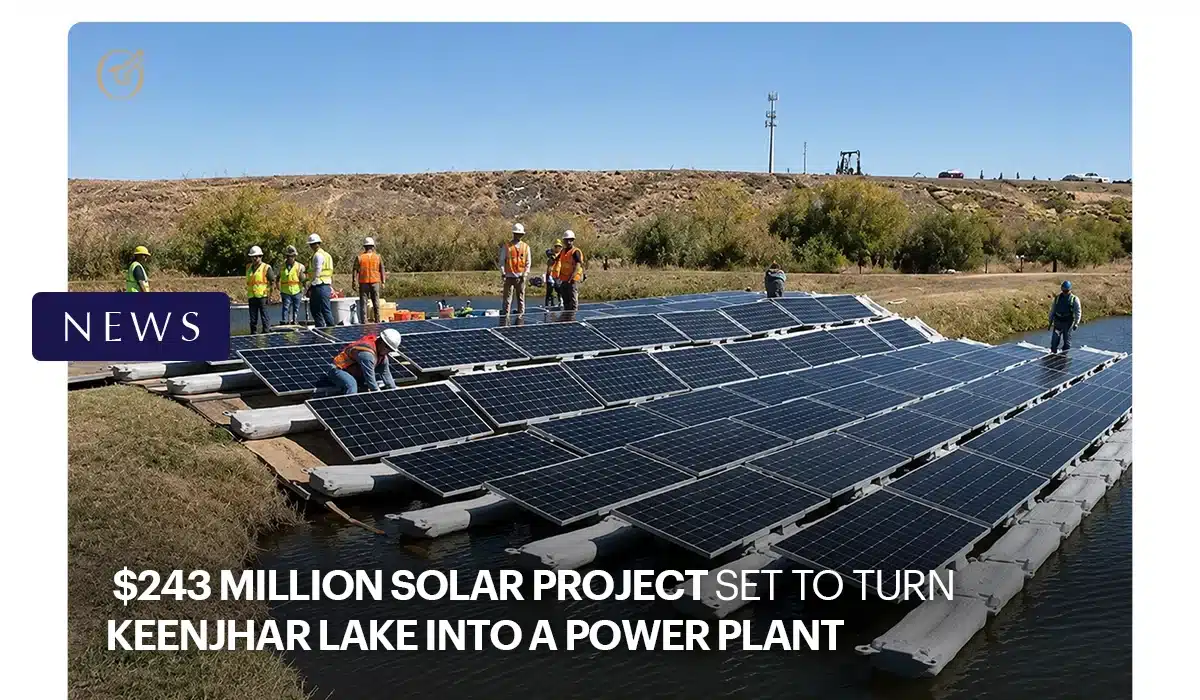
$243 Million Solar Project Set to Turn Keenjhar Lake Into a Power Plant

KARACHI: The Pakistani government has announced plans to develop a 500-megawatt floating solar power project at Keenjhar Lake in Sindh, marking a significant milestone in the country’s transition to clean, renewable energy. The project, estimated to cost $243.63 million, is projected to generate approximately 861.91 gigawatt-hours of electricity annually, operating at a capacity factor of 19.6%.

The electricity generated by the facility will be supplied to K-Electric under a long-term power purchase agreement. A letter of intent has already been secured from K-Electric, and the process to select Engineering, Procurement and Construction contractors through competitive bidding is currently underway. The Sindh Transmission and Dispatch Company has also signed a memorandum of understanding with GO Energy Private Limited to facilitate power transmission from the project site.

Situated 137 kilometres from Karachi on the surface of Keenjhar Lake, one of Sindh’s largest freshwater bodies, the project will utilise approximately 1,606 acres of the lake’s surface to accommodate nearly one million solar panels. The floating design offers dual advantages: it eliminates land acquisition challenges associated with conventional solar installations and leverages the natural cooling effect of water to improve panel efficiency and overall energy output.

The initiative aligns with Pakistan’s 2030 emissions reduction targets and is part of a broader national push to diversify energy sources and reduce dependence on costly imported fossil fuels. Construction is expected to commence in 2026, with commercial operations projected to begin by 2028. The project is also anticipated to generate significant employment during both the construction and operational phases.

However, the project has drawn concern from local fishing communities and environmentalists. As Keenjhar Lake falls within a designated Ramsar wetland site, experts have flagged potential risks to migratory bird habitats and local fisheries, underscoring the need for thorough environmental oversight throughout the project’s development.

For more news on real estate and special reports, visit Chakor Ventures.

CategoriesCitadel One3 Architecture Construction Developments Investment Property Real Estate Real Estate Investment Towers

City View Apartments Islamabad: The Complete Guide (2026)

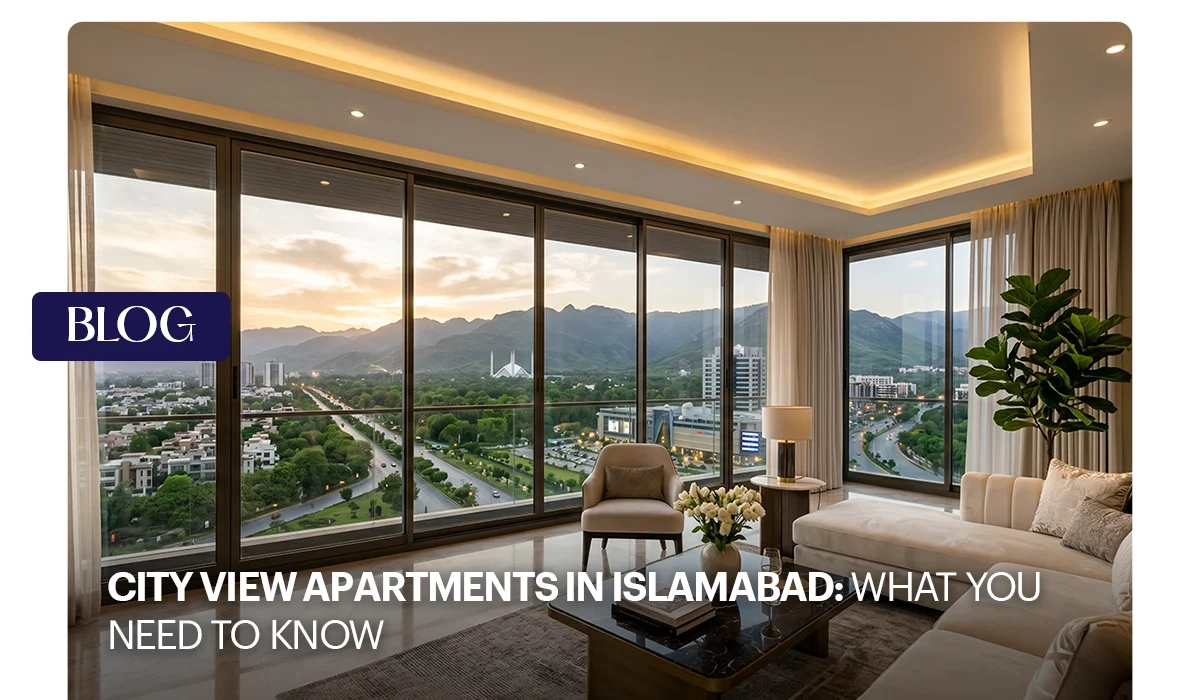
There are cities where height gives you more concrete. Then there is Islamabad a city where rising above the roofline reveals one of the most distinctive urban panoramas in South Asia: a low-lying capital spread across a valley floor, the geometric order of its master-planned sectors giving way to the hazy green ridgeline of the Margalla Hills. A city view apartment in Islamabad is not an abstract amenity. It is a fundamentally different way to experience the capital.

Demand for city view apartments Islamabad has grown consistently over the past several years, driven by a convergence of factors.

This guide covers everything you need to know what a genuine city view apartment looks like in Islamabad, where to find one, what to look for before committing, and why location within the city determines view quality, lifestyle quality, and long-term value in roughly equal measure.

Table of Contents

  1. What Makes a City View Apartment Worth It in Islamabad?
  2. Long-Term Rent and Buy: What the Market Actually Offers
  3. Location Guide: Where in Islamabad Do You Get the Best Views?
  4. What to Look for Before You Commit
  5. Buying vs. Renting: Which Is Right for You?
  6. Citadel One3: A New Benchmark for City View Living in Islamabad
  7. Frequently Asked Questions

What makes city view apartments Islamabad worth it?

Islamabad was designed from scratch in the 1960s by Greek urban planner Constantinos Doxiadis. That deliberate, low-density layout, wide avenues, sector-based zoning, and generous green belts mean that a city view here rarely means staring at a wall of concrete.

From the upper floors of a tower in the Blue Area, you are typically looking at tree canopy, the tiled rooflines of F-sector houses, the distant white dome of the Faisal Mosque, the green swathe of F-9 Park, and behind it all, the permanent, weather-shifting presence of the Margalla Hills.

This is what separates a premium Islamabad apartment from its equivalent in Lahore or Karachi. The horizontal city drops away beneath you. What replaces it is a view that combines the energy of a modern capital with the calm of a landscape that predates it by millions of years.

Long-Term Rent and Buy: What the Market Actually Offers

The long-term market for apartments for sale in Islamabad with genuine city or Margalla views is more limited than headlines suggest. Many developments marketed as city view apartments are either in locations where height does not yet translate to an unobstructed view, or in housing societies at an early enough stage of development that the view will be compromised as surrounding construction catches up.

Genuinely premium Margalla view apartments in Islamabad tend to fall into two categories: hillside society developments in Zone IV, where the natural elevation and distance from the urban core mean long-range unobstructed views of the Margalla range; and high-rise towers in the Blue Area, where the height of the building itself clears the surrounding low-rise fabric and delivers a panoramic 360-degree view.

The Blue Area high-rise option, the category into which Citadel One3 falls, offers both the view and the location simultaneously. It is also the rarer product, because CDA-regulated development within the Blue Area and Jinnah Avenue corridor imposes strict controls on what can be built. Supply is limited by design. That structural scarcity is a key driver of long-term value.

Location Guide: Where in Islamabad Do You Get the Best Views?

The city’s geography divides the city view apartment Islamabad market into distinct zones with different view profiles, price points, and lifestyle implications.

Location View Profile Typical Use
Blue Area / Jinnah Avenue City skyline + Faisal Mosque + Margalla Hills Short stay, investment, long-term residence

The Blue Area and Jinnah Avenue corridor stands alone in one respect: it is the only zone in Islamabad where the view, the location, and the commercial infrastructure converge in the same address.

Living above the city’s dominant commercial spine means that the landmarks you see from your window, Faisal Mosque, F-9 Park, the Margalla ridgeline, are the same landmarks you pass on the way to work, to dinner, to everything.

What to look for before you commit?

Whether you are booking a short stay or signing a purchase agreement, several practical considerations apply universally.

Floor level matters more than you expect. Islamabad is a predominantly low-rise city. In most sectors, buildings top out at two or three storeys. To get a genuinely unobstructed view from a Blue Area tower, you need to be high enough to clear the surrounding built fabric.

CDA NOC status is non-negotiable for purchases. Before transferring any funds, verify that the development holds a valid Capital Development Authority No Objection Certificate. The CDA publishes a list of approved and unapproved housing schemes on its official website. Purchasing in a development without CDA approval exposes buyers to the risk of demolition notices, untransferable title, and inability to secure financing. This step takes five minutes and can prevent years of legal difficulty.

Developer track record matters. Look beyond the renders and ask what the developer has already delivered. A developer with a completed project in the same market on the same street, at a comparable scale, is offering proof of concept, not just a promise. That distinction is material.

Power backup. Islamabad experiences load-shedding, particularly during the summer months. Premium high-rise towers in the Blue Area typically build backup power into the infrastructure, but this should be confirmed, not assumed. A generator that covers corridors and common areas but not individual units is not the same as full building backup.

Management post-handover. For investment buyers, the quality of building management after handover determines rental income and asset preservation. Who manages the building? What are the annual maintenance charges? Is there a rental management service for investors who want to rent their units without being involved day-to-day? These questions matter as much as the purchase price.

Buying vs. Renting a City View Apartment in Islamabad

Buy if you are a Pakistani resident or overseas national with a three-to-five-year or longer investment horizon. Blue Area apartments have shown the strongest and most stable price appreciation of any property type in the city. CDA-approved high-rise units on or near Jinnah Avenue are a scarce asset in this market, and scarcity tends to compound over time.

Rent short-term if you are visiting Islamabad for work or family, on a corporate posting, or a diaspora visitor spending weeks rather than months. Serviced apartments in the Blue Area towers give you hotel security and services with genuine living space and city views, the right product for this need.

Rent long-term if you are an expat or professional on a multi-year posting who values flexibility over asset accumulation. Fully furnished long-term lets in the Blue Area corridor are available through building operators, typically at monthly rates negotiated directly. 

Citadel One3: A New Benchmark for City View Living Islamabad

Citadel One3 is Chakor Ventures’ premium residential condominium tower, rising 40+ floors along Jinnah Avenue in the Blue Area. It represents one of the few genuinely new high-rise residential products to come to market in Islamabad’s most established commercial corridor in recent years.

The project is developed by Chakor Ventures, the same firm behind Citadel 7, Islamabad’s first premium corporate tower on Jinnah Avenue, delivered ahead of schedule with grey structure complete.

What Citadel One3 City View Apartments Islamabad offers:

  • Location: Jinnah Avenue, Blue Area, Islamabad’s dominant commercial core.
  • Views: Direct sightlines to the Faisal Mosque, F-9 Park, and the Margalla Hills three of Islamabad’s most iconic landmarks, from a single address
  • Scale: 40+ floors rising above the surrounding low-rise fabric, ensuring that views are genuine and not aspirational
  • Total area: 27,500 sq ft, with both commercial and residential units
  • Amenities: Gym, sports and kids play area, culinary court, rental stay management, smart parking for 350+ cars, advanced firefighting systems, secure entry and exit points, CCTV infrastructure
  • Rental management: A built-in rental stay management service means investors who purchase units can generate short-stay rental income without managing it directly, bridging the short-stay and investment buyer segments in one structure

The project offers what most city view apartments Islamabad cannot: a panoramic view from Islamabad’s most recognisable landmarks, delivered by a developer who has already proved it can build at this scale, at this address.

FAQs – City View Apartments Islamabad

Which area in Islamabad has the best city view apartments Islamabad?

For the combination of view quality, location, and long-term investment value, the Blue Area and Jinnah Avenue corridor is the strongest option in the city. 

Are city view apartments Islamabad available on installments?

Yes. Most new-launch condominium projects in Islamabad, including those in the Blue Area, offer structured installment plans.

Is a CDA NOC important when buying City View Apartments Islamabad?

Yes, It is essential.

Can overseas Pakistanis buy city view apartments Islamabad?

Yes. Overseas Pakistanis can purchase CDA-approved City View Apartments Islamabad without restriction.

What floor do you need to be on for a real City View Apartments Islamabad?

In the Blue Area, the surrounding built fabric is mostly two to four storeys. A tower of 40+ floors begins delivering genuinely unobstructed panoramic views from the middle floors upward.

Final Word – City View Apartments Islamabad

Islamabad offers a city view apartment market that is genuinely distinctive, not because of density or skyline height, but because of what the city looks like when you rise above it. The combination of a planned low-rise capital and the Margalla Hills as a permanent northern backdrop creates a view that rewards altitude in a way few other Pakistani cities can match.

For more information on types of property taxes and real estate investment options, please visit Chakor.