CDA Approves Rs152bn Budget — Highest in Authority’s 66-Year History
Islamabad — Updated August 28, 2026
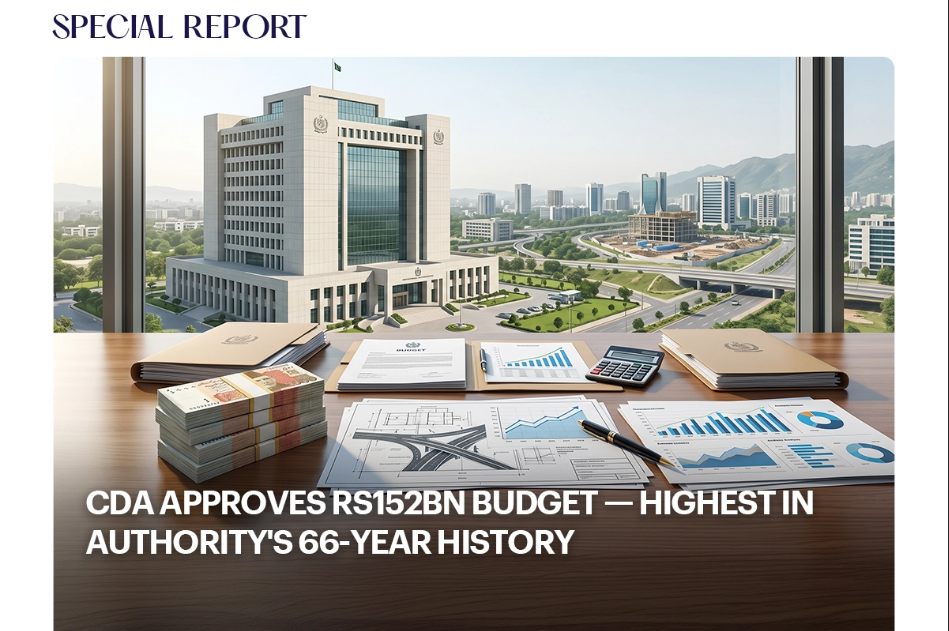
On August 25, 2026, the Capital Development Authority (CDA) board chaired by Chairman Sohail Ashraf approved a Rs152 billion budget for fiscal year 2026-27, reported by Dawn as the highest in the authority’s history. (Dawn, Aug 26, 2026) That framing is worth testing rather than repeating. This report lays out the full budget, then examines three things a purely descriptive write-up would skip: whether the “record” claim survives scrutiny, whether CDA’s underlying finances support the number, and what CDA’s own track record suggests about how much of it will actually get spent.
1. The Budget at a Glance
Of the Rs152 billion total, Rs112 billion is earmarked for new and ongoing development works and Rs40 billion for non-development (administrative/running) expenditure.
CDA projects Rs152.5 billion in receipts: 74% from self-finance (plot auctions and taxes), 19% from revenue receipts, and 7% from an opening balance. By spending category, 74% goes to development, 24% to non-development, and 2% to the Metropolitan Corporation Islamabad (MCI). (Dawn, Aug 26, 2026)
Development allocation breakdown:
| Allocation | Amount | Covers |
|---|---|---|
| 26 priority projects | Rs55 billion | Not itemised in board disclosure |
| 63 new projects | Rs16 billion | Sector development, infrastructure, sewerage, metro buses |
| 246 ongoing works | Rs13.5 billion | Existing projects in progress |
| Pending liabilities | Rs7 billion | Legacy payment obligations |
| Lump-sum provisions | Rs19 billion | Contingency/unallocated |
Source: Dawn, Aug 26, 2026. These five line items sum to Rs110.5bn against the reported Rs112bn development total — a gap that exists in the original board disclosure, not something introduced in this report.
Two other decisions came out of the same meeting: the board approved Package-II of the cleanliness/garbage collection contract, outsourcing collection and transport to the Losar landfill in Rawalpindi for four years, and approved 10 additional acres for Daanish School Kuri. (Dawn, Aug 26, 2026)
3. Can CDA Afford Its Own Ambitions? The Land Bank Problem
CDA covers most of its expenditure through auctioning commercial plots it has not built a durable revenue base beyond its land holdings, and conducts two to three auctions a year. (Dawn, Aug 26, 2026) This isn’t an incidental detail; it’s the mechanism financing 74% of the new budget.
Live examples from this month: a three-day commercial plot auction in early August generated Rs16.4 billion, with a single Blue Area plot fetching Rs9.1 billion in one bid. (ProPakistani, Aug 4, 2026; ProPakistani, Aug 6, 2026)
That volatility, dependent on land market appetite, which fluctuates with interest rates, political stability, and buyer confidence, sits underneath a headline number presented as fixed and stable.
The clearest sign that CDA’s cash position doesn’t match its ambitions: just one week before approving the Rs152bn “record” budget, the same board again chaired by Sohail Ashraf approved seeking a Rs20 billion bridge facility from the federal government. A board member told Dawn: “Today, we decided to seek a federal government loan for sector development.” (Dawn, Aug 18, 2026)
That report detailed the specific commitments straining CDA’s balance sheet: the Expressway Service Road (~Rs5bn), the Margalla Road Extension (~Rs3.8bn), the New Convention Centre (NICEEC, near Malpur, built for the 2027 SCO summit lowest bid Rs37 billion after a design revision added steel components), the first phase of a new cricket stadium (lowest bid ~Rs8.9bn), two underpass projects, and a planned Safari Park. (Dawn, Aug 18, 2026; Zameen News, 2026)
An authority that needs a federal loan to fund sector development while simultaneously approving its largest development allocation in three years is, at minimum, carrying more committed spending than its liquid revenue currently supports.
4. Does CDA Deliver What It Budgets? A Mixed Track Record
The most concrete reason for scepticism about the Rs152bn figure converting into real infrastructure is what happened to last year’s budget. FY2025-26 included Rs17 billion for three tourism projects a zipline, a safari park, and a cricket stadium near Sector D-12 none of which broke ground. (Dawn, Aug 26, 2026) That same year’s Rs90.2bn initial allocation was also revised down to Rs81bn mid-year, a roughly 10% cut from the original plan. (Dawn, Aug 26, 2026)
This year’s budget carries similar exposure: Rs7 billion is earmarked simply for pending liabilities (unpaid obligations from prior commitments), and 246 separate ongoing works are competing for a combined Rs13.5 billion, an average of roughly Rs55 million per project, which is thin for infrastructure works if spread unevenly.
Whether the 63 new projects and 26 priority projects move faster than last year’s stalled tourism package is the open question this report can’t answer in advance; it’s the one to watch over the coming fiscal year.
5. The Governance Backdrop
Sohail Ashraf, who also serves as Islamabad’s Chief Commissioner, became CDA chairman in April 2026, succeeding Muhammad Ali Randhawa. At that transition, an unnamed CDA official summarised the structural problem now facing a much larger budget: “How long will we continue selling plots for development projects and paying salaries? There should be a new model to end dependency on the sale of plots.” (Dawn, Apr 2, 2026)
That same report flagged unresolved issues the new chairman inherited: stalled development in sectors I-12, I-15, E-12 and C-15; unresolved compensation for land-affected persons in D-13, E-13, F-13, C-13 and C-15; a chronic water shortfall (CDA supplies ~70 million gallons daily against ~220mgd demand); and a 1960 master plan that was meant to be revised every 20 years but has instead seen 51 piecemeal amendments rather than a comprehensive update. (Dawn, Apr 2, 2026)
None of these structural issues is resolved by a larger budget number a bigger allocation for sewerage and infrastructure only helps if the underlying planning and delivery capacity keeps pace with the money.
Separately, CDA did make one real reform in this period: cutting the property transfer fee from 3% back to 1% in April 2026, reversing a July 2025 increase that had been criticised for raising transaction costs. (Wirasat Real Estate, Apr 2026; CDA official release, Apr 9, 2026)
6. What Expert and Market Commentary Exists
Independent economists and real estate analysts have not published commentary specifically reacting to the August 26 budget announcement as of this writing; it’s roughly 48 hours old. What is available:
- On CDA’s financing model specifically: the two insider quotes above (the “new model to end dependency” comment from April 2026, and the loan-seeking board member’s comment from August 18) are the most substantive on-record structural critique available, both from within CDA itself rather than outside analysts.
- On real estate market impact: analysts cited by Wirasat Real Estate said the property transfer fee reduction should lower transaction costs and improve transparency in Islamabad’s property market, though this reaction predates and is unrelated to the new budget. (Wirasat Real Estate, Apr 2026) Separately, property-market commentary has argued that specific infrastructure catalysts like the Margalla Road extension matter more for sector-level property values (D-12, E-11, D-13) than headline mega-projects like the cricket stadium, whose realistic completion window has reportedly slipped toward 2028-29. (Milkiyat, Jun 2026)
- On the macro backdrop: economists Naved Hamid and Waqar Wadho, commenting on Pakistan’s federal FY2026-27 budget generally, described minimal room for growth under the current IMF programme. Hamid put it bluntly: “We don’t really have any room.” (Dawn, Jun 2026) That’s a comment on the national fiscal picture, not CDA specifically, but it frames a genuine tension: CDA is scaling up its own spending sharply in the same year the federal government is operating under IMF-driven austerity, worth watching for whether federal support (like the Rs20bn loan request) materialises on CDA’s timeline.
If independent analysis of this specific announcement is published in the coming days, it would be worth a follow-up.
7. How CDA Compares
- Lahore Development Authority (LDA): approved Rs88.613 billion for FY2026-27, under 60% of CDA’s figure. (ProPakistani, Aug 19, 2026)
- Sargodha Development Authority (SDA): approved Rs697.415 million — illustrating the scale gap between the federal capital’s authority and a smaller regional one. (APP, Jul 10, 2026)
- Federal/ICT context: CDA’s budget is separate from the Islamabad Capital Territory (ICT) Administration, the local-government body. The National Assembly separately approved Rs23.22 billion for ICT Administration’s operations, part of a Rs968.041 billion demands-for-grants package passed in June 2026, and the PSDP earmarked Rs21.82 billion for the Interior Division (up 69.2% from Rs12.9bn), covering ICT Administration among other departments. (Business Recorder, Jun 23, 2026; Business Recorder, Jun 13, 2026) None of this federal money is part of CDA’s Rs152bn.
8. Critical Assessment
Reading the full record together, three conclusions seem more defensible than the headline framing:
- The record claim is overstated, not fabricated. Rs152bn is a genuinely large budget and likely the biggest in three years, but Rs156.35bn (2021-22) and a reported ~Rs308bn (2022-23) complicate any claim to an all-time high. The one number that may genuinely be a record is the Rs112bn development allocation, which edges out 2023-24’s Rs107.463bn.
- The financing base hasn’t changed despite the bigger number. CDA is more reliant than ever on volatile land-auction income, and needed a federal loan request the week before approving this budget the exact dependency an internal official called for ending back in April.
- Delivery risk is the biggest open question. With last year’s Rs17bn tourism package fully unbuilt, Rs7bn in pending liabilities carried into this year, and 246 ongoing projects sharing Rs13.5bn, the gap between what’s approved on paper and what gets built on the ground is the detail worth tracking through the fiscal year, not the size of the initial number.
For anyone using this budget as a signal for real estate or development planning in Islamabad, the more reliable indicators are likely to be specific, funded, in-progress projects (like the Margalla Road extension) rather than the aggregate Rs152bn figure or the political framing around it.
9. Sourcing & Verification Notes
- Wikipedia’s infobox for CDA still lists Muhammad Ali Randhawa as chairman; multiple 2026 Dawn reports, including the budget story itself, consistently show Sohail Ashraf holding the post since April 2026. (Wikipedia)
- The Rs110.5bn vs Rs112bn gap in the development breakdown (Section 1) is present in CDA’s own disclosure as reported by Dawn and has not been reconciled publicly.
- The FY2022-23 Rs308bn figure (Section 2) was reported as a board estimate pending Federal Cabinet approval; this report could not confirm whether that exact figure was the final approved budget for that year.
- CDA was established June 14, 1960, per the authority’s own ordinance page — used to calculate any “X years old” reference. (CDA official site)
Sources
Abbasi, K. (2026, August 26). CDA board approves record Rs152bn budget for fiscal year 2026-27. Dawn. https://www.dawn.com/news/2025266/cda-board-approves-record-rs152bn-budget-for-fiscal-year-2026-27
APP. (2026, July 10). SDA governing body approves 697.4m budget for FY2026–27. https://www.app.com.pk/punjab/sda-governing-body-approves-697-4m-budget-for-fy2026-27/
Business Recorder. (2026, June 13). Public Sector Development Programme: Rs21.82bn tagged for Interior Div. https://www.brecorder.com/news/40425303/public-sector-development-programme-rs2182bn-tagged-for-interior-div
Business Recorder. (2026, June 23). 10 demands for grants: NA approves Rs968bn budgetary allocations. https://www.brecorder.com/news/amp/40426898
Capital Development Authority. (2026, April 9). CDA cuts property transfer fee, plans cultural revamp and waste system overhaul in Islamabad. https://www.cda.gov.pk/cdaImagesGallery/capital-development-authority-cuts-property-transfer-fee-plans-cultural-revamp-and-waste-system-overhaul-in-islamabad
Capital Development Authority. (n.d.). CDA Ordinance, 1960. Retrieved August 28, 2026, from https://www.cda.gov.pk/cdaOrdinance
Capital Development Authority (Pakistan). (n.d.). In Wikipedia. Retrieved August 28, 2026, from https://en.wikipedia.org/wiki/Capital_Development_Authority_(Pakistan)
Dawn. (2021, June 3). Record Rs156bn budget approved for CDA. https://www.dawn.com/news/1627259
Dawn. (2022, April 1). CDA budget for fiscal year 2022-23 estimated at Rs308bn. https://www.dawn.com/news/1682781
Dawn. (2026, April 2). New Capital Development Authority chief faces governance, planning, water challenges. https://www.dawn.com/news/1987739/new-capital-development-authority-chief-faces-governance-planning-water-challenges
Dawn. (2026, June 3). Budget 2026-27: Analysis: A budget to calm lenders or households? https://www.dawn.com/news/2004792
Dawn. (2026, August 11). CDA seeks 4,000 top-class hotel rooms in Islamabad ahead of 2027 SCO summit. https://www.dawn.com/news/amp/2021974
Dawn. (2026, August 18). CDA seeks Rs20bn federal loan for sector development. https://www.dawn.com/news/2023510/cda-seeks-rs20bn-federal-loan-for-sector-development
Geo News. (2026, June 14). Key takeaways from Federal Budget 2026-27. https://www.geo.tv/latest/668536-key-takeaways-from-federal-budget-2026-27
Milkiyat. (2026, June 29). Cheapest CDA sectors to invest in Islamabad 2026 guide. https://milkiyat.com/articles/cheapest-cda-sectors-to-invest-in-islamabad-2026
ProPakistani. (2026, August 4). CDA sells 4 plots for Rs. 13.8 billion in single day. https://propakistani.pk/2026/08/04/cda-sells-4-plots-for-rs-13-8-billion-in-single-day/
ProPakistani. (2026, August 6). CDA collects over Rs. 16 billion in 2 days from property auction. https://propakistani.pk/2026/08/06/cda-collects-over-rs-16-billion-in-2-days-from-property-auction/
ProPakistani. (2026, August 19). LDA approves Rs. 88.6 billion budget for 2026-27. https://propakistani.pk/2026/08/19/lda-approves-rs-88-6-billion-budget-for-2026-27/
The News. (2021, June 3). CDA approves Rs156 billion budget for next fiscal year. https://www.thenews.com.pk/print/843866-cda-approves-rs156-billion-budget-for-next-fiscal-year
The News. (2023, July 5). CDA approves Rs150.9 billion budget. https://www.thenews.com.pk/print/1087208-cda-approves-rs150-9-billion-budget
Tribune. (2024, July 15). CDA approves Rs91.73b surplus budget for FY25. https://tribune.com.pk/story/2479769/cda-approves-rs9173m-surplus-budget-for-fy25
Wirasat Real Estate. (2026, April 15). CDA reduces property transfer fee in Islamabad from 3% to 1%. https://wirasat.com/cda-reduces-property-transfer-fee-in-islamabad/
Zameen News. (2026, August). CDA targets 4,000 top-class hotel rooms for SCO.

BBC-featured Content Specialist with a sharp eye for search intent and a proven ability to turn content into a growth engine. I leverage cutting-edge digital marketing tools to craft strategies that fuel organic traffic, amplify brand growth, and own the local SEO landscape, particularly across the competitive real estate market. I help brands dominate search rankings and convert visibility into measurable business success.