CategoriesSpecial Report Tax

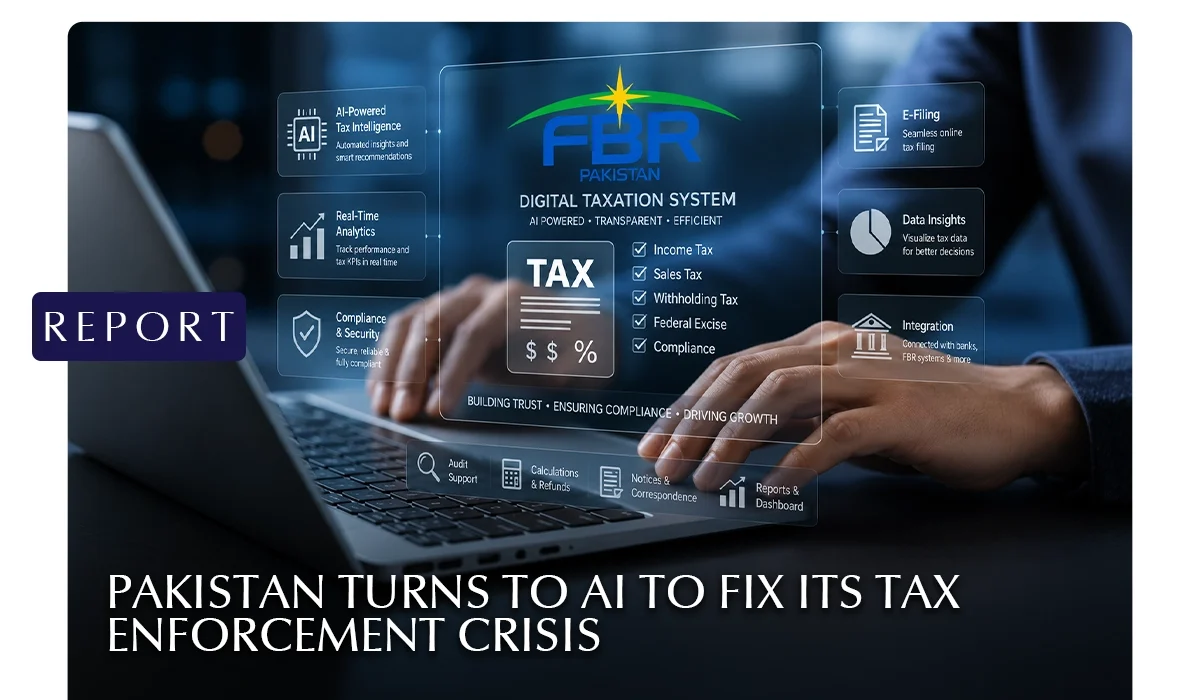
Pakistan turns to AI to fix its tax enforcement crisis

The government is weighing AI-based return scrutiny, real-time digital tracking, and e-auctions for seized goods, a tech-first overhaul that officials say could transform how Pakistan collects revenue and confronts evasion.

ISLAMABAD: In a significant shift in how Pakistan approaches tax enforcement, the federal government is actively considering deploying artificial intelligence and digital monitoring systems to detect evasion, broaden the tax base, and reduce the human discretion that has long been blamed for corruption and revenue leakage.

The proposals, reviewed at a high-level meeting on May 13, mark the most explicit government commitment yet to technology-driven tax reform and come at a moment when Pakistan is under intense IMF pressure to raise revenues or risk jeopardizing its stabilization program.

The meeting was chaired by Federal Minister for Economic Affairs Ahad Cheema and attended by a cross-ministry lineup that included Federal Minister for Climate Change Musadik Malik, Adviser on Industries and Production Haroon Akhtar Khan, Minister of State for Finance Bilal Azhar Kayani, FBR Chairman Rashid Mahmood Langrial, and Attorney General Mansoor Usman Awan. The breadth of representation underscored that the government views this not as a narrow FBR administrative reform but as a whole-of-government priority.

The FBR’s briefing to the meeting identified five core problems that AI and digital tools are meant to address: underreporting of income and sales, non-reporting of taxable transactions, under-invoicing to lower declared values, outright tax evasion, and smuggling.

Together, these practices are estimated to cost the national exchequer hundreds of billions of rupees every year, though the government has not published a precise figure. What is clear is that Pakistan’s tax-to-GDP ratio remains among the lowest in the region, and officials increasingly believe that administrative failures, not just policy gaps, are a root cause.

“The government supports a tax system with minimum human interaction, one that reduces discretion, limits opportunities for corruption, and brings transparency to enforcement.” Federal Minister Ahad Cheema.

Among the specific proposals on the table, the most consequential is an AI-based system to scrutinize tax returns and flag false or anomalous data. Rather than relying on manual audits, a process that is slow, resource-intensive, and prone to selective enforcement, the system would use algorithmic pattern recognition to identify discrepancies between declared income and observable financial behaviour.

Tax reform specialists say this approach has shown measurable results in countries such as India, Rwanda, and several Eastern European states, where AI-assisted compliance checks have increased voluntary declarations and reduced audit backlogs. The question for Pakistan, analysts note, is not whether the technology works, but whether the institutional infrastructure to support it is ready.

Alongside AI-based return checking, the government is considering real-time digital tracking mechanisms across commercial and industrial sectors. This would mean continuous data feeds from point-of-sale systems, invoicing platforms, and supply chain records flowing into a centralised FBR database, a model that would make it significantly harder for businesses to report different figures to different authorities or to simply not report at all.

A further proposal involves an e-auction system for goods confiscated by customs, replacing a discretionary and often opaque process with a transparent public platform. Officials say the e-auction reform alone could both raise direct revenue and deter smugglers who currently factor in the low cost of having goods seized.

Fiscal policy analysts have offered a cautiously optimistic reading of the proposals, while flagging familiar implementation risks. Pakistan has announced digital tax reforms before track-and-trace systems, electronic invoicing mandates, and point-of-sale integration drives with uneven results.

The FBR’s capacity to build and maintain complex AI systems in-house is limited, and dependence on external vendors raises questions about data security, system continuity, and accountability.

“The design of these proposals is sound,” noted one Islamabad-based economist who follows tax administration closely. “The challenge is that every previous wave of FBR digitalisation has run into the same obstacles: resistance from within the bureaucracy, political interference in enforcement, and a lack of follow-through after the initial announcement.” Officials at the meeting acknowledged these concerns, with Cheema directing the FBR to ensure proposals are practical and technology-oriented before the Finance Bill is finalised.

The AI enforcement push sits within a broader fiscal consolidation framework that includes over Rs 1.1 trillion in additional taxes and levies for FY2027, a package linked directly to IMF targets and a government ambition to achieve a primary budget surplus of 2 percent of GDP.

The government has also assured the IMF that Pakistan’s provinces will not introduce any measures that could undermine reform commitments. But the AI component is being watched closely precisely because it represents a departure from the traditional approach of simply adding new tax rates to an already narrow base. If it works, it would expand who pays rather than just how much they pay, a structural shift that Pakistan’s revenue base has needed for decades.

For more news on real estate and Special Reports, visit Chakor Ventures.

References
Press Information Department, Government of Pakistan. (2026, May 13). Meeting on AI-based tax enforcement and digital monitoring reforms for the upcoming Finance Bill. https://pid.gov.pk/site/press_detail/32730
ProPakistani. (2026, May 19). Pakistanis may face over Rs. 1.1 trillion in new taxes in the upcoming budget. ProPakistani. https://propakistani.pk/2026/05/19/pakistanis-may-face-over-rs-1-1-trillion-in-new-taxes-in-upcoming-budget/
Dawn. (2026). FBR mulls AI-based monitoring. Dawn. https://www.dawn.com/news/2000063
Daily Times. (2026). The government plans AI-based tax reforms for digital monitoring. Daily Times. https://dailytimes.com.pk/1492964/government-plans-ai-based-tax-reforms-for-digital-monitoring/

CategoriesSpecial Report Economy Eid News

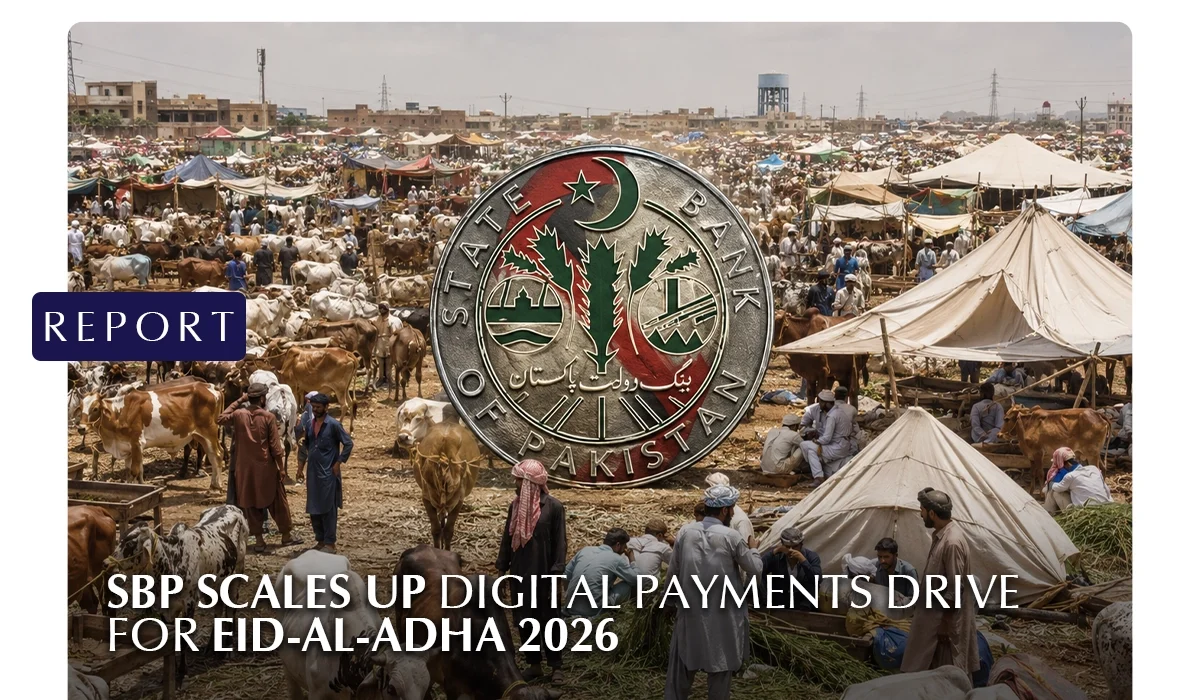
SBP Scales Up Digital Payments Drive for Eid-ul-Adha 2026, Expanding Coverage to 96 Cattle Markets Nationwide

SBP Scales Up Digital Payments Drive for Eid-al-Adha 2026, Expanding Coverage to 96 Cattle Markets Nationwide

Central bank deploys 22 banks, temporary transaction relaxations, and digital infrastructure in bid to reduce cash dependency during Eid trading season

Islamabad, May 16, 2026

ISLAMABAD — The State Bank of Pakistan (SBP) has launched its most expansive digital payments initiative to date ahead of Eid-ul-Adha 2026, extending its annual “Go Cashless” campaign to 96 cattle markets across the country, a near-doubling of the 54 markets covered in the preceding year. The central bank’s move signals a deliberate escalation of its efforts to digitise one of Pakistan’s largest seasonal commercial events, where billions of rupees exchange hands, predominantly in cash, over the course of just a few weeks.

A Seasonal Window for Financial Inclusion

Eid-ul-Adha, one of Islam’s most significant religious observances, is accompanied in Pakistan by an enormous surge in livestock trading. Cattle markets locally known as mandi become bustling commercial hubs in the days preceding the festival, attracting buyers and sellers from across provinces and socioeconomic backgrounds. Historically, these transactions have been conducted almost exclusively in cash, presenting considerable security risks and limiting financial traceability.

The SBP has framed the cattle market campaign as a strategic leverage point in its broader financial inclusion agenda. By targeting an event with high transaction volumes and wide public participation, the central bank is attempting to convert seasonal cash users into habitual adopters of digital payment channels. The 2026 campaign, announced on May 15, represents the most operationally ambitious iteration of this effort since its inception.

List of Cattle Markets

City Mandi Location
Bahawalpur Ahmad pur Road Near Suzuki Showroom, Bahawalpur.
Jhangi wala road Near Civil Hospital, Bahawalpur.
Yazman Road near Bahawalpur Airport, Bahawalpur.
D I Khan Main Cattle Market , Qureshi Moor , D.I Khan
Faisalabad Model Cattle Market, Niamoana, Samundari Road, Faisalabad
Cattle Market 85 Jhaal, Silanwali Road, Sargodha
Bhakkar Road, By Pass Jhang
Cattle Market Adjacent to New Sabzi Mandi, Chiniot.
Gujranwala Mafiwala, Sialkot Bypass, Gujranwala
Khiali Bypass, Sheikhupura Road, Gujranwala
Imtiaz Store, Wapda Town, Near Chan da Qila (Lahore Bypass), Gujranwala
Hyderabad Main Hatri Bypass opposite Ayub Restaurant Hyderabad
Bismillah City Unit #10 latifabad Hyderabad
Near Indus Hospital main Hyderabad – Tando Muhammad Khan Road, district Tando Muhammad Khan
Islamabad Near Facto Cement Factory, Sangjani, Islamabad
Sector I-15 Markaz, Islamabad
Bhara Kahu, Islamabad
Near Sultana Foundation Lehtarar Road, Islamabad
Rawalpindi Bhatta Chowk intersection of Twin Cities
Zia Masjid Express High way Islamabad
Rawat Rawalpindi
Karachi Northern Bypass Mandi (Taiser Town, District West)
Liyari Express Way Cattle Market
Northern Bypass Gai Mandi
Malir Cattle Market
Korangi Crossing Cattle Market
Cattle Fiesta, DHA Phase 1
Lahore Shahpur Kanjran Cattle Market, Lahore
Nishter Zone at LDA City (near Sidhar Village at Kahna Kachha, Defence Road Lahore
road Lahore
Cattle Market Burki Road Lahore
Raiwand Cattle Market Lahore
Multan Billi Wala by-pass Multan
Lahore Morr Khanewal
Fatima Town Multan
Bakar Mandi Haji Shareef Chowk Multan
Muzaffarabad Maweshi Mandi located at Talhi Mandi, Muzaffarabad
Langarpura Cattle Market,Chikoti Road Langarpur Muzaffarabad
Bela Noorshah Cattle Market, Bela Noorshah
Peshawar Mal Mandi Ringroad
Kala Mandi
Palosai Mandi
Syphen Cattle Market
Peshawar Cattle Mandi
Quetta Eastern Bypass
Western Bypass
Airport Road
Spiny Road
Sialkot Aimanabad Road, NawaPind, Sialkot
Sambrial-Wazirabad Road, Near UGOKI, Sialkot
Pasrur Bypass Jassar Wala Tehsil Daska
Sukkur City Point , Sukkur
Thehri, Khairpur
Ali Wahan, Rohri
Main Shikarpur Road, Jacobabad

Operational Infrastructure and Participating Institutions

Under the 2026 framework, 22 commercial banks will establish dedicated camps and kiosks within their assigned markets. Bank representatives will be tasked with on-the-spot account opening for cattle sellers, livestock transporters, and allied service providers, while simultaneously deploying QR code-based payment terminals to facilitate instant digital transactions.

To address cash access needs in parallel, the central bank will also deploy mobile banking vans, automated teller machines (ATMs), and Cash Deposit Machines (CDMs) at market sites where infrastructure permits.

Critically, the SBP has introduced temporary relaxations on transactional and account balance limits, effective from May 14 through June 5, 2026, to accommodate the elevated payment volumes typical of the Eid trading season.

Expert Analysis: Ambition, Execution, and Structural Challenges

Financial sector analysts broadly welcome the initiative as a meaningful step toward broadening digital financial access, while noting that the operational challenges of converting informal, trust-based livestock markets to cashless models should not be underestimated.

“The SBP deserves credit for the consistency and scale of this campaign,” said a Karachi-based economist specialising in digital finance. “Doubling the number of covered markets in a single year reflects genuine institutional commitment. But the real metric is not how many markets are covered; it is the percentage of transactions within those markets that actually shift to digital rails. That data, if published transparently, would tell us whether the campaign is achieving systemic change or merely symbolic presence.”

Pakistan’s financial technology ecosystem has undergone considerable transformation in recent years, with the central bank’s own Raast instant payment system, Pakistan’s first fully interoperable instant payment system, launched in January 2021, emerging as a key enabler of zero-cost, real-time digital transfers. The SBP’s encouragement of Raast-enabled services alongside mobile banking applications and QR payments reflects an effort to consolidate these tools for public use in high-traffic informal settings.

However, analysts have flagged structural barriers that regulatory directives alone cannot resolve. Connectivity gaps in peri-urban and rural markets, low digital literacy among older cattle traders, and a deep cultural preference for physical currency in large-value livestock transactions present persistent headwinds.

“A seller moving a high-value animal sometimes worth several hundred thousand rupees often prefers cash because it offers immediacy and privacy,” noted a policy researcher at a Lahore-based development institute. “Building trust in digital systems for high-stakes, one-time transactions requires more than kiosks and QR codes. It requires demonstrable reliability, fraud protection, and peer adoption.”

Regulatory Context and National Digital Strategy

The Go Cashless campaign is situated within Pakistan’s wider national agenda to expand financial inclusion and formalise economic activity. Pakistan remains among the countries with the largest unbanked populations globally. The World Bank’s Global Findex 2025 Report identified it as one of eight countries accounting for over half of the world’s 1.3 billion unbanked adults.

Nevertheless, recent years have seen measurable progress: according to SBP data, bank account coverage has risen from 47 percent of the adult population in 2018 to around 64 percent, driven partly by the proliferation of mobile wallets and branchless banking services.

The SBP’s temporary relaxation of account and transaction limits during the Eid window is noteworthy from a regulatory standpoint. Such adjustments recognise that standard Know Your Customer (KYC) thresholds, designed for routine banking, can inadvertently exclude individuals seeking to make legitimate, high-value seasonal payments. By calibrating limits to seasonal economic realities, the central bank is attempting to reduce friction without compromising the integrity of its anti-money laundering framework.

Outlook

With Eid-ul-Adha widely expected to fall on May 27, 2026, the window for on-the-ground deployment is narrow. The success of this year’s campaign will likely be assessed not only by uptake figures but also by the SBP’s ability to retain newly onboarded customers within the formal banking system beyond the festival season. Sustained engagement rather than one-time digital transactions would represent the more durable indicator of progress toward Pakistan’s financial inclusion objectives.

The central bank has encouraged citizens to utilise mobile banking applications, branchless banking wallets, Raast-enabled services, and QR payment platforms for all Eid-related transactions, emphasising the security, convenience, and systemic benefits of reducing cash dependency in high-traffic commercial settings.

For more news on real estate and Special Reports, visit Chakor Ventures.

 References

Business Desk. (2026, May 15). Eid ul Adha: SBP launches ‘Go Cashless’ campaign for cattle markets. Geo News. https://www.geo.tv/latest/664625-eid-ul-adha-sbp-launches-go-cashless-campaign-for-eid-ul-adha-cattle-markets

Profit Desk. (2026, May 15). SBP scales up Eid ul Adha Go Cashless drive; expands coverage to 96 cattle markets. Profit — Pakistan Today. https://profit.pakistantoday.com.pk/2026/05/15/sbp-scales-up-eidul-adha-go-cashless-drive-expands-coverage-to-96-cattle-markets/

Pakistan Today. (2026, May 16). SBP expands Eid ul Azha cashless payments drive to cattle markets. Pakistan Today. https://www.pakistantoday.com.pk/2026/05/16/sbp-expands-eidul-azha-cashless-payments-drive-to-cattle-markets

State Bank of Pakistan. (2026, May 14). Go Cashless — Eid ul Adha 2026 [Press release]. https://www.sbp.org.pk

CategoriesBudget Economy Investment News Special Report Tax

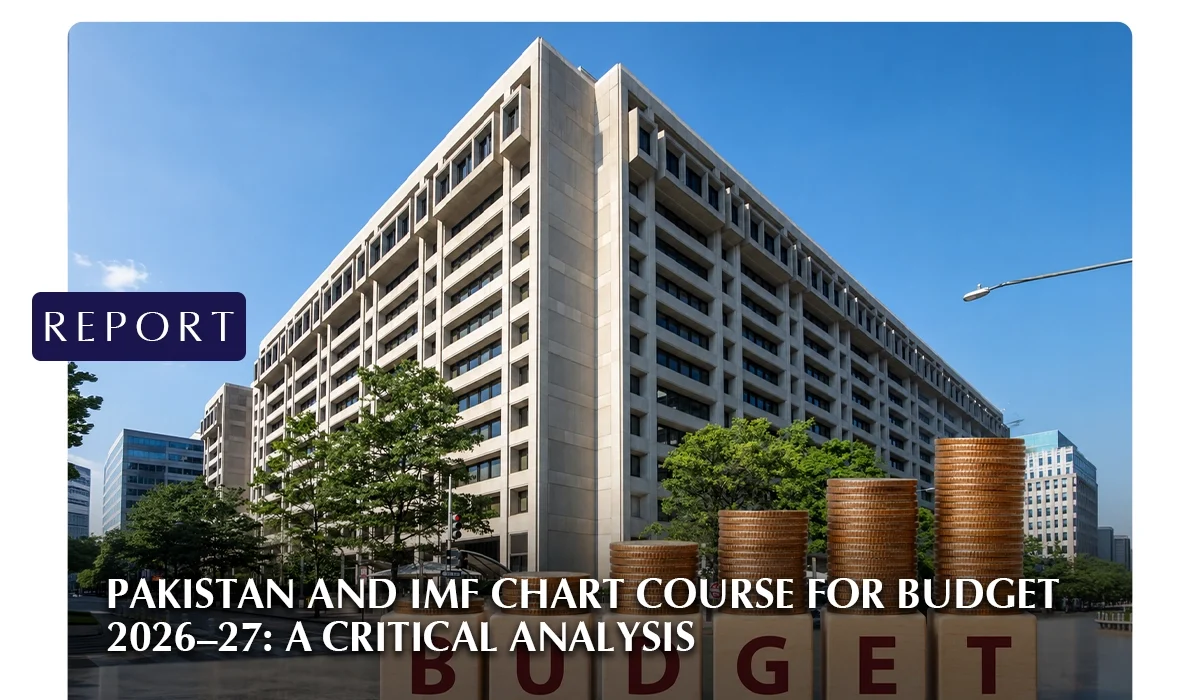
Pakistan and IMF Chart Course for Budget 2026–27: A Critical Analysis

Pakistan and IMF Chart Course for Budget 2026–27: A Critical Analysis

By News Desk | May 14, 2026

Pakistan’s Finance Minister Senator Muhammad Aurangzeb met with a visiting International Monetary Fund (IMF) mission on May 13, 2026, in Islamabad for high-level discussions on the country’s macroeconomic outlook, the upcoming federal budget for fiscal year 2026–27, and the broader structural reform agenda. The meeting comes at a pivotal moment: the IMF had just approved a fresh disbursement of approximately $1.3 billion five days earlier, and Pakistan is navigating a complex economic environment shaped by external debt pressures, a volatile global commodity landscape, and the ongoing fallout from the Middle East conflict.

The Meeting: What Was Discussed

The talks, held between Minister Aurangzeb and IMF Mission Chief Ms Iva Petrova, covered four broad areas: macroeconomic stabilisation, upcoming budget preparations, structural reform priorities, and Pakistan’s engagement with international development partners.

According to the Ministry of Finance, both sides exchanged views on “maintaining reform momentum, preserving macroeconomic stability, and advancing structural reforms to promote investment, productivity, and export-led growth.” 

The minister highlighted improvements in Pakistan’s external sector, citing month-on-month and year-on-year growth in remittances and exports as evidence of strengthening macroeconomic fundamentals.

Aurangzeb framed the government’s reform agenda as a long-term and technically grounded one designed to break Pakistan’s historical pattern of boom-and-bust economic cycles. He stressed the importance of structural reforms, productivity enhancement, deregulation, and improved export competitiveness. He also briefed the delegation on Pakistan’s economic cooperation with China and efforts to attract long-term foreign investment.

The meeting was attended by key institutional heads, including State Bank of Pakistan (SBP) Governor Jameel Ahmad, Finance Division Secretary Imdad Ullah Bosal, and Federal Board of Revenue (FBR) Chairman Rashid Mahmood Langrial.

The $1.3 Billion Disbursement: Context and Significance

The meeting followed the SBP’s announcement that it had received SDR 914 million, approximately US$1.3 billion under two IMF programmes: the Extended Fund Facility (EFF) and the Resilience and Sustainability Facility (RSF). This brings total disbursements under both arrangements to SDR 3,348 billion, or roughly $4.8 billion.

The IMF Executive Board had approved the disbursement on May 8, 2026, following the successful completion of the third review under Pakistan’s 37-month EFF arrangement, which was first approved on September 25, 2024. 

An additional SDR 154 million (approximately $220 million) was disbursed under the RSF, the climate-focused facility approved on May 9, 2025, aimed at helping Pakistan build resilience against natural disasters.

The funds were credited to SBP accounts on May 12, 2026, and will be reflected in Pakistan’s official foreign exchange reserve figures for the week ending May 15, 2026.

IMF Deputy Managing Director Nigel Clarke, speaking after the Executive Board meeting, offered a pointed message alongside the approval: “Pakistan needs to maintain strong macroeconomic policies while accelerating reform efforts, which are critical to managing external shocks and fostering higher sustainable medium-term growth.” Clarke specifically flagged that shocks from the Middle East conflict underline the continued urgency of structural reforms.

IMF’s Formal Assessment

In its end-of-mission statement from March 2026, following the third EFF review, the IMF noted that “programme implementation under the EFF remained broadly aligned with the authorities’ commitments through end-February 2026.” The Fund acknowledged progress on fiscal consolidation, monetary policy tightening, and energy sector reforms, while also noting that discussions on deepening structural reforms were still ongoing.

Pakistan has committed under the programme to maintaining a primary budget surplus of 1.6% of GDP for FY2026, moving toward a 2% surplus target by FY2027. The IMF has maintained these targets firmly, declining to ease them despite weak tax collection performance by the FBR earlier in the year.

IMF Mission Chief Iva Petrova acknowledged that Pakistan’s authorities “remain committed to pursuing sound and prudent macroeconomic policies to preserve the recent gains in macro-financial stabilisation, while deepening structural reforms to accelerate growth and strengthening social protection to mitigate the impact of volatile energy prices on the most vulnerable.”

Budget 2026–27: What to Expect

According to sources cited by Business Recorder, the government is unlikely to introduce new taxes in the upcoming budget, instead aiming to meet its revenue targets through enforcement and administrative measures estimated at Rs 778–780 billion. The budget is expected to offer some relief to the salaried class, with Aurangzeb reportedly seeking to lower tax rates and raise the taxable income threshold in recognition of salaried workers’ disproportionate contribution to tax revenue.

The IMF delegation is also expected to consult with the Ministry of Energy and other departments on structural reforms in the power sector and state-owned enterprises (SOEs), aligning expenditure planning and revenue targets ahead of the formal budget presentation.

Expert Opinions: Cautious Optimism Mixed With Structural Concerns

While the IMF approval has been broadly welcomed as a confidence-building signal, independent economists have urged caution.

Analysts cited by Energy Update noted that “the IMF approval will provide short-term stability to financial markets while reinforcing investor confidence in Pakistan’s economic reform agenda and long-term fiscal sustainability.” However, they stopped short of calling the situation structurally resolved.

Economist Sajid Amin, commenting on the FY2025–26 budget earlier in the cycle, which set the framework now being built upon, offered a pointed critique: “Overall, I feel the budget falls short on structural and bold reforms; it is a stabilisation budget formed to meet revenue targets. The objective or principle guiding the budget is the incoming IMF tranche.” His view reflects a broader concern that Pakistan’s fiscal decisions are being shaped primarily by programme compliance rather than domestic economic strategy.

Economist Ali Hasnain echoed this, describing the prior budget as “relatively disciplined but within the status quo,” while warning that tariff reductions favouring import-dependent industries such as auto and mobile manufacturing do little for export competitiveness and remain “a road to nowhere.”

Perhaps most critically, economist and policy analyst Dr. Nadeem ul Haque, writing in a review of Pakistan’s economic press coverage, challenged the broader reform narrative head-on: “Pakistan has been in and out of IMF programs for four decades. Which structural reforms from earlier cycles actually survived?” He argued that the IMF’s diplomatic language, “accelerating reform efforts,” masks a recurring failure to build lasting institutional capacity. 

He described repeated cycles of tax reform, energy reform, privatisation, and governance reform returning under new labels, and characterised the programme’s revenue-heavy, expenditure-light architecture as potentially counterproductive: “Raising rates while undermining the productive base that generates the denominator of the very ratio being targeted is not fiscal reform, it is fiscal cannibalism.”

On the energy sector, one of the most critical areas of the reform agenda, Business Recorder’s editorial commentary noted that the circular debt, now approaching Rs 1.9 trillion, is not merely a cash-flow management challenge but rather “the accumulated financial residue of twenty years of politically driven IPP contracting, below-cost tariffs, and deep governance failure.”

The Bigger Picture: Stability Versus Transformation

The central tension in Pakistan’s current economic trajectory is one that the Aurangzeb-IMF meeting placed on full display: the difference between macroeconomic stabilisation and genuine structural transformation. Pakistan’s foreign exchange reserves have improved, reaching $16 billion by the end of December 2025, up from $14.5 billion in June 2025, and inflation has been brought progressively under control. These are measurable gains.

Yet the structural challenges, such as a narrow tax base, a bloated public sector, energy sector inefficiencies, high external liabilities, and a persistent inability to generate export-led growth, remain largely unresolved. The government’s stated commitment to moving Pakistan away from boom-and-bust cycles is not new; the same language has featured in reform agendas under multiple administrations.

What sets the current moment apart, analysts note, is the combination of continued IMF engagement, a Finance Minister with clear private-sector credentials, and crucially $4.8 billion in cumulative programme disbursements that have restored a degree of fiscal credibility. 

Whether this translates into durable transformation will depend on the content of Budget 2026–27, the pace of SOE privatisation, and the government’s ability to broaden the tax base without further burdening an already stretched formal sector.

Conclusion

The May 13 meeting between Finance Minister Aurangzeb and the IMF mission was substantive and, by official accounts, constructive. Pakistan has made measurable progress on macroeconomic stabilisation, a point the IMF itself has acknowledged. The $1.3 billion disbursement reflects continued programme compliance and offers near-term support to foreign exchange reserves.

However, the harder work of structural transformation in taxation, energy, governance, and SOE reform remains incomplete. As Budget 2026–27 takes shape, the critical question is whether the government will use this window of relative stability to introduce genuinely bold reforms, or whether, as critics have cautioned, the budget will once again be calibrated primarily around programme targets rather than Pakistan’s long-term economic needs.

References

Clarke, N. (2026, May 8). Statement on the IMF Executive Board approval of third EFF review for Pakistan. International Monetary Fund. https://www.energyupdate.com.pk/2026/05/09/imf-approves-1-3bn-for-pakistan-warns-of-rising-risks-from-middle-east-conflict/

Dawn. (2026, May 13). Finance minister discusses budget preparations with visiting IMF mission. https://www.dawn.com/news/1999908

Dawn. (2025, June 10). ‘Short of structural, bold reforms’: Finance experts unpack 2025–26 budget. https://www.dawn.com/news/1916314

International Monetary Fund. (2026, March 11). Pakistan: End-of-mission statement on the third review of the 37-month extended arrangement under the EFF and the second review of 28-month arrangement under the RSF. https://www.imf.org/en/news/articles/2026/03/11/pr-26075-pakistan

International Monetary Fund. (2026, March 27). IMF reaches staff-level agreement on the third review for the 37-month extended arrangement under the EFF and the second review under the RSF Pakistan. https://www.imf.org/en/news/articles/2026/03/27/pr-26095-pakistan

Kundi, I. A. (2026, May 14). Finance minister briefs IMF on upcoming budget. The Nation. https://www.nation.com.pk/14-May-2026/finance-minister-briefs-imf-upcoming-budget

Petrova, I. (2026, March 27). IMF reaches staff-level deal with Pakistan for $1.2bn tranche after third EFF review. The Express Tribune. https://tribune.com.pk/story/2599737

ul Haque, N. (2026, May 8). A review of economic journalism and opinion pages, May 1–8, 2026: More information, limited inquiry. Nadeem ul Haque Substack. https://nadeemulhaque.substack.com/p/a-review-of-economic-journalism-and

Web Desk. (2026, May 13). FinMin Aurangzeb discusses upcoming budget preparations, economic reforms in meeting with IMF mission. The Express Tribune. https://tribune.com.pk/story/2607861

Web Desk. (2026, May 13). Pakistan, IMF discuss upcoming federal budget. Business Recorder. https://www.brecorder.com/news/40420959

CategoriesSpecial Report Economy Investment News

Pakistan’s Reserves Rise by $23m, Signalling Steady Financial Recovery

Pakistan’s foreign exchange reserves continued their gradual upward trend this week, with the State Bank of Pakistan (SBP), the country’s central bank, reporting a $23 million increase for the week ended April 30, 2026. While the figure itself is modest, it reflects an incremental recovery that economists and policymakers have been closely tracking as Pakistan works to stabilise its external financial position.

Foreign exchange reserves, in the simplest terms, are the dollars and other foreign currencies that a country keeps in reserve. Think of them as the national savings account held in foreign money. These reserves are used to pay for imports, repay foreign loans, stabilise the national currency, and demonstrate to the rest of the world that a country can meet its financial obligations. When they rise, it signals strength. When they fall, alarm bells ring.

The Numbers at a Glance

The State Bank of Pakistan reported a $23 million increase in its foreign exchange reserves during the week ended April 30, 2026, which reached $15.85 billion. The country’s total liquid foreign reserves stood at $21.29 billion, of which commercial banks held net reserves of $5.44 billion.

The data also showed a slight increase in commercial banks’ reserves, which grew by $170,000 to reach $5.4428 billion. Overall, Pakistan’s total foreign exchange reserves recorded a combined increase of $24.5 million, bringing the national total to $21.2935 billion.

It is important to understand the difference between these two figures. The SBP’s reserves of $15.857 billion are the government-held reserves that are directly available for managing exchange rate pressures, paying sovereign debt, and financing critical imports.

The commercial banks’ reserves are separately managed and not directly deployable by the government in the same way. Together, the two pools form Pakistan’s total liquid foreign reserves.

What This Means for the Rupee

Alongside the reserves data, the currency market provided a broadly stable reading. The rupee saw a marginal gain of Rs 0.01 against the US dollar, closing at 278.71 in the interbank market against the previous close of 278.72.

A one-paisa movement is numerically negligible. But what it signals is arguably more important than the size of the shift: the rupee is not under fresh pressure. For a currency that spent years in near free-fall, losing more than half its value against the dollar between 2021 and 2023, a period of exchange rate stability is itself a meaningful development.

Stability in the rupee directly benefits ordinary Pakistanis, as it prevents further spikes in the prices of imported goods from fuel and edible oil to medicines and electronics.

The IMF Dimension: A Critical Near-Term Catalyst

The weekly reserve figure gains considerably more weight when placed in the context of an anticipated IMF disbursement that has been the focus of Pakistan’s financial managers and market observers alike.

The IMF Executive Board was scheduled to consider Pakistan’s Staff-Level Agreement on May 8, 2026. If approved, the country was expected to receive around $1.2 billion in fresh funding under its ongoing financial support programme.

The Ministry of Finance and the State Bank of Pakistan showed unanimous optimism over economic growth and achieving fiscal and current account targets, with the development coming amid anticipated approval of disbursements worth over $1.2 billion by the IMF.

SBP Governor Jameel Ahmad, testifying before the National Assembly’s Standing Committee, stated that the current fiscal year would end with foreign exchange reserves of $17 billion. The IMF staff mission was also expected to visit Islamabad on May 15 for finalisation of the next fiscal year (2026–27) budget in consultation with the Ministry of Finance, the SBP, the FBR, and the Power and Petroleum Divisions.

Taken together, these developments paint a picture of a government actively managing its external financing calendar and, for the moment, keeping pace with its obligations.

Gold Markets: A Parallel Development

The week’s financial news was not limited to reserves. Pakistan’s domestic gold market saw a sharp upward movement, closely tracking international price gains.

In the local market, the price of gold per tola jumped Rs7,800 to settle at Rs496,762, according to rates issued by the All-Pakistan Gems and Jewellers Sarafa Association.

Similarly, the price of 10-gram gold increased by Rs6,687 to Rs425,893. Internationally, spot gold gained 1% to $4,733.59 per ounce, after touching a two-week high earlier in the trading session.

The rally was driven by geopolitical factors: improving sentiment around a potential US-Iran diplomatic agreement eased fears of prolonged instability and lowered expectations of persistently high interest rates, both of which support investor appetite for gold.

Interactive Commodities Director Adnan Agar, commenting on the market, noted that gold had shown strong intraday volatility. He stated that for the bullish trend to continue, gold would need to cross and close above $4,875, with the next target at $4,850, followed by $4,900, and eventually the psychologically important $5,000 mark. He cautioned that if the market closed below $4,700, it would enter a dangerous zone where prices could decline towards $4,500.

Expert Analyst Perspectives – Cautious Optimism from Markets

Mohammad Sohail, CEO of Topline Securities, one of Pakistan’s leading brokerage firms, attributed the broader reserve improvement trend to a combination of policy actions and improving fundamentals.

He noted that the rise in foreign exchange reserves reflects improved external account management, higher remittances, better exports, and disciplined policy actions under the IMF’s guidance. He had also projected that reserves would surpass $17 billion by June 2026, citing strong remittances and a reduction in interest payments as key drivers.

Analysts at Arif Habib Limited provided a useful benchmark for measuring the practical impact of reserve movements. Following an earlier reserve jump triggered by an IMF disbursement, they calculated that the improvement in reserves had strengthened Pakistan’s external buffer, with import cover rising from 2.41 months a week earlier to 2.62 months, based on average imports of the last three months.

The number of months a country could theoretically continue importing without any new foreign inflows is a key health metric for any economy’s reserve position. Three months is the internationally recognised minimum safe threshold.

More broadly, market analysts pointed to the investment dimension of rising reserves. Analysts noted that stronger reserves reduce perceived risk, making Pakistan a relatively more attractive destination for portfolio and direct investments.

This shift could gradually ease borrowing costs and improve access to international capital markets. However, the same analysts added that confidence remains highly sensitive to policy consistency and global economic conditions.

A Dissenting, Structural View

Not all expert commentary has been optimistic. Dr. Raania Ahsan, a PhD economist and former Executive Director General at the Board of Investment in the Prime Minister’s Office, offered a sharper and more cautionary assessment in a widely-read analysis published in The Express Tribune in April 2026.

She argued that Pakistan’s external stability is measured more in optics than in underlying strength, warning that the country’s reserves are not entirely organic, being built on a combination of IMF disbursements, bilateral deposits, and administrative controls on imports and currency movement. In other words, they reflect managed stability, not deep structural health.

She flagged the reported repayment of billions to the UAE funds that had been rolled over annually as signalling the erosion of the assumed rollover comfort, noting that the transition from rollover to repayment fundamentally alters the external financing equation.

On the role of the IMF, Dr. Ahsan drew a critical distinction: stabilisation should not be mistaken for resolution. The IMF addresses liquidity issues. Pakistan’s challenge is one of structural solvency.

She concluded that Pakistan’s current external stability is sustained not by expansion but by compression through restricted imports, managed currency markets, and tight interest rates.

These measures have bought time but have not resolved the underlying imbalance between what the country earns and what it spends in foreign exchange. Exports remain narrow and insufficient.

A separate risk scenario, cited in regional financial coverage, added a sobering stress-test dimension: analysts noted that Pakistan has very limited room to absorb a fuel price hike because of its thin foreign exchange reserves, dependence on imported energy, and reliance on IMF-backed reforms, underscoring that the reserve cushion, while growing, remains sensitive to external commodity shocks.

Conclusion

Pakistan’s $23 million weekly increase in SBP foreign exchange reserves is, in isolation, a small number. But it belongs to a consistent pattern of week-on-week improvement that reflects a country working methodically to rebuild its financial resilience. The stability of the rupee, the improving reserve trajectory, and the anticipated IMF disbursement together paint a cautiously constructive picture.

Yet, as both market analysts and independent economists make clear, the headline reserve figure tells only part of the story. The reserves are still supported by external financing rather than export-driven organic growth, and the gap between managed stability and durable resilience remains real. The question Pakistan’s economy must ultimately answer, as Dr. Ahsan pointedly framed it, is not whether it can meet its next obligation, but whether it can build a system that stops depending on constantly preparing for the next one.

Citations

  1. Hanif, U. (2026, May 8). Foreign reserves rise by $23m. The Express Tribune. https://tribune.com.pk/story/2606902/foreign-reserves-rise-by-23m
  2. Pakistan’s foreign exchange reserves rise by $23 million in a week. (2026, May 7). Dunya News. https://dunyanews.tv/en/Business/950262-pakistans-foreign-exchange-reserves-rise-by-23-million-in-a-week
  3. Kiani, K. (2026, May 7). Finance ministry, SBP show optimism over economic growth amid expected $1.2bn tranche from IMF. Dawn. https://www.dawn.com/news/1998450
  4. SBP Reserves Increase By $730 Million Just Weeks Ahead of Next IMF Meeting. (2026, April 30). ProPakistani. https://propakistani.pk/2026/04/30/sbp-reserves-increase-by-730-million-just-weeks-ahead-of-next-imf-meeting/
  5. Pakistan’s Forex Reserves Rise by $730 Million Ahead of IMF Board Review. (2026, April 30). Bloom Pakistan. https://bloompakistan.com/pakistans-forex-reserves-rise-ahead-of-imf-review/
  6. Pakistan foreign exchange reserves jump sharply. (2026, April 30). Times of Islamabad. https://timesofislamabad.com/30-04-2026/pakistan-foreign-exchange-reserves-jump-sharply/
  7. Ahsan, R. (2026, April 20). Between reserves and reality: external sector under pressure. The Express Tribune. https://tribune.com.pk/story/2603647/between-reserves-and-reality-external-sector-under-pressure
  8. Pakistan’s foreign reserves reach $21.09b, boosted by IMF inflows. (2025, December 19). The Express Tribune. https://tribune.com.pk/story/2582945/import-cover-improves-to-262-months
  9. Pakistan exceeds IMF target as SBP reserves reach $14.5 billion. (2025, July 3). Geo.tv. https://www.geo.tv/latest/612144-pakistan-exceeds-imfs-target-with-sbps-reserves-reaching-145bn
  10. Pakistan reserves could plunge to $1.6 billion by 2028 over fuel shock: Report. (2026). ProKerala / South China Morning Post report. https://www.prokerala.com/news/articles/a1757934.html
CategoriesSpecial Report News Property Laws Property Taxes Real Estate Tax

Property Tax Section 7E Struck Down by Federal Constitutional Court

ISLAMABAD: In a landmark ruling that closes nearly four years of legal battles across Pakistan, the Federal Constitutional Court (FCC) has unanimously declared Section 7E of the Income Tax Ordinance, 2001, unconstitutional, wiping the controversial property tax off the books entirely and delivering a major blow to the Federal Board of Revenue (FBR).

Chief Justice Amin-ud-Din Khan, sitting alongside Justice Ali Baqar Najafi, delivered the short order in open court in Islamabad, marking one of the most significant tax rulings in Pakistan’s recent judicial history.

What Was Section 7E?

To understand why this ruling matters, you need to understand what Section 7E actually did and why so many people found it deeply unfair.

Section 7E was inserted into the Income Tax Ordinance through the Finance Act 2022. It introduced a “deemed income” tax on immovable property, essentially treating the value of real estate as if it were generating taxable rental income at a fixed rate, regardless of whether the owner had actually earned a single rupee from that property.

In plain terms, if you owned a plot or house that you weren’t renting out or selling, the tax authorities could still charge you income tax on what they assumed you should have earned. The law imposed this tax from tax year 2022 onwards, calculated at a rate of 5% of the property’s fair market value.

The law did carve out some exceptions. It excluded a person’s single self-owned property, business premises used by active taxpayers, agricultural land used for farming, properties owned by provincial or local governments, and assets allotted to armed forces personnel or war-wounded individuals. Properties with a combined fair market value below Rs. 25 million were also exempt.

But for everyone else, salaried professionals, retired civil servants, heirs to family property, and major business houses alike, unexpected tax demands quickly followed. In a country where real estate has historically been the default savings vehicle for the middle class, the provision struck a raw nerve almost immediately.

A Four-Year Legal War Across the Country

What followed Section 7E’s introduction was one of the most sprawling tax litigations Pakistan has ever seen. Over 200 petitioners, from individual homeowners in Karachi to major textile conglomerates in Lahore, from bar associations to listed corporations, challenged the law in High Courts across the country.

The results were deeply inconsistent, creating a confusing patchwork of legal rulings that differed province by province:

The Peshawar High Court and the High Court of Balochistan struck down Section 7E entirely as ultra vires the Constitution. The Islamabad High Court charted a middle course, declining to invalidate the entire provision but declaring subsection (2) unconstitutional.

The Lahore High Court initially sided with the taxpayers through a Single Judge, only for a Division Bench to reverse that verdict and uphold the law. The High Court of Sindh, for its part, dismissed constitutional petitions, leaving Karachi’s taxpayers with no relief.

The result was an absurd situation where your tax obligations depended not on the law itself, but on which province you happened to file your legal challenge in. This clearly called for a single, definitive ruling from the highest court.

The Federal Constitutional Court Consolidates the Cases

The Federal Constitutional Court took up the matter, consolidating a staggering array of cases, civil petitions from Karachi, Lahore, Peshawar, and Quetta; cases transferred from the Islamabad High Court; and freshly filed transfer cases into one grand consolidated hearing.

The bench heard arguments over seven intensive days in April 2026, the 13th, 14th, 15th, 27th, 28th, 29th, and 30th, with a formidable array of advocates on both sides. Senior counsel representing taxpayers included Rashid Anwer, Salman Akram Raja, and Faisal Siddiqi, among others. The Federation and FBR were represented by counsel, including Asma Hamid and Hafiz Ahsan Ahmad Khokhar.

The arguments revolved around several core constitutional questions: Could Parliament lawfully impose income tax on income that was never actually received? Did the provision violate the fundamental right to property? Was the concept of “deemed income” constitutionally valid without any genuine accrual of income? And critically, did the levy actually function as a disguised wealth tax, something Parliament does not have the legislative competence to impose under the Constitution’s legislative lists?

The Verdict: Void from Day One

The court’s decision, reserved on April 30, was read by Chief Justice Amin-ud-Din Khan, who noted that all actions taken by FBR under Section 7E are now void.

The court held that Section 7E is ultra vires the Constitution. It is struck down. It is void ab initio, meaning it is treated as if it never legally existed, from the very moment of its enactment in 2022.

This is a critical legal distinction. The ruling does not just stop the tax going forward; it retroactively erases the legal basis for every assessment, demand, and action taken under Section 7E since it was introduced four years ago.

The Federal Constitutional Court upheld appeals filed by citizens challenging the decisions of the Islamabad and Lahore High Courts, effectively reversing those courts’ conclusions that the provision was constitutional.

Who Benefits?

Taxpayers who received assessments or demands under Section 7E, ranging from salaried individuals to large listed companies, are now formally in the clear.

The decision is expected to provide significant relief to Pakistan’s real estate sector, which had been under pressure since the law came into force. With greater clarity and reduced tax-related concerns, investors are likely to show renewed interest in rental property opportunities within developments such as Citadel 7 and Citadel One3, projects by Chakor. Property owners who had delayed transactions or investment decisions due to this tax liability can now move forward with greater legal certainty.

The FBR, which had filed appeals seeking to reinstate the provision, lost comprehensively. The constitutional court dismissed all appeals filed by the FBR seeking its restoration.

What This Means Going Forward

The ruling is a clear constitutional signal to Parliament: you cannot tax income that does not exist. Fictionalizing income treating the notional rental value of a property as actual taxable earnings crosses a constitutional line between income tax and wealth tax, and Parliament does not have unlimited power to blur that boundary.

For property owners across Pakistan, the immediate takeaway is straightforward. Any tax demand, assessment, or penalty issued under Section 7E has no legal standing. The law is treated as if it never existed. And the FBR has no further recourse on this provision unless Parliament were to attempt a fresh, constitutionally compliant legislative approach a path that would face significant legal scrutiny given this ruling.

For the broader tax and real estate ecosystem, the verdict restores a degree of investor confidence that had been shaken since 2022, and removes what many had called an arbitrary and constitutionally dubious burden from millions of property owners across the country.

For more news on real estate and Special Reports, visit Chakor Ventures.

Citations

  1. Dunya News, “FCC strikes down controversial Section 7E of income tax law”, updated May 7, 2026.
  2. Mettis Global, “FCC strikes down Section 7E tax on property”.
  3. ProPakistani, “Constitutional Court Declares Section 7E Unconstitutional in Major Relief for Property Sector”, May 7, 2026.
  4. HUM News English, “FBR loses appeal as court scraps Section 7E tax rule”.
  5. Federal Board of Revenue, Income Tax Ordinance, 2001 — Amended up to 20.02.2026, Section 7E, “Tax on deemed income.”
CategoriesSpecial Report Economy Feature Article Investment

SBP Raises Policy Rate to 11.5% as Middle East Tensions Fuel Price Pressures

On Monday afternoon, Pakistan’s central bank changed a number that touches nearly every aspect of economic life in the country, from car loans to factory financing. The State Bank of Pakistan (SBP) raised its policy rate by one full percentage point, from 10.5% to 11.5%, effective April 28, 2026. It was the first rate hike in nearly three years, and it caught most analysts off guard.

What Is the Policy Rate, and Why Does It Matter?

Think of the policy rate as the master dial controlling the cost of money in the economy. When the SBP raises it, commercial banks charge more on loans for homes, businesses, and cars. The idea is that pricier credit discourages excessive spending, which in theory slows inflation. When it cuts rates, borrowing gets cheaper, and the economy is nudged to grow faster.

What Prompted This Decision?

The SBP pointed squarely at the ongoing Middle East conflict. The war has pushed up global oil prices, raised freight charges for ships, and increased cargo insurance premiums. For Pakistan, a net energy importer, these translate directly into higher fuel, transport, and electricity costs at home.

Inflation, measured by the Consumer Price Index, stood at 7.3% in March 2026, reflecting moderate but persistent price pressures. Core inflation, the stickier, underlying measure that excludes volatile food and energy, climbed to 7.8%. Both were trending in the wrong direction.

The MPC’s own assessment was stark: the current supply shock may push inflation to double digits in the coming months, and it is expected to stay above the 5–7% target range for most of FY27. The SBP decided that waiting would be riskier than acting early.

Why Were Analysts Surprised?

Economists were divided over the SBP’s 100 bps rate hike, reflecting a broader debate over whether interest rates are the right tool for a supply-driven inflation shock.

Dr. Khaqan Najeeb, former adviser to the Ministry of Finance, called it “a strong pre-emptive response to a classic external supply shock,” but said the size of the move appeared high. In his view, a smaller increase may have sent the same signal while preserving policy flexibility.

That signalling effect is important: central banks raise rates not only to cool demand, but also to shape expectations and discourage businesses and workers from assuming inflation will keep rising.

Dr. Ashfaque Hasan Khan disagreed more strongly, arguing that the inflation pressure was not demand-led: “The rising prices are not due to excessive demand. They are primarily caused by increasing oil prices and supply chain disruptions, factors over which we have no control. The shock is coming from the supply side, for which interest rate is not an ideal policy instrument.”

He also warned that higher rates would raise the government’s borrowing costs and worsen fiscal pressure, adding, “Since we had committed to the IMF in the last review, we had to increase the interest rate. This has nothing to do with Pakistan’s current economic fundamentals.”

The Bigger Picture

Pakistan’s economy has been in recovery mode. Real GDP grew 3.8% in the first half of FY26, compared to just 1.9% in the same period a year earlier, while the current account posted a small surplus during July–March, supported by resilient workers’ remittances. 

FX reserves stood at around $15.8 billion as of April 24, with the SBP projecting a rise above $18 billion by June 2026, partly buoyed by a Eurobond issuance, Pakistan’s first return to international capital markets in over four years.

The less comfortable side: tax collection fell short of target by Rs 611 billion through March, and GDP growth for FY26 is now expected at the lower end of the projected range.

What It Means in Practice

Higher rates mean more expensive loans across the board. Small businesses relying on bank credit will feel the squeeze most. Savers, on the other hand, typically earn better returns when rates rise. For the government, servicing Pakistan’s large domestic debt becomes costlier, adding pressure to an already strained budget.

What to Watch Next

The next MPC meeting in June coincides with the federal budget, making it one of the most consequential economic moments of the year. If Middle East tensions cool and oil prices ease, the case for further hikes weakens, and cuts could return sooner than expected. If the conflict deepens, more tightening cannot be ruled out.

The clearest indicator to watch is core inflation. If it stabilises over the coming months, the rate hike is doing its job. If it keeps rising despite higher borrowing costs, it would suggest the real problem lies beyond the reach of monetary policy in global commodity markets and fiscal decisions that only the government can make.

For more news on real estate and Special Reports, visit Chakor Ventures.

Citations