
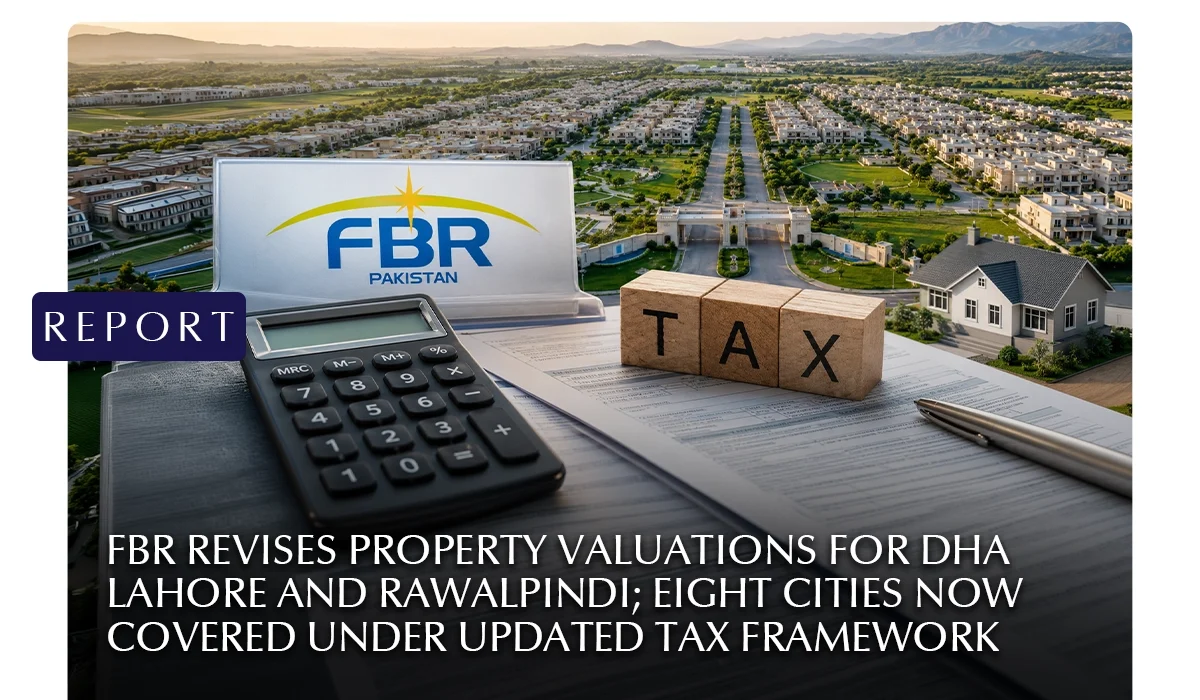

ISLAMABAD — The Federal Board of Revenue has updated the official valuations of properties in Defence Housing Authority areas of Lahore and Rawalpindi, through two separate orders issued on Tuesday. The revisions will directly affect the amount of tax that buyers and sellers are required to pay when a property changes hands in these localities.
The updates were formalised through Statutory Regulatory Orders S.R.O. 876(I)/2026 for Lahore and S.R.O. 877(I)/2026 for Rawalpindi, both signed by Muhammad Amin Qureshi, Secretary Rules and SRO, Revenue Division. They amend valuations originally set in October 2024 and bring the total number of cities where the FBR has revised property benchmarks in recent months to eight, following similar exercises carried out for Islamabad and other major urban centres.
Understanding the FBR Rate
When a property is sold in Pakistan, the government uses an official benchmark value set by the FBR to calculate withholding tax, which is a tax collected at the point of the transaction. This FBR rate is separate from both the actual price agreed between buyer and seller and the Deputy Commissioner rate set by provincial governments for stamp duty purposes.
The purpose of periodically revising these benchmarks is to keep them closer to real market values. When official values are too far below what properties actually trade for, the withholding tax collected ends up being lower than it should be, effectively allowing significant portions of high-value transactions to go under-taxed. There are multiple online property tax calculators which help you calculate your property taxes.
Lahore: What the New Rates Say
The Lahore order revises valuations for DHA Phases VI through XIII, all administratively located within Nishtar Town. Rates here are expressed in rupees per marla, the standard unit of land measurement in Punjab.
The most valuable commercial address in the entire Lahore table is the Broadway strip in DHA Phase VIII, the main commercial avenue running through sub-sectors A, B, C and D, officially valued at Rs. 4,988,970 per marla. This figure forms the basis of withholding tax calculations for any commercial plot or shop sold along that stretch.
Among residential areas, DHA Phase XI Rahbar, Sector I carries the highest valuation at Rs. 967,960 per marla, reflecting its established infrastructure and sustained demand. At the lower end, DHA Phase XIII, formerly known as DHA City and located furthest from the city centre, is valued at Rs. 204,960 per marla, consistent with its earlier stage of development.
DHA Phase VI, one of Lahore’s most established residential addresses, is valued at Rs. 1,132,460 per marla for most residential blocks. The C, M and N Blocks carry a lower residential rate of Rs. 761,460 per marla, though their commercial land value rises sharply to Rs. 4,369,410 per marla, reflecting heavy commercial activity in those areas.
A significant addition in this notification is the first-ever official valuation assigned to One Central DHA, a newer development that previously had no FBR benchmark. It has now been entered into the official table at Rs. 760,000 per marla for residential open plots and Rs. 3,100,000 per marla for commercial plots. This means transactions in One Central DHA will now carry a formally calculated withholding tax obligation for the first time.
Across all DHA Lahore entries, built structures, that is, houses or commercial buildings as opposed to bare land, are assessed at a uniform Rs. 1,750 per square foot for residential and Rs. 2,800 per square foot for commercial, regardless of which phase they are located in.
Rawalpindi: A Different Scale, Similar Intent
The Rawalpindi order covers DHA Phases I through V and DHA Valley. An important distinction: unlike Lahore, where rates are expressed per marla, Rawalpindi valuations in this notification are given in rupees per square foot. This reflects a difference in how property is traditionally measured and administered across the two cities.
The highest commercial valuation in Rawalpindi’s table belongs to DHA Phase II, at Rs. 17,677 per square foot for commercial open plots, the single largest figure in the Rawalpindi notification. DHA Phase I follows at Rs. 15,427 per square foot for commercial land.
On the residential side, DHA Phase II again leads at Rs. 2,878 per square foot, while DHA Valley, the most peripheral of the listed localities, sits at just Rs. 466 per square foot for residential open plots. The gap between these two figures illustrates how sharply official land values decline as the distance from the city’s established core increases.
DHA Phases II Extension, III and IV share an identical commercial open plot rate of Rs. 5,946 per square foot, indicating that the FBR considers their commercial potential broadly equivalent. Their residential rates, however, vary: Phase IV at Rs. 1,322 per square foot, Phase III at Rs. 1,011 per square foot and Phase II Extension at Rs. 778 per square foot, differences that broadly reflect each area’s level of development and infrastructure maturity.
Built structure rates across Rawalpindi DHA phases are set at Rs. 1,470 per square foot for commercial and Rs. 735 per square foot for residential in most phases, with DHA Valley’s residential superstructure rate marginally higher at Rs. 770 per square foot.
The Broader Context
Pakistan’s property market has long operated with a well-documented gap between declared transaction values and actual market prices. For years, it was common practice for buyers and sellers to register a property at a fraction of its true value, reducing their tax liability significantly.
FBR valuation revisions are one of the primary tools available to narrow that gap and, with it, improve tax collection from a sector that has historically contributed far less to the national treasury than its scale would suggest.
These revisions also carry relevance beyond individual transactions. Pakistan’s economic reform commitments, including those made under its ongoing programme with the International Monetary Fund, have consistently identified the real estate sector as an area requiring greater documentation and tax compliance. The gradual extension of revised FBR benchmarks to more cities and localities is part of the government’s response to those obligations.
For buyers and sellers in the affected DHA areas, the immediate effect is straightforward: withholding tax at the point of transaction will now be calculated on a revised official value, which in most cases will be closer to actual market prices than the figures it replaces.
Those accustomed to a significant gap between the FBR rate and the market price should account for a narrower margin when planning the financial aspects of a property transaction.
For more news on real estate and Special Reports, visit Chakor Ventures.
References
Federal Board of Revenue, Government of Pakistan. (2026, May 19). S.R.O. 876(I)/2026: Revision of valuation of immovable properties Nishtar Town, Lahore [Statutory notification]. Revenue Division, Islamabad. File No. 2(17)R&S/2017.
Federal Board of Revenue, Government of Pakistan. (2026, May 19). S.R.O. 877(I)/2026: Revision of valuation of immovable properties Rawalpindi [Statutory notification]. Revenue Division, Islamabad. File No. 2(31)R&S/2024.
Akhter, S. (2026, May 19). FBR revises property valuation tables for Nishtar Town Lahore. Pkrevenue.com. https://pkrevenue.com/fbr-revises-property-valuation-tables-for-nishtar-town-lahore/
Government of Pakistan. (2001). Income Tax Ordinance, 2001 (XLIX of 2001), Section 68(4). National Assembly of Pakistan.
Federal Board of Revenue, Government of Pakistan. (2024, October 29). S.R.O. 1722(I)/2024: Valuation of immovable properties Lahore [Statutory notification]. Revenue Division, Islamabad.
Federal Board of Revenue, Government of Pakistan. (2024, October 29). S.R.O. 1728(I)/2024: Valuation of immovable properties Rawalpindi [Statutory notification]. Revenue Division, Islamabad.

BBC-featured Content Specialist with a sharp eye for search intent and a proven ability to turn content into a growth engine. I leverage cutting-edge digital marketing tools to craft strategies that fuel organic traffic, amplify brand growth, and own the local SEO landscape, particularly across the competitive real estate market. I help brands dominate search rankings and convert visibility into measurable business success.
