Pakistan’s cities are growing faster than ever, and thoughtful urban planning has never been more critical. At Chakor, our Urban Developments and Planning section explores the master plans, zoning decisions, infrastructure investments, and community projects shaping how Pakistan’s urban centres evolve.
For developers, investors, and citizens alike, understanding how cities are being planned today is the key to knowing where value will be created tomorrow.
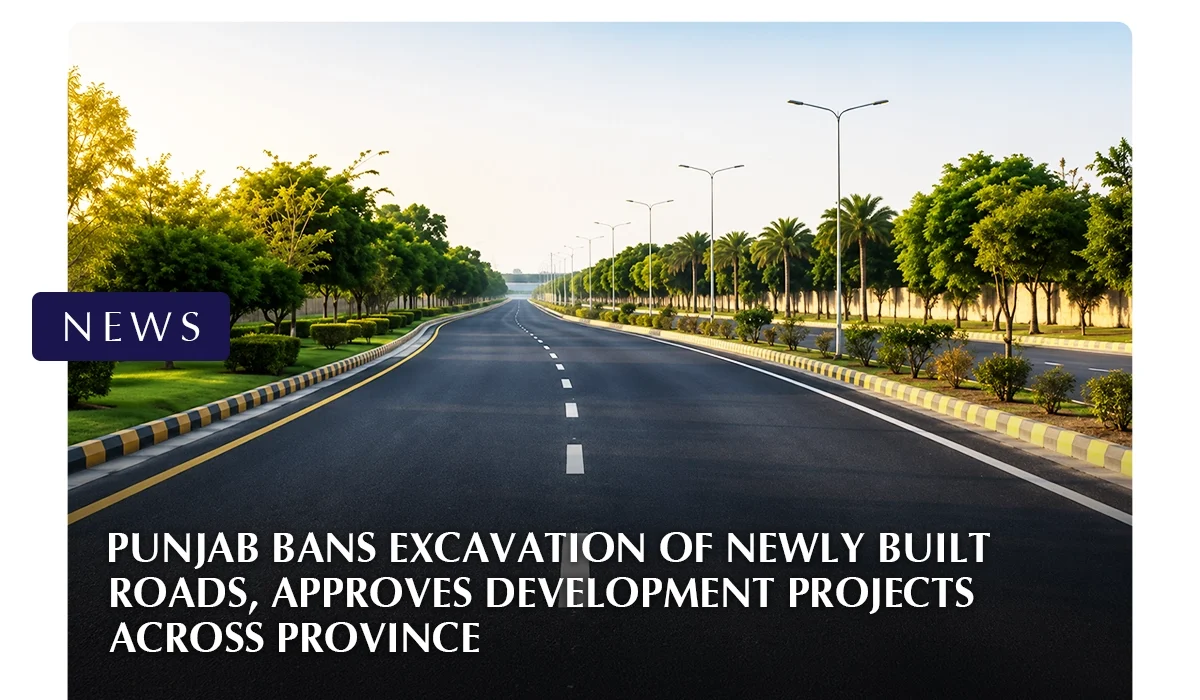
LAHORE: CM Punjab Maryam Nawaz has prohibited excavation or damage to newly constructed roads across Punjab, directing improved coordination between government departments to prevent repeated digging after infrastructure projects are completed.
The directive was issued during a meeting reviewing own-source revenue development schemes across several divisions. Authorities were also instructed to ensure that manholes and sewerage covers remain level with road surfaces, while newly developed roads must include proper drainage systems, signage and lane markings.
The provincial government approved a wide range of infrastructure and urban improvement projects covering Lahore, Multan, Bahawalpur, Sahiwal, Rawalpindi and Faisalabad divisions.
In Lahore, the government approved improvement plans for several major roads, along with beautification work at Lakshmi Chowk. Authorities were also directed to enhance sections of the Orange Line corridor along Multan Road through cleaning, plantation and mural work.
Development schemes involving road construction and widening, sewerage systems, drainage, solar streetlights and public facilities were approved for districts including Kasur, Sheikhupura, Multan, Vehari, Lodhran, Bahawalpur, Sahiwal and Faisalabad.
Rawalpindi district received approval for 13 projects, while additional schemes were cleared for Attock, Murree, Jhelum and Chakwal.
The chief minister also directed departments to establish clear completion timelines for development projects and barred officials from collecting charges from shopkeepers without prior approval.
BBC-featured Content Specialist with a sharp eye for search intent and a proven ability to turn content into a growth engine. I leverage cutting-edge digital marketing tools to craft strategies that fuel organic traffic, amplify brand growth, and own the local SEO landscape, particularly across the competitive real estate market. I help brands dominate search rankings and convert visibility into measurable business success.
ISLAMABAD: The Capital Development Authority (CDA) has moved forward with plans to construct an underpass at Kashmir Chowk on Murree Road, with the project estimated to cost around Rs1.4 billion.
The proposed underpass, located at Dhokri Chowk near Islamabad Club, is intended to improve traffic movement at the busy intersection. Under the planned arrangement, vehicles travelling from the Serena side towards Rawalpindi will use the underpass, while traffic heading towards Murree will pass over its upper section.
CDA has opened technical bids submitted by Habib Construction Services and M/s Kamran Khan (Kundi Group). During the evaluation process, Kundi Group was declared non-responsive and subsequently filed a grievance with the civic authority. Financial bids will remain unopened until the complaint is decided. Officials expect the matter to be resolved within 15 days.
Separately, CDA is also preparing another underpass at the junction of Faisal Avenue and Margalla Road, where the PC-I is being finalised before the tendering process begins.
The projects form part of CDA’s broader road infrastructure programme aimed at improving traffic flow across Islamabad. Meanwhile, the federally funded 10th Avenue project remains incomplete, with about half of its work still pending despite its original 2024 completion target.
BBC-featured Content Specialist with a sharp eye for search intent and a proven ability to turn content into a growth engine. I leverage cutting-edge digital marketing tools to craft strategies that fuel organic traffic, amplify brand growth, and own the local SEO landscape, particularly across the competitive real estate market. I help brands dominate search rankings and convert visibility into measurable business success.
ISLAMABAD: The Capital Development Authority (CDA) has issued a formal directive to all sponsors of private housing schemes and projects in Islamabad Capital Territory (ICT), requiring them to transparently display approved layout plans amid growing concerns about public deception in the housing sector.
The notice, issued by the Planning Wing under reference No. CDA/PLW/DG-SP/General/2026/280 and signed by Ijaz Ahmad Sheikh, Director General (Spatial Planning) and Director Housing Societies, follows a communication from the National Accountability Bureau (NAB) Regional Bureau, Islamabad/Rawalpindi, dated May 11, 2026.
According to the CDA, NAB had observed that several housing sponsors and developers were misrepresenting the approval status of their schemes either by failing to display approved layout plans altogether or by presenting outdated and unapproved versions to prospective buyers.
The authority noted that such practices create a false impression of legal standing, mislead the public, and result in financial loss and hardship.
To curb the trend, the CDA has directed all housing societies to upload and regularly update their approved layout plans on official websites and to prominently display these plans, measuring at least 7×5 feet, at reception areas of project sites and booking offices, accompanied by a QR code linking to verified project information.
The directive further invokes Clause-40 of the 2023 Regulation for Planning and Development of Private Housing Schemes, requiring that all allotment letters be routed through a CDA-linked digital platform and vetted by authorised officials before being deemed valid.
Housing societies have ten days to submit compliance reports with supporting evidence; otherwise, the matter will be referred to NAB for potential legal action. The notice has also been circulated to utility providers, including IESCO and SNGPL, and to regulatory bodies such as PEMRA and SECP, to ensure coordinated enforcement across the sector.
Dedicated and detail-oriented SEO Content Writer, Real Estate Writer, and Research Analyst based in Islamabad, with proven expertise in developing accurate, valuable, and well-researched content. Skilled in analytical writing, market research, and reporting, with the ability to turn insights into clear, professional, and impactful content. Passionate about exploring new ideas, analyzing industry trends, and contributing to high-quality writing and research-driven projects.
ISLAMABAD: The State Bank of Pakistan (SBP) has issued a revised regulatory framework for housing finance, allowing banks and development finance institutions (DFIs) to finance up to 90 percent of a property’s value, up from previous limits under earlier circulars. The new regulations, which took effect immediately upon issuance, supersede several circulars issued between 2019 and 2021, and the central bank has directed all banks and DFIs to ensure strict compliance.
Under the updated rules, the maximum loan-to-value ratio has been set at 90:10, meaning eligible borrowers can secure financing covering up to 90 percent of a property’s assessed value.
Housing finance may be extended for a range of purposes, including purchasing a house, apartment, or plot; constructing on an already-owned plot; renovating or expanding an existing home; and installing renewable energy systems within housing units.
The maximum repayment tenor for standard housing finance is fixed at 30 years, while renewable energy financing has a shorter maximum tenor of 10 years.
To safeguard borrowers from over-leveraging, the SBP has capped total monthly loan repayments, including the proposed housing finance and any other consumer loans, at 65 percent of a borrower’s net disposable income.
Banks and DFIs must also obtain updated credit information reports through the State Bank’s Electronic Credit Information Bureau or a licensed private credit bureau, with approved proxy models available to assess informal income where applicable.
Additional safeguards include mandatory documentation of property title and ownership, lenders’ formal acknowledgement of received documents, and a general requirement that financed properties be mortgaged in the lender’s favour.
For loans up to Rs. 5 million, a lien supported by a Green Property Certificate may serve as sufficient security. The framework also mandates comprehensive insurance or Takaful coverage equal to the outstanding finance amount, and lenders must clearly disclose coverage terms and charges to borrowers.
Dedicated and detail-oriented SEO Content Writer, Real Estate Writer, and Research Analyst based in Islamabad, with proven expertise in developing accurate, valuable, and well-researched content. Skilled in analytical writing, market research, and reporting, with the ability to turn insights into clear, professional, and impactful content. Passionate about exploring new ideas, analyzing industry trends, and contributing to high-quality writing and research-driven projects.
LAHORE: The Lahore Development Authority‘s governing body has approved an Rs88.613 billion budget for LDA and the Traffic Engineering and Planning Agency (TEPA) for the 2026-27 fiscal year, setting a revenue target of Rs47 billion. The decision was made during a meeting chaired by LDA Vice Chairman Mian Marghub Ahmed, with senior officials from housing, finance, local government and WASA departments in attendance.
Under the approved budget, Rs10 billion sourced through a Punjab government loan has been earmarked for structural road projects, while Rs6.3 billion will fund Annual Development Programme schemes.
Development work in LDA City has been allocated Rs12.5 billion, with a further Rs13.5 billion set aside for sustainable development and urban regeneration initiatives. LDA Avenue 1 will receive Rs4 billion, and TEPA has been granted a separate Rs3.5 billion budget alongside amendments to existing building and zoning regulations.
On the revenue side, the authority has set targets of Rs17 billion from town planning activities and Rs19.2 billion from property sales and allotments, with LDA City expected to contribute Rs15 billion of that figure.
The governing body also greenlit several new initiatives, including a pilot maintenance-charge scheme for residential and commercial properties in LDA Avenue 1, Jubilee Town and LDA Enclave, with services offered free for an initial two-month period.
Additionally, officials approved plans to develop commercial plots on 118 kanals along Ferozepur Road near Arfa Karim Tower for a proposed technology park, and allocated Rs100 million toward a child-friendly city initiative undertaken in partnership with UNICEF.
Other approvals included launching a new residential and commercial sector within LDA City and installing solar lighting across several city blocks. Officials credited the authority’s leadership for achieving a record Rs32 billion in revenue during the previous fiscal year, the highest total in LDA’s history.
Dedicated and detail-oriented SEO Content Writer, Real Estate Writer, and Research Analyst based in Islamabad, with proven expertise in developing accurate, valuable, and well-researched content. Skilled in analytical writing, market research, and reporting, with the ability to turn insights into clear, professional, and impactful content. Passionate about exploring new ideas, analyzing industry trends, and contributing to high-quality writing and research-driven projects.
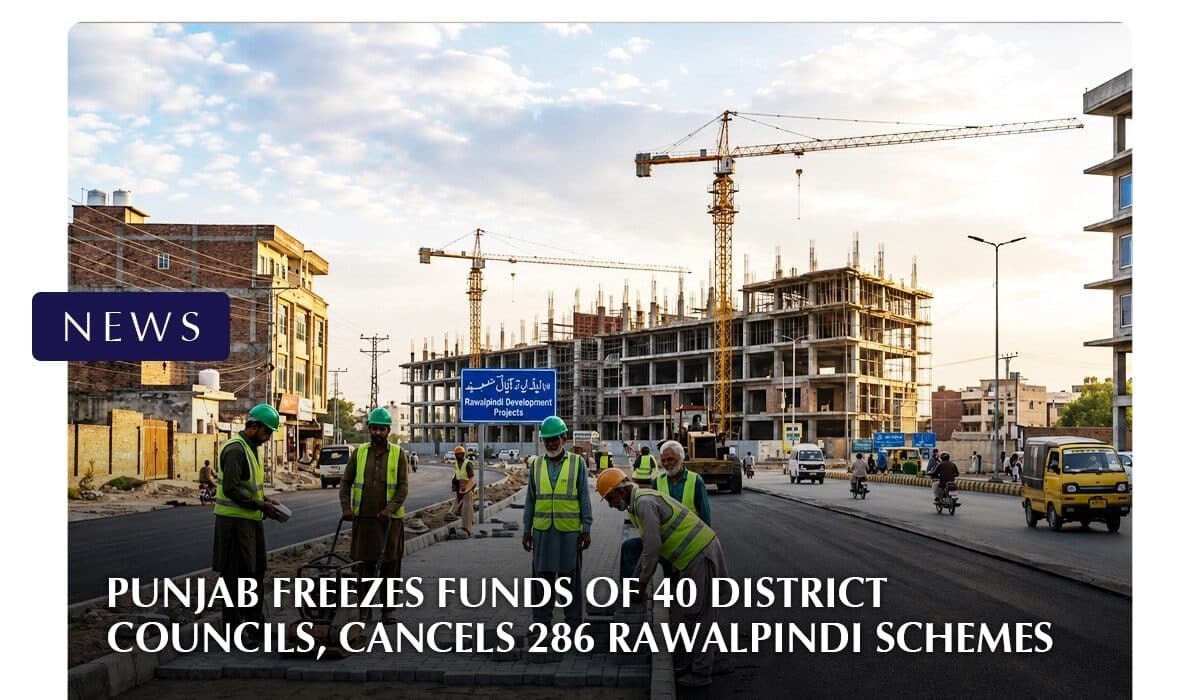
RAWALPINDI: The Punjab government has frozen the funds of all 40 district councils across the province, including the Rawalpindi District Council, following the rollout of a new local government system, a move that has led to the cancellation of all 286 small and large development schemes previously undertaken by the Rawalpindi council.
District council funds are now being transferred to the newly established tehsil councils, with contractors previously registered at the district level being re-registered with their respective tehsil councils. Only schemes in the final stages of completion have been permitted to continue; all other grants and development funds now fall under tehsil council control.
The Rawalpindi District Council had earlier approved a budget of Rs7.84 billion, of which nearly Rs3 billion was allocated for local-level grants and development schemes.
With district council operations wound down, tehsil councils and the Water and Sanitation Agency (WASA) are executing new water-supply and grant-funded projects in Rawalpindi. WASA has taken over water-supply schemes previously managed by the district council, including the Chahan Dam Water Supply Project. The project is designed to deliver 12 million gallons of clean water daily to a population of roughly one million.
Separately, under the Punjab chief minister’s Clean Drinking Water pilot initiative, pipeline networks and filtration plants have begun supplying clean drinking water to underdeveloped areas of Rawalpindi and Chaklala.
The restructuring marks one of the most significant administrative shake-ups of Punjab’s local government framework in recent years, shifting fiscal and developmental authority from district-level bodies to the newly empowered tehsil councils.
BBC-featured Content Specialist with a sharp eye for search intent and a proven ability to turn content into a growth engine. I leverage cutting-edge digital marketing tools to craft strategies that fuel organic traffic, amplify brand growth, and own the local SEO landscape, particularly across the competitive real estate market. I help brands dominate search rankings and convert visibility into measurable business success.
ISLAMABAD: The federal government is finalising a comprehensive development package to overhaul Pakistan’s construction sector, centred on the creation of a Construction Industry Development Board (CIDB) and an extension of the Defect Liability Period (DLP) from one year to three years.
Federal Minister for Economic Affairs and Establishment Division Senator Ahad Khan Cheema chaired a high-level meeting attended by Minister of State for Finance Bilal Azhar Kayani, Federal Secretary for Housing and Works Captain (R) Mahmood, the Managing Director of the Public Procurement Regulatory Authority, and representatives of the Construction Association of Pakistan (CAP).
The proposed CIDB will combine development and regulatory functions, overseeing industry standards, contractors, and consultants through a joint public-private platform. Officials confirmed plans to raise the DLP further to five years over time, aiming to hold contractors accountable for long-term structural quality.
For the first time, consultants will face legal and financial accountability for design flaws under the new framework, a gap CAP representatives said had long undermined project quality, since only contractors currently face default penalties.
Officials are also evaluating a dedicated Construction Development Bank (CDB) to address financing and guarantee bottlenecks. Cheema has directed the Ministry of State for Finance to begin formal talks with the State Bank of Pakistan and the Pakistan Banks Association to assess its feasibility.
The broader package includes tax incentives and revised import-export policies designed to encourage technology adoption and strengthen local construction capacity. The CIDB framework will be submitted to the Prime Minister for final approval.
Cheema said the reforms aim to ensure public infrastructure investment is not compromised by substandard execution, positioning Pakistan’s construction sector to meet international regulatory and quality benchmarks.
BBC-featured Content Specialist with a sharp eye for search intent and a proven ability to turn content into a growth engine. I leverage cutting-edge digital marketing tools to craft strategies that fuel organic traffic, amplify brand growth, and own the local SEO landscape, particularly across the competitive real estate market. I help brands dominate search rankings and convert visibility into measurable business success.
ISLAMABAD: The Capital Development Authority (CDA) has approved 37 commercial and residential projects covering more than 6.69 million square feet across the Islamabad Capital Territory during 2026.
According to CDA, its Building and Housing Control Wing, through the Design Vetting Committee, reviewed 42 commercial projects during seven meetings held this year and granted approval to 37 of them.
The approved developments include commercial and apartment buildings, mixed-use projects, offices, hostels, five mosques and one school. Together, the projects comprise 721 commercial units, 1,981 residential flats and 362 office units, with a total covered area of 6,690,580 square feet.
CDA said it is also working to streamline procedures for building-plan approvals, completion certificates and other regulatory permissions in the housing sector.
The authority said these processes will continue to be implemented in accordance with the ICT Building Control Regulations 2023, with safety and security requirements remaining part of the approval framework.
BBC-featured Content Specialist with a sharp eye for search intent and a proven ability to turn content into a growth engine. I leverage cutting-edge digital marketing tools to craft strategies that fuel organic traffic, amplify brand growth, and own the local SEO landscape, particularly across the competitive real estate market. I help brands dominate search rankings and convert visibility into measurable business success.
Pakistan is facing one of the most serious water crises in its history. Groundwater levels in cities like Lahore, Karachi, and Islamabad are dropping every year, water tanker costs keep rising, and monsoon rains that once recharged the water table now mostly run off into drains and streets. Against this backdrop, more homeowners across Pakistan are turning to a simple but effective solution: a Rainwater Harvesting System for Homes.
Instead of letting rainwater go to waste, a Rainwater Harvesting System for Homes captures it, stores it, and puts it to use, reducing dependence on tankers, borewells, and overstretched municipal supply.
This guide will walk you through exactly how a Rainwater Harvesting System for Homes works, what it costs in the Pakistani market, and practical ways to save water and money with one.
What Is a Rainwater Harvesting System?
A Rainwater Harvesting System for Homes is a setup that collects rain from your rooftop or terrace, filters it, and stores it in a tank for later use. This isn’t a new concept in this region; the first urban rainwater harvesting system in Pakistan was installed at Faisal Mosque, Islamabad, back in 2010, with a storage capacity of nearly 3 million litres. What’s changing now is that this practice is moving from mosques and government buildings into ordinary homes.
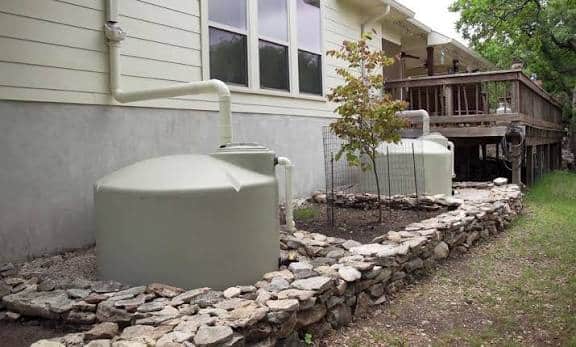
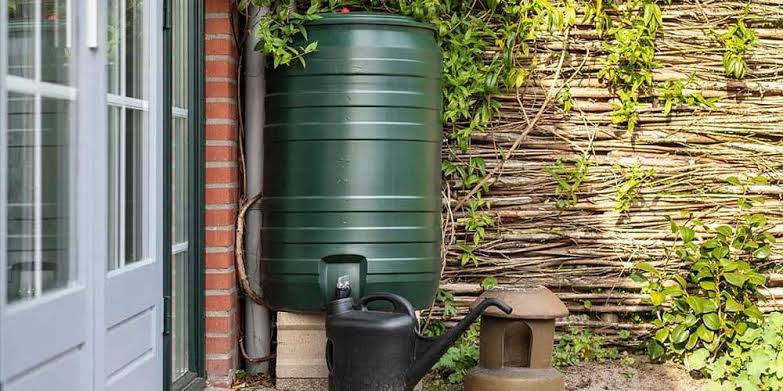
A Rainwater Harvesting System for Homes can be as simple as a plastic drum placed under a downspout, or as advanced as an underground concrete tank with a filtration chamber and pump connected directly to your household plumbing. Either way, the goal is the same: capture free rainwater that would otherwise flow into the street, and use it for everyday needs like gardening, washing, cleaning, and even non-potable indoor use.
In fact, the Capital Development Authority (CDA) has already made rooftop rainwater harvesting mandatory for new buildings in Islamabad, and cities like Lahore have invested millions of rupees into public harvesting projects.
How Does a Rainwater Harvesting System Work?
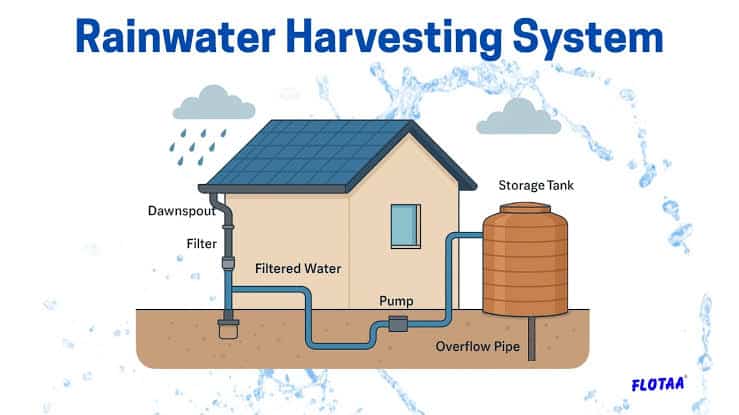
If you’re wondering how does a rainwater harvesting system work, the process is easy to understand once you break it into steps.
1. Collection (roof or terrace)
Rainwater harvesting begins at your rooftop or terrace, which acts as the catchment area. In cities like Lahore, which receives around 670mm of rainfall annually, even an average-sized rooftop can collect thousands of litres of water over a single monsoon season through a well-designed Rainwater Harvesting System for Homes.
2. Conveyance (pipes and downspouts)
Rainwater flows off the roof into gutters and PVC downspouts, which channel it toward the storage point. Many systems in Pakistan use a simple diverter to let the first, dirtiest flush of water (carrying dust and debris from the roof) bypass the tank.
3. Filtration
Before storage, water passes through a mesh or filter chamber to remove leaves, dust, and sediment a critical step given Pakistan’s dusty urban environment. Some homeowners even use a simple muslin cloth as an inexpensive first-level filter.
4. Storage
The filtered water then collects in a tank, either an above-ground plastic tank (the most common option in Pakistani homes) or an underground concrete/ferrocement tank built into the ground floor or lawn area.
5. Pump and Distribution
For larger systems, a motor pump moves stored water to an overhead tank or directly into a separate plumbing line for irrigation, washing, or toilet flushing.
6. Backup and Overflow
A properly built Rainwater Harvesting System for Homes includes an overflow pipe to safely direct excess water once the tank is full, and many households keep their WASA or tanker connection as backup during dry months.
This complete cycle of collection, conveyance, filtration, storage, and distribution is what makes a Rainwater Harvesting System for Homes such a practical addition to any Pakistani household, whether in Islamabad, Lahore, Karachi, or smaller cities.
Types of Rainwater Harvesting Systems for Homes in Pakistan
Drum or Barrel Systems
The most affordable and common starting point. A plastic drum placed under a downspout can be set up for as little as Rs. 1,500–3,000 and is ideal for garden watering and outdoor cleaning.
Above-Ground Plastic Tank Systems
This is the most popular option for Pakistani homes. Tanks ranging from 500 to 2,000 litres are widely available from local brands and can be connected to a simple filtration and piping setup for a complete Rainwater Harvesting System for Homes.
Underground Concrete or Ferrocement Tanks
Common in larger homes and plots, these tanks are built into the ground and offer much larger storage capacity, often several thousand litres, while keeping the lawn or driveway usable above.
Combined Harvesting-and-Recharge Systems
Increasingly used in Islamabad under CDA regulations, these systems both store water for reuse and direct excess water into recharge wells to replenish groundwater, an approach also recommended by Pakistan’s Council of Research in Water Resources (PCRWR).
Rainwater Harvesting Cost in Pakistan
One of the biggest questions homeowners have before installing a Rainwater Harvesting System for Homes is what it will actually cost. It’s worth noting upfront: there is no official government price list for home rainwater harvesting systems in Pakistan. Regulatory bodies like PCRWR (Pakistan Council of Research in Water Resources) and CDA (Capital Development Authority) publish technical guidelines and building bylaws, but not itemised consumer pricing.
The figures below are based on current retail prices from Pakistani water tank suppliers and rainwater harvesting cost ranges reported by real estate and construction industry sources, not fixed government rates.
System Type
Estimated Market Cost (PKR)
Basic drum/barrel setup (DIY)
Rs. 1,500 – 5,000
500–1,000 litre plastic tank + basic filtration
Rs. 15,000 – 40,000
Above-ground system with piping and pump
Rs. 40,000 – 150,000
Underground concrete/ferrocement tank system
Rs. 80,000 – 400,000
Full CDA-compliant system (larger homes)
Rs. 80,000 – 500,000
Real estate industry sources tracking Islamabad’s building regulations report that a complete, CDA-compliant Rainwater Harvesting System for Homes typically falls between Rs. 80,000 and Rs. 500,000, depending on property size, though it’s worth stressing that CDA itself has not published an official fixed rate, and actual costs will vary by contractor, roof area, and material choices.
What drives the rainwater harvesting cost up or down?
Tank type and size – Retail prices from Pakistani suppliers (Dura, Sonex, Polycon, Turk Plast) show 500-litre plastic tanks starting around Rs. 8,000–15,000, and 1,000-litre tanks ranging from Rs. 12,000–32,000 depending on brand and layer quality. Underground concrete tanks cost more due to excavation and construction work.
Filtration quality – A basic mesh or cloth filter costs very little, while a proper multi-stage filtration chamber adds several thousand rupees.
Pump and plumbing – A motor pump and separate distribution line typically add Rs. 15,000–50,000 depending on system complexity.
Excavation and construction – Underground tanks require digging and structural work, adding Rs. 30,000–150,000 depending on tank size and soil type.
Labour and location – Installation costs tend to run higher in Islamabad and Lahore than in smaller towns.
Getting an accurate quote for your home Because pricing varies significantly by roof size, soil conditions, and contractor rates, the most reliable way to budget for a Rainwater Harvesting System for Homes is to get quotes directly from local installers or architectural firms that specialise in rainwater harvesting; several now operate in Islamabad in response to CDA’s building requirements. This gives you a system-specific quote rather than a generic estimate.
DIY vs. Professional Installation A basic drum-based Rainwater Harvesting System for Homes is well within DIY reach; many Pakistani households set one up for under Rs. 5,000 using PVC piping, plastic drums, and a cloth filter. For a full system with underground storage, pumps, and plumbing tied into your house, hiring a local plumber or a firm experienced in rainwater harvesting is the safer route to avoid leaks, contamination, or non-compliance with CDA rules (where applicable).
How Much Money Can You Save?
The savings potential of a Rainwater Harvesting System for Homes in Pakistan is significant, especially given how expensive tanker water has become in many areas. A single water tanker delivering roughly 2,000 litres can cost around Rs. 1,500 or more, depending on your city a cost that adds up quickly during dry months.
Homeowners who install even a modest Rainwater Harvesting System for Homes report reducing their monthly water expenses by up to Rs. 6,000 during peak summer months, particularly when the harvested water is used for gardening, car washing, floor cleaning, and other non-potable needs. Larger systems that supply toilets and laundry can cut overall water costs even further, especially in areas with unreliable WASA supply or high dependence on private tankers.
Keep in mind that a Rainwater Harvesting System for Homes is a long-term investment. While a fully built underground system can cost several hundred thousand rupees upfront, many households recover this cost within a few years through reduced tanker bills and lower reliance on paid water sources, not to mention the added value it brings to your property, especially in cities like Islamabad where such systems are becoming a regulatory requirement.
Benefits Beyond Cost Savings
Reduced dependence on tankers and borewells – Especially valuable in cities facing falling groundwater levels.
Groundwater recharge – Combined harvesting-and-recharge systems help replenish aquifers, a growing priority under PCRWR guidance.
Flood and drainage relief – Capturing rooftop runoff reduces pressure on urban drainage systems during heavy monsoon rains.
Better quality water for outdoor use – Rainwater is naturally soft and free of the salinity issues common in groundwater in parts of Pakistan.
Regulatory compliance – In Islamabad, a compliant Rainwater Harvesting System for Homes is now a legal requirement under CDA building bylaws, making early installation a smart move for homeowners and builders alike.
Tips to Maximise Savings and Efficiency
Match your tank size to your roof area and local rainfall
Start with a simple drum system
Use harvested water for non-potable needs first
Maintain your filters regularly
Check local regulations
Is a Rainwater Harvesting System Worth It for Your Home?
Given Pakistan’s worsening water scarcity, rising tanker costs, and falling groundwater levels, a Rainwater Harvesting System for Homes is one of the most practical investments a homeowner can make. Whether you start with a Rs. 3,000 drum setup or invest in a full underground concrete tank system costing several hundred thousand rupees, the long-term savings on water bills combined with the environmental and regulatory benefits make it a smart choice for homes across Lahore, Karachi, Islamabad, and beyond.
Frequently Asked Questions
How does a rainwater harvesting system work? It collects rainwater from your rooftop, filters out dust and debris, and stores it in a tank for uses like gardening, washing, and cleaning the basic principle behind every Rainwater Harvesting System for Homes.
How much does a rainwater harvesting system cost in Pakistan? Costs range from around Rs. 1,500 for a basic drum setup to Rs. 500,000 for a full underground, CDA-compliant system, depending on property size and complexity.
Can I drink harvested rainwater? It’s possible with proper multi-stage filtration and treatment, but most residential systems in Pakistan are designed for non-potable uses like gardening, cleaning, and toilet flushing.
How much water can I collect from my roof? It depends on your roof size and local rainfall. A home in a high-rainfall city like Lahore can collect thousands of litres per monsoon season through a well-designed Rainwater Harvesting System for Homes.
Final Verdict
A Rainwater Harvesting System for Homes isn’t just an environmentally responsible choice in Pakistan; it’s becoming a financial necessity. With tanker prices rising and groundwater reserves shrinking, every litre of rain captured on your rooftop is a litre you don’t have to buy.
Dedicated and detail-oriented SEO Content Writer, Real Estate Writer, and Research Analyst based in Islamabad, with proven expertise in developing accurate, valuable, and well-researched content. Skilled in analytical writing, market research, and reporting, with the ability to turn insights into clear, professional, and impactful content. Passionate about exploring new ideas, analyzing industry trends, and contributing to high-quality writing and research-driven projects.
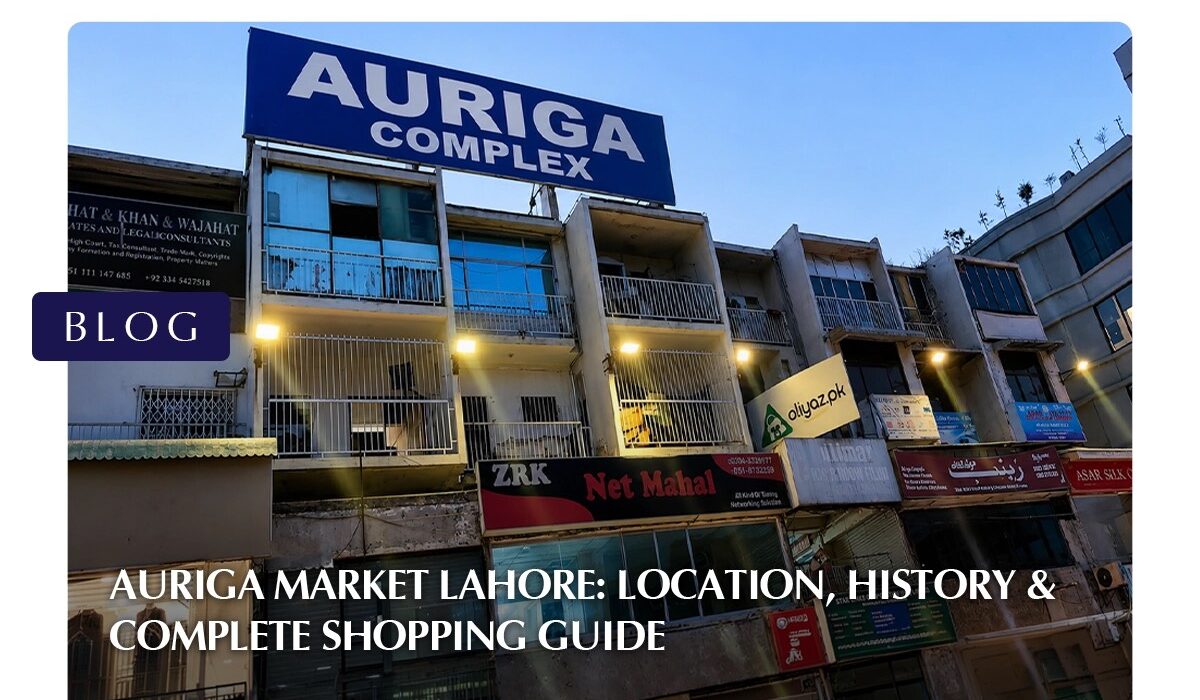
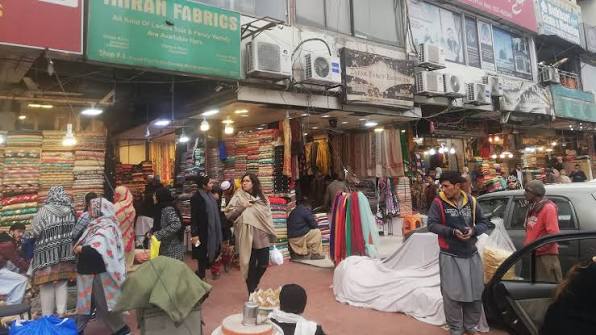
Auriga Market is one of Lahore’s most recognisable shopping destinations, known for its mix of clothing outlets, bridal wear shops, and everyday retail under one roof. Tucked into the heart of Gulberg, Auriga Market Lahore draws shoppers from across the city looking for affordable fashion, home essentials, and a lively local shopping experience. This guide covers the market’s history, its exact location, what to shop for, prices, timings, and how the old and new sections differ.
Key Information About Auriga Market Lahore
Detail
Information
Area
Gulberg, Lahore
Nearest intersection
Main Boulevard Gulberg & Zahoor Elahi Road
Known aliases
Auriga Complex, Auriga Centre, New Auriga Shopping Mall
Common misspelling
Origa Market
Floors
Multi-storey (3+ floors in the newer sections)
Typical price range
Roughly PKR 1,500 to PKR 30,000 for most clothing items
Weekday timings
Monday to Saturday, late morning to late evening
Sunday timings
Afternoon start, open later into the night
Parking
Available, limited during peak hours
History of Auriga Market
Auriga Market traces its roots back several decades to a small cluster of shops in Gulberg. What is now referred to as the old Auriga Market Lahore began as a modest commercial strip before growing into a full multi-storey complex.
The market takes its name from the original Auriga Complex, one of the first multi-storey commercial buildings to come up in the area at the time. That early structure set the tone for the retail development that followed.
Old Auriga Market vs. New Auriga Shopping Mall
Over the years, newer retail blocks were built alongside the original structure, and today the market is generally split into two identifiable parts:
Old Auriga Market Lahore – the original complex, still referenced by name in property listings and by long-time traders in the area. It houses smaller, more established shops, several of which have operated for decades.
New Auriga Shopping Mall – the newer, larger multi-storey section built later on the same stretch, spread across multiple floors with a higher shop count and a stronger focus on bridal wear and unstitched fabric.
Both sections sit close enough to each other that most visitors treat them as one continuous market, even though they have distinct commercial identities on paper.
Auriga Market Lahore Location
The Auriga Market Lahore location sits right at the intersection of Main Boulevard Gulberg and Zahoor Elahi Road, placing it firmly in one of Lahore’s most central and well-connected localities.
Its position makes it an easy stop for residents of Gulberg, Model Town, and Garden Town, and it is close to Ferozepur Road as well, which brings in shoppers from further afield.
How to Get There
Mode of transport
Notes
Private car
Direct access via Main Boulevard Gulberg; parking is limited during peak hours
Ride-hailing (Careem, Uber)
Widely used and generally the most convenient option
Public bus
Regular routes pass through Gulberg
Rickshaw
Easily available for short-distance trips within Gulberg and nearby areas
Shopping Categories at Auriga Market
Auriga Market is best known for its clothing and fashion offerings, but the range extends well beyond that.
This is the market’s biggest draw. Well-known names such as Bareeze, Khaadi, and Alkaram Studio have outlets here alongside independent shops selling local and imported fabric.
Tailoring shops are common too, offering custom stitching for anything purchased on-site, useful for shoppers who want a finished outfit rather than just fabric.
Jewellery, Footwear, Home Décor, and Electronics
Beyond clothing, the smaller speciality shops round out the market’s appeal: jewellery stores stock both everyday and occasion pieces, footwear shops cover the full range from traditional to modern styles, and a handful of electronics and home décor shops mean a single trip can cover several errands at once.
Food and Dining at Auriga Market
Shopping trips at Auriga Market are usually paired with a food break.
Street food – golgappas, samosas, chana chaat, and jalebi from vendors around the complex
Cafes and casual restaurants – a mix of Pakistani, Chinese, and fast food options nearby
Quick bites for wholesale buyers – small eateries that stay open through the market’s busier trading hours
Who Visits Auriga Market
Budget-conscious shoppers looking for negotiable prices on clothing and accessories
Brides and wedding shoppers sourcing bridal wear, jewellery, and fabric in one trip
Wholesale and bulk buyers stocking up on fabric or ready-made garments for resale
Local families running errands across clothing, footwear, and home décor in a single visit
Facilities: Banking, Parking, and Security
Several bank branches and ATMs operate in and around the market, which is useful given the volume of daily transactions in the area.
Parking is available but limited, and spaces can fill up quickly during peak hours, so visiting during off-peak times or using public transport is generally more convenient.
Security personnel and CCTV coverage are present throughout the complex, though shoppers are still advised to stay alert in crowded sections, as with any busy commercial area.
How Auriga Market Compares to Other Lahore Markets
Shoppers after negotiable prices and traditional wear tend to prefer Auriga Market. Those wanting fixed prices and branded outlets are generally better served at Packages Mall, while Liberty Market sits somewhere in between.
Auriga Market’s central location means several other well-known Lahore spots are close by:
Liberty Market – a short drive away, offering a similar mix of local and international retail
MM Alam Road – known for upscale dining and boutiques, ideal for winding down after shopping
Gaddafi Stadium – home ground of Pakistan’s national cricket team, a short distance from the market
Best Time to Visit Auriga Market
Late mornings and early afternoons tend to be less crowded, making them a better time to browse without the rush. Evenings, particularly on weekends, see the highest footfall, so shoppers looking for a quieter experience may prefer visiting earlier in the day.
Wedding season and the run-up to Eid are consistently the busiest periods, since bridal wear and fabric shops see the highest demand at those times.
Tips for Shopping at Auriga Market
Carry cash – many smaller shops don’t accept cards
Bargain confidently – negotiation is a normal part of shopping here, especially for clothing and accessories
Visit off-peak – late mornings on weekdays are quieter than weekend evenings
Plan for parking – arrive early or use ride-hailing during busy hours
Compare a few shops first – prices for similar items can vary between stores within the same market
FAQs About Auriga Market
The following are some of the FAQs.
Where exactly is Auriga Market located?
The Auriga Market Lahore location is at the intersection of Main Boulevard Gulberg and Zahoor Elahi Road, close to Ferozepur Road.
What is the difference between the old and new sections of the market?
The old Auriga Market Lahore refers to the original Auriga Complex, one of the area’s first multi-storey commercial buildings. The New Auriga Shopping Mall is the larger, newer section built later on the same stretch, with more floors and a bigger focus on bridal wear.
Is Auriga Market budget-friendly?
Yes. It caters to a wide range of budgets, with both affordable and higher-end options available across clothing, jewellery, and footwear shops. Most clothing items fall roughly between PKR 1,500 and PKR 30,000.
What are the market’s general timings?
The market generally operates from late morning to late evening on weekdays and Saturdays, with a later start and later closing on Sundays.
Is parking available at Auriga Market?
Parking is available but limited, and it can fill up quickly during busy hours. Off-peak visits or ride-hailing are recommended.
What can I buy at Auriga Market?
Shoppers can find clothing and unstitched fabrics, bridal wear, jewellery, footwear, home décor items, and electronics accessories.
How does Auriga Market compare to Liberty Market or Packages Mall?
Auriga Market is better suited to shoppers who want negotiable prices and traditional wear. Liberty Market offers a broader brand mix, while Packages Mall is the choice for fixed prices and international brands.
Conclusion
Auriga Market remains one of Gulberg’s most practical and popular shopping destinations, combining a long-standing local history with a wide range of retail options under one roof. Whether visiting the old Auriga Market Lahore section or the newer additions around it, shoppers consistently find a mix of affordability, variety, and convenience that keeps the market relevant year after year.
BBC-featured Content Specialist with a sharp eye for search intent and a proven ability to turn content into a growth engine. I leverage cutting-edge digital marketing tools to craft strategies that fuel organic traffic, amplify brand growth, and own the local SEO landscape, particularly across the competitive real estate market. I help brands dominate search rankings and convert visibility into measurable business success.