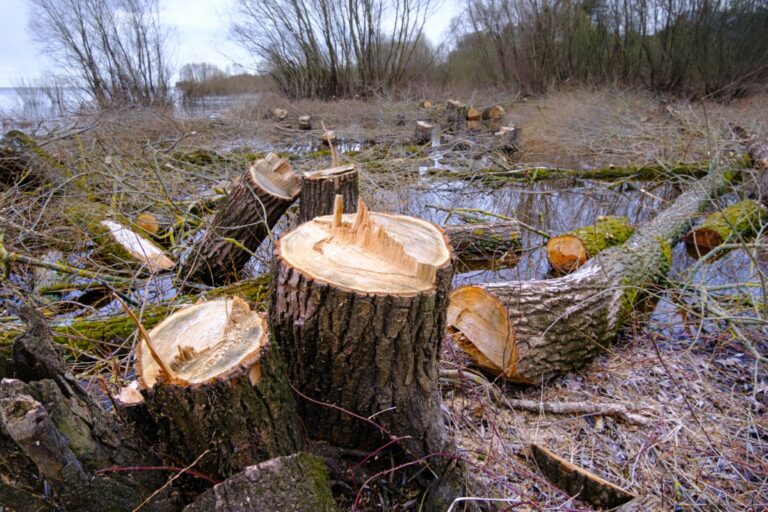
Pakistan’s forests are under growing pressure, and the consequences touch everything from climate resilience to urban planning. At Chakor, our Deforestation section sheds light on the environmental, economic, and social impact of forest loss, alongside the restoration efforts and policies working to reverse the trend.
Understanding deforestation is essential for anyone invested in sustainable development and the long-term health of Pakistan’s landscape.
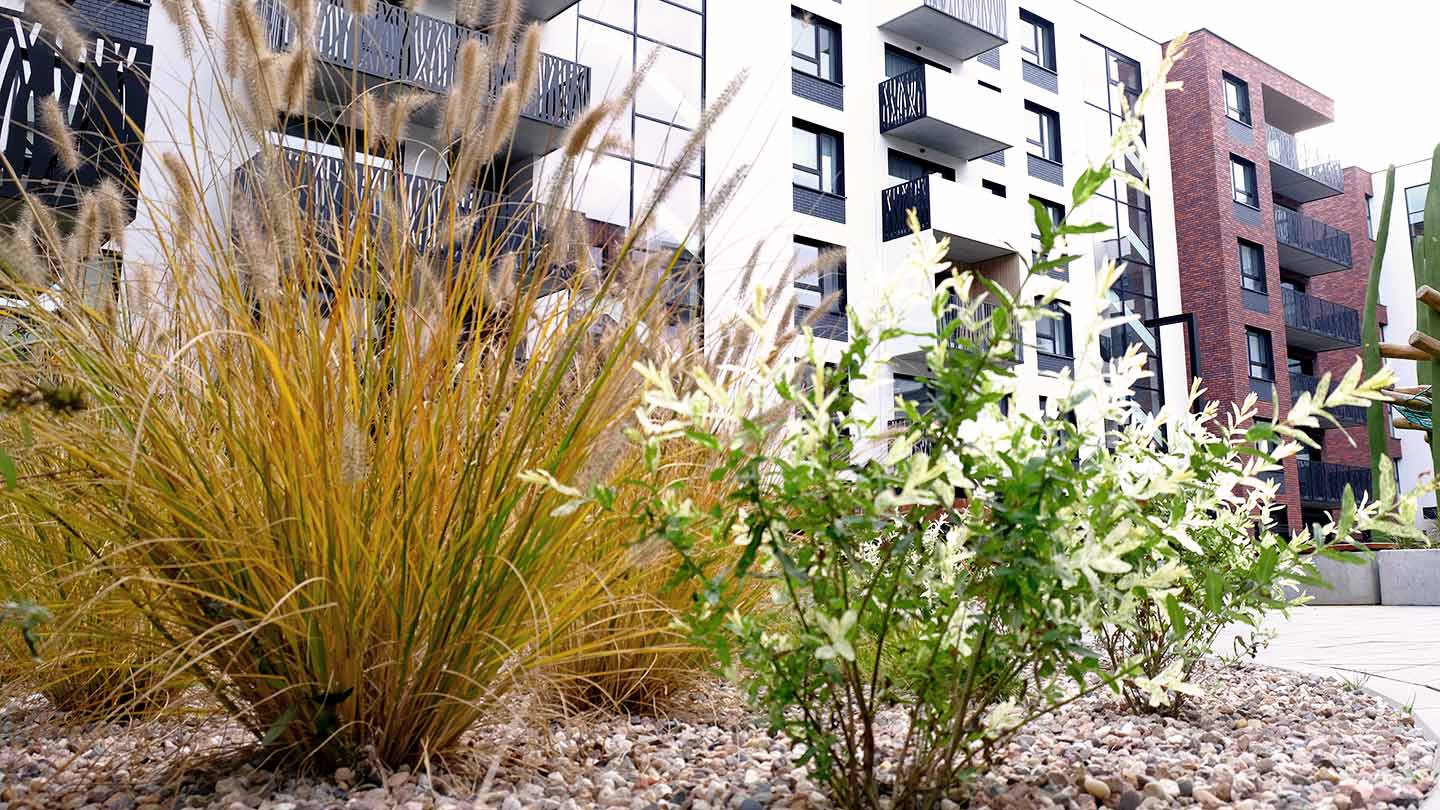
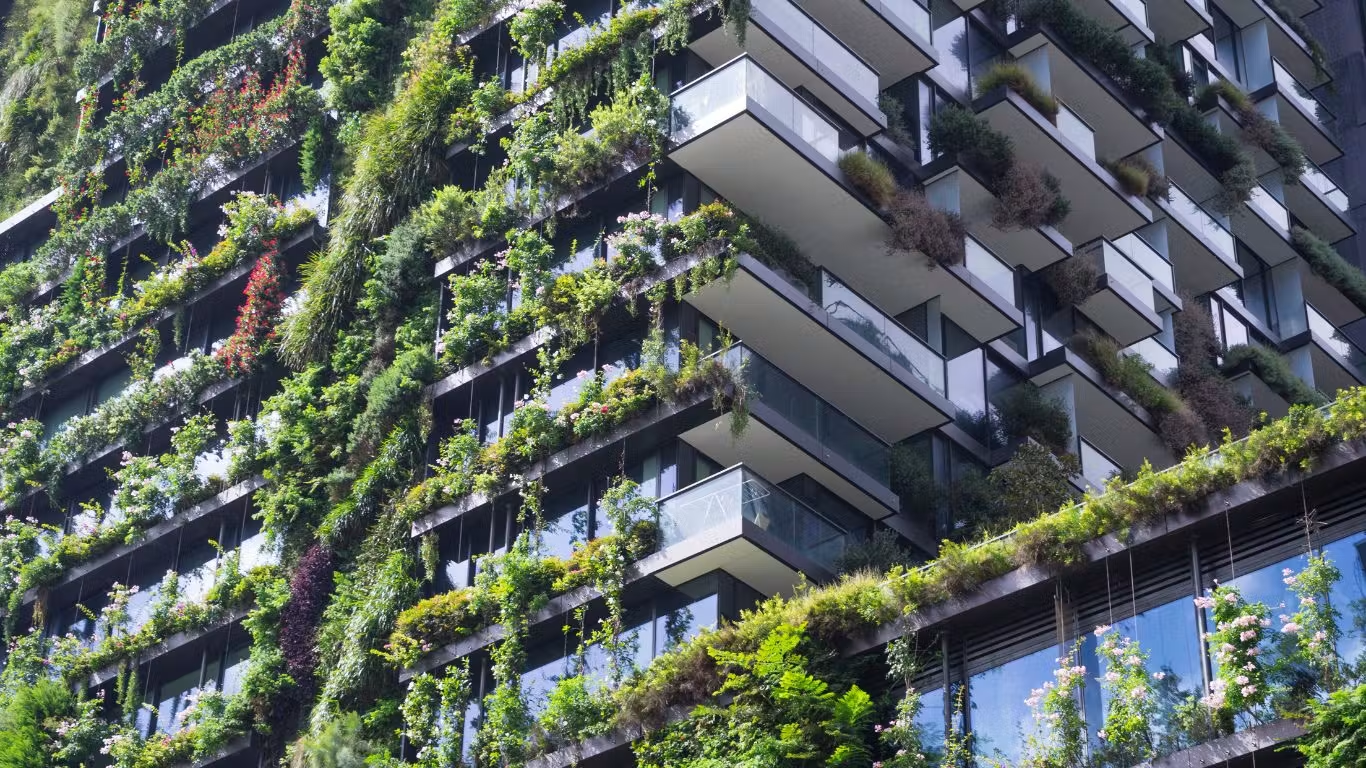
Pakistan’s real estate sector is entering a new era, one where climate-resilient real estate is no longer a niche concept but a market necessity. The 2022 floods submerged nearly a third of the country and caused an estimated $40 billion in damage, a stark reminder that the built environment cannot ignore climate risk any longer. Today, buyers, investors, and developers are rethinking how homes and commercial spaces are designed, built, and certified. Climate-resilient real estate now sits at the center of that shift, supported by sustainable real estate development practices and growing demand for green building certification across major cities.
This blog explains what climate-resilient real estate means for Pakistan, why it matters, and how the market is adapting.
What Is Climate-Resilient Real Estate?
Climate-resilient real estate refers to properties designed and constructed to withstand climate-related stressors such as flooding, extreme heat, and unpredictable rainfall, while protecting the wellbeing of residents and maintaining long-term asset value. It goes beyond aesthetics or energy savings. It is about ensuring a building can function safely and efficiently even as weather patterns become more extreme.
In Pakistan, this is not a distant concern. The housing sector faces a significant shortfall alongside growing climate risks, and most existing structures were never built to handle the intensity of floods, heatwaves, or storms the country now experiences. Climate-resilient real estate addresses this gap through better materials, smarter design, and disaster-aware planning.
Why Climate-Resilient Real Estate Matters for Pakistan
Pakistan ranks among the countries most vulnerable to climate change, yet much of its housing stock was never designed with resilience in mind. A few reasons this matters now more than ever:
Rising climate risk affects property value. Buildings that perform better against flooding, heat, and extreme weather tend to command higher rents and stronger resale value, while vulnerable properties face higher insurance and maintenance costs over time.
Urban flooding is a recurring threat. Karachi, Lahore, and other major cities regularly face monsoon flooding, making resilient drainage, elevated foundations, and flood-resistant materials essential rather than optional.
Energy and water demand keep rising. Passive design, insulation, and efficient systems reduce strain on an already stressed power grid while lowering utility bills for residents.
Investor expectations are shifting. Global capital increasingly favours developments that can demonstrate climate resilience and sustainability credentials, particularly as international investors look at Pakistan’s property sector.
Sustainable Real Estate Development
Climate-resilient real estate does not happen by accident. It is the outcome of deliberate sustainable real estate development, a process that integrates energy efficiency, resource-conscious design, and disaster resilience from the earliest planning stages rather than as an afterthought.
In practice, sustainable real estate development in Pakistan increasingly includes:
Low-carbon construction materials, such as autoclaved aerated concrete (AAC) blocks and interlocking bricks, which studies show can meaningfully reduce cooling energy demand and construction costs compared to conventional materials.
Passive design strategies, including solar orientation, natural ventilation, and shading, which reduce dependence on mechanical cooling in Pakistan’s hot climate.
Water conservation systems, such as rainwater harvesting and greywater recycling, which help offset the country’s growing water scarcity.
Renewable energy integration, particularly solar panels, which take advantage of Pakistan’s abundant sunlight to cut electricity costs and reduce grid dependence.
Resilient infrastructure planning, including improved drainage, elevated site design, and flood-conscious layouts for master-planned communities.
Developers who commit to sustainable real estate development are not just responding to climate risk; they are also meeting a clear shift in buyer expectations, especially among younger, environmentally conscious purchasers and overseas Pakistanis evaluating long-term investments.
The Role of Green Building Certification
Green building certification has become one of the clearest ways for developers to prove that a project meets recognised sustainability and resilience standards, rather than simply claiming it. Two frameworks are shaping this conversation in Pakistan:
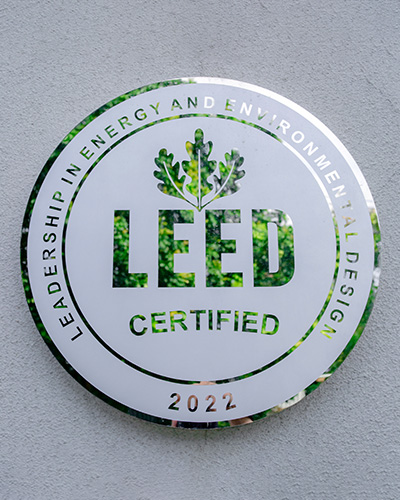
LEED (Leadership in Energy and Environmental Design), developed by the U.S. Green Building Council, remains the world’s most widely used green building rating system. It evaluates projects on energy efficiency, water conservation, material selection, and indoor environmental quality, awarding certification levels from Certified up to Platinum. LEED-certified buildings can cut electricity and water bills significantly, an important advantage in a market facing rising energy costs.
EDGE (Excellence in Design for Greater Efficiencies), an IFC-backed certification, simplifies green building design and focuses on resource efficiency and net-zero performance. EDGE also supports a Building Resilience Index, giving developers, banks, insurers, and governments a way to assess and disclose climate resilience across a portfolio.
Green building certification is gaining real traction in Pakistan. Institutions and urban development authorities have started pursuing LEED and EDGE recognition for major projects, signalling that certification is moving from a rare achievement to an expected standard for large-scale developments.
For developers, pursuing certification demonstrates credibility to both local buyers and international investors, while positioning a project ahead of regulatory trends that are likely to tighten in the coming years.
How Pakistan’s Property Market Is Responding
The shift toward climate-resilient real estate is visible across Pakistan’s major cities. In Karachi, new projects increasingly feature solar power, rainwater harvesting, and green building certification as standard offerings rather than premium add-ons.
In Lahore and Islamabad, urban development authorities and private developers are integrating resilient infrastructure, smart mobility, and green public spaces into master-planned communities.
This momentum is also being supported at the policy level. Recent reforms, including reductions in withholding tax and the removal of Federal Excise Duty on certain property transactions, have lowered the cost of developing and investing in real estate, creating more room for developers to invest in sustainable features without passing steep costs onto buyers.
For overseas Pakistanis and institutional investors, climate-resilient real estate offers a practical advantage: lower long-term operating costs, stronger asset protection against extreme weather, and greater alignment with the sustainability standards increasingly demanded by global capital.
What Buyers and Investors Should Look For
When evaluating a property or project for climate resilience, a few practical indicators are worth checking:
Certification status — Is the project pursuing or holding LEED, EDGE, or an equivalent green building certification?
Drainage and flood planning — Does the site design account for monsoon flooding and urban drainage capacity?
Material choices — Are low-carbon, insulating materials used to reduce cooling demand?
Water and energy systems — Does the development include rainwater harvesting, solar power, or greywater recycling?
Long-term maintenance plans — Is there a clear strategy for monitoring and maintaining resilience features after handover?
Final Thoughts
Climate-resilient real estate is fast becoming the defining standard for Pakistan’s property market, not a future ambition but a present-day requirement. As climate risks intensify, sustainable real estate development and green building certification are giving developers a credible framework to build safer, more efficient, and more valuable properties. For buyers and investors alike, understanding these standards is no longer optional. It is central to making sound, future-focused property decisions in Pakistan.
As one of Pakistan’s leading real estate developers, Chakor continues to track these shifts closely, ensuring its projects reflect the standards that today’s buyers and international investors expect.
Frequently Asked Questions
What does climate-resilient real estate mean?
It refers to properties built to withstand climate-related risks such as flooding, extreme heat, and storms, while protecting resident wellbeing and long-term property value.
Why is green building certification important in Pakistan?
Green building certification, such as LEED or EDGE, verifies that a project meets recognised standards for energy efficiency, water conservation, and resilience, giving buyers and investors measurable proof of sustainability rather than unverified claims.
How does sustainable real estate development reduce costs?
Sustainable real estate development uses passive design, efficient materials, and renewable energy to lower a building’s energy and water consumption, which reduces utility costs for owners and occupants over the property’s lifetime.
Is climate-resilient real estate more expensive to build?
Some resilient materials and certification processes involve upfront investment, but they typically deliver long-term savings through lower utility bills, reduced maintenance, and stronger resale value.
BBC-featured Content Specialist with a sharp eye for search intent and a proven ability to turn content into a growth engine. I leverage cutting-edge digital marketing tools to craft strategies that fuel organic traffic, amplify brand growth, and own the local SEO landscape, particularly across the competitive real estate market. I help brands dominate search rankings and convert visibility into measurable business success.
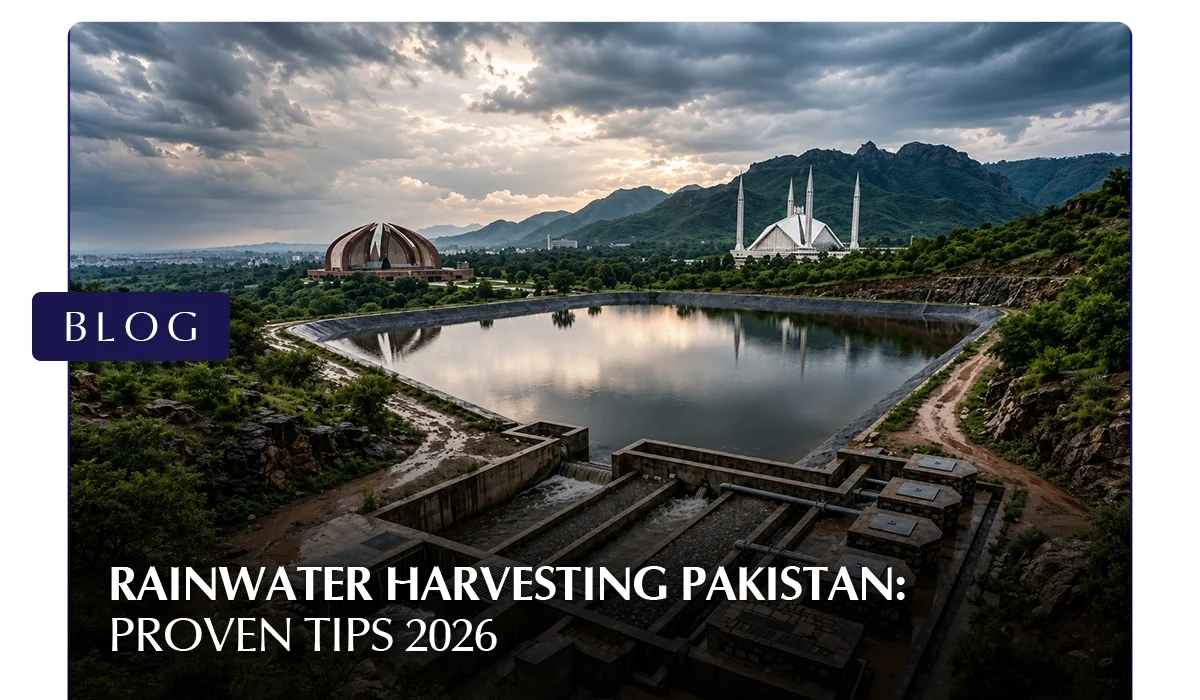
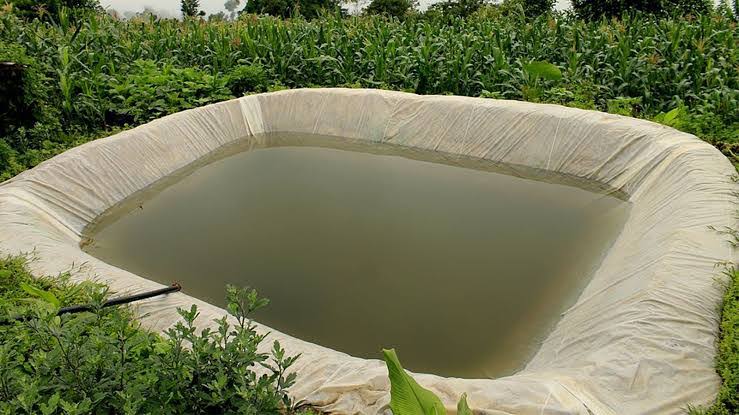
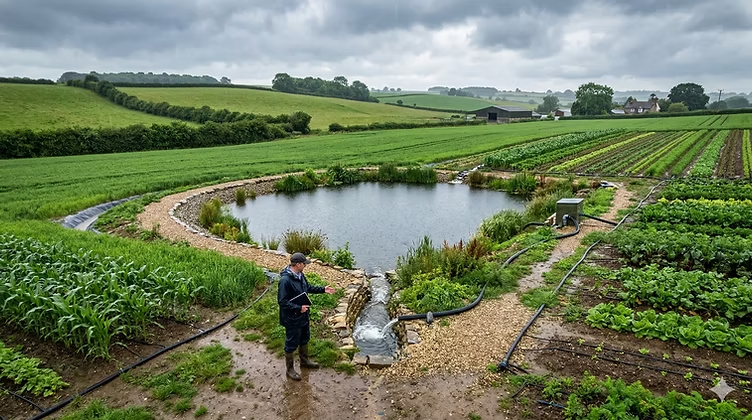
Pakistan is running out of water. Annual per capita water availability has fallen from over 5,000 cubic metres at independence to below 1,000 cubic metres today, pushing the country into the “water-scarce” category. Rainwater harvesting Pakistan offers one of the most practical, low-cost ways to slow this decline. It collects rain that would otherwise run off roofs, roads and open land, then stores it for reuse or sends it underground to recharge depleting aquifers.
This guide explains why rainwater harvesting Pakistan has become urgent, how the systems work, what government bodies are doing about it, and how households, builders and communities can take part.
Why Rainwater Harvesting in Pakistan Matters Right Now
Water scarcity in Pakistan is not a future risk. It is a present reality. The country now sits among the ten most water-stressed nations in the world. Groundwater tables are dropping in major cities, canal supplies are stretched thin, and more than half the population lacks access to safely managed drinking water.
A few numbers explain the scale of the problem:
Per capita water availability has dropped from around 5,260 cubic metres in 1951 to under 900 cubic metres today.
Pakistan can store only about 30 days of water nationally, far short of the 1,000-day buffer recommended for arid countries.
Roughly 90 percent of agricultural output depends on a single source, the Indus Basin Irrigation System.
Around 93 percent of available water goes to agriculture, leaving a thin margin for cities and households.
Rainwater harvesting Pakistan will not solve this crisis alone, but it reduces pressure on groundwater, cuts urban flooding, and gives households and buildings a backup source of water during dry months.
Climate Change in Pakistan and the Changing Rainfall Pattern
Climate change in Pakistan is making the water problem harder to manage, not easier. Rainfall has become more erratic. Long dry spells are now followed by short, intense monsoon bursts that overwhelm drains instead of soaking into the ground.
Experts from the International Water Management Institute have pointed to a rise in heatwaves and heavy precipitation events across South Asia linked to human-induced climate change, with Pakistan experiencing both extremes within the same year.
This swing between drought and flood is exactly the pattern rainwater harvesting in Pakistan is designed to manage. Storage tanks and recharge wells capture sudden heavy rain instead of letting it flood streets, then release that water slowly for use during the dry months that follow.
How Rainwater Harvesting Systems Work
A basic rainwater harvesting system follows a simple path:
Catchment – Rain lands on a roof, terrace, courtyard or paved surface.
Conveyance – Sloped surfaces and pipes direct the water toward a collection point.
Filtration – A first-flush diverter and filter screen remove dust, leaves and debris from the initial runoff.
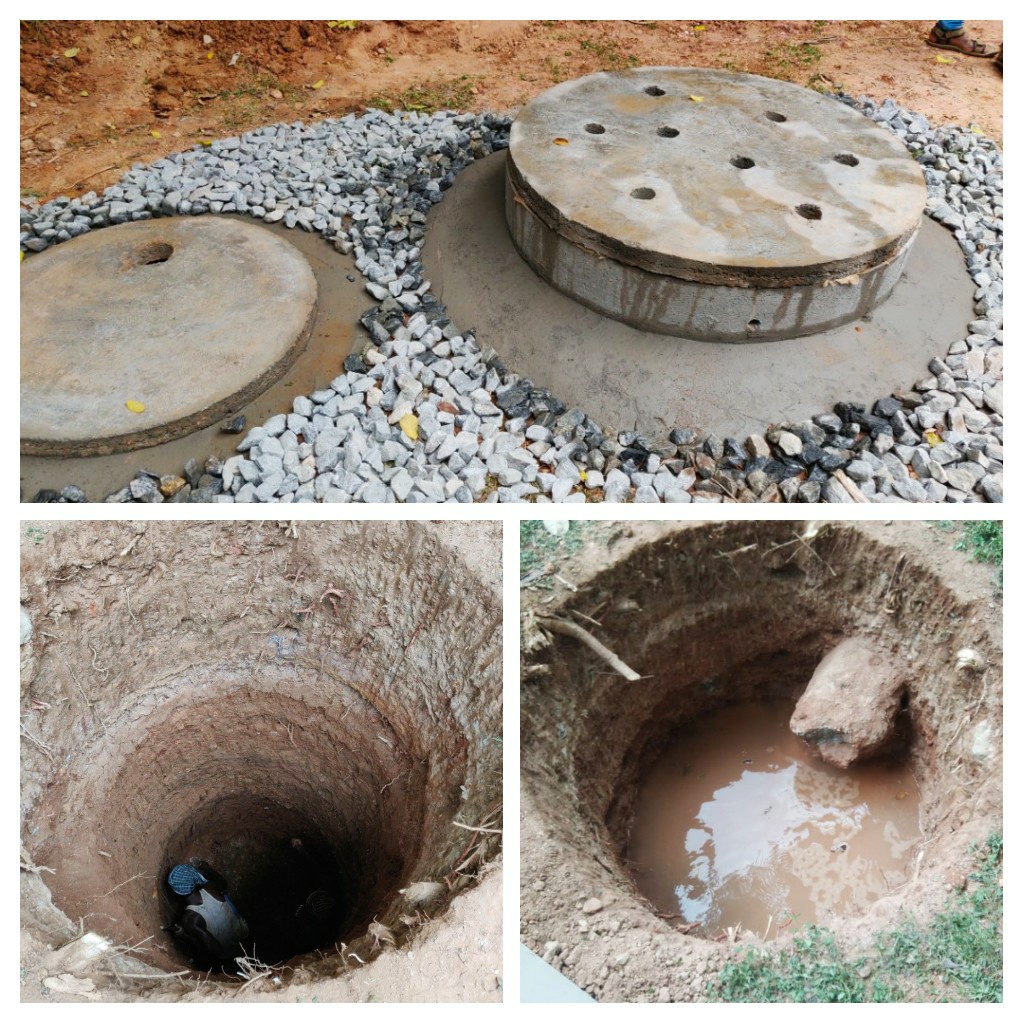
Storage or recharge – Water is either stored in a tank for reuse or channeled into a recharge well or pit to replenish groundwater.
Stored rainwater is generally used for gardening, washing, cleaning, and flushing. It is not safe for drinking unless it passes through proper treatment and testing.
Storage Tanks vs Recharge Wells -Rainwater Harvesting Pakistan
System
Best suited for
What it does
Storage tank
Homes, farmhouses, offices
Collects water for direct household reuse
Recharge pit
Small plots, gardens, open land
Lets filtered water percolate into the soil
Recharge well
Large properties, mosques, apartment blocks
Sends filtered surplus water deep underground to recharge the aquifer
Most well-designed projects use a combination: a tank for everyday reuse and a recharge point for any overflow during heavy rain.
Rainwater Harvesting Pakistan in Practice: Cities and Deserts
Urban Recharge Wells in Islamabad and Lahore
The Capital Development Authority has made rooftop rainwater harvesting mandatory for new construction in Islamabad under its building bylaws.
The authority has also been installing groundwater recharge wells across the city, working alongside the Pakistan Council of Research in Water Resources (PCRWR).
At one recharge site in Islamabad, researchers recorded a rise in the water table of nearly five metres after monitoring rainfall between May and September.
In Lahore, the Water and Sanitation Agency has built underground water tanks in flood-prone neighbourhoods. One such tank, built at a cost of Rs. 140 million, can hold 1.4 million gallons of rainwater drawn from a 30-acre catchment area.
The collected water is later used to irrigate public parks and green belts, easing pressure on piped supply while also reducing urban flooding.
Rainwater Harvesting in the Cholistan Desert
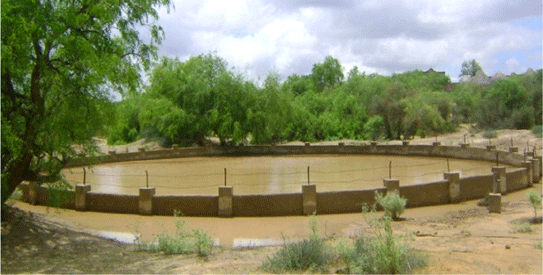
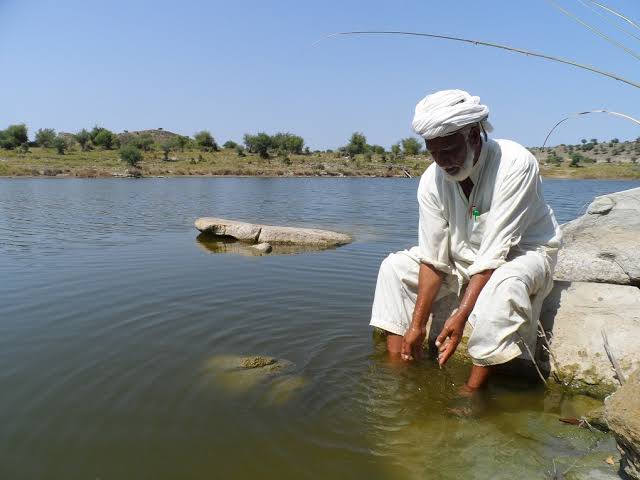
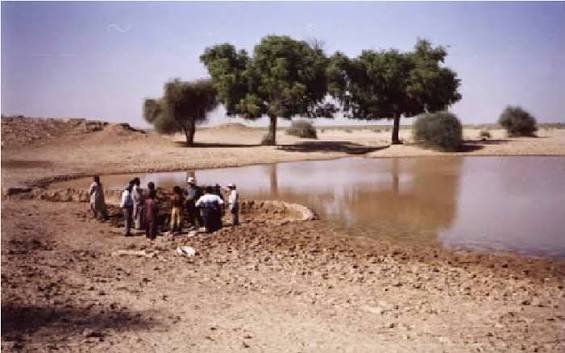
Rainwater harvesting Pakistan also plays a critical role far from major cities. In the Cholistan desert, rainfall is the only realistic water source for nomadic communities and their livestock. PCRWR has built a network of over 110 reservoirs across 26,000 square kilometers of desert, with a combined storage capacity of 440 million gallons.
This network, paired with newly drilled tubewells, has cut seasonal migration and saved an estimated Rs. 6 billion a year in losses linked to livestock movement and water shortages.
Benefits of Rainwater Harvesting Pakistan
Reduces dependence on groundwater, slowing the decline of water tables in over-extracted areas.
Lowers urban flood risk by capturing runoff before it overwhelms drains and roads.
Provides a backup water source for gardening, cleaning, and non-drinking household use during dry spells.
Supports agriculture and livestock in arid and desert regions where canal water never reaches.
Improves long-term building resilience, especially in cities where municipal supply is already intermittent.
Common Mistakes That Cause Rainwater Harvesting Pakistan Systems to Fail
Rainwater harvesting projects in Pakistan often fail for avoidable reasons:
Sending unfiltered roof water directly into a recharge well, which pushes silt and pollutants into the aquifer.
Undersized overflow pipes that cannot handle monsoon-level rainfall.
Tanks and filter chambers buried under finished paving with no access for cleaning.
Using one generic design across very different properties, rather than sizing the system to the actual roof area, rainfall pattern, and household need.
A system built without proper filtration and maintenance access may look fine in its first year and then fail during the next serious monsoon.
Not without treatment. Most systems are designed for gardening, washing, cleaning, and flushing rather than direct drinking use.
What causes water scarcity in Pakistan?
Rapid population growth, heavy reliance on a single river system, limited water storage infrastructure, and increasingly erratic rainfall linked to climate change in Pakistan have combined to push per capita water availability below internationally recognised scarcity thresholds.
Does rainwater harvesting Pakistan help with urban flooding?
Yes. Storing and redirecting heavy rainfall through tanks and recharge wells reduces the volume of runoff that would otherwise overwhelm city drains.
Final Word
Rainwater harvesting in Pakistan sits at the intersection of two growing problems: worsening water scarcity in Pakistan and the unpredictable rainfall brought on by climate change in Pakistan. Government-led projects in Islamabad, Lahore and the Cholistan desert show that the approach works at very different scales, from a single rooftop system to a desert-wide reservoir network. For households, builders and communities alike, treating rainwater as a resource rather than a runoff problem is one of the most direct ways to respond to Pakistan’s deepening water crisis.
BBC-featured Content Specialist with a sharp eye for search intent and a proven ability to turn content into a growth engine. I leverage cutting-edge digital marketing tools to craft strategies that fuel organic traffic, amplify brand growth, and own the local SEO landscape, particularly across the competitive real estate market. I help brands dominate search rankings and convert visibility into measurable business success.
Water shortage is a real problem in most cities today. Borewells run dry. Water bills keep rising. Groundwater levels keep falling. A rainwater harvesting system offers a simple, low-cost fix. It collects rain that would otherwise run off your roof or yard and turns it into a usable water source for drinking, irrigation, flushing, or simply topping up the ground beneath your feet.
This guide covers everything about a rainwater harvesting system: what it is, how it works, its components, methods, benefits, cost, water quality standards, and the rules that apply in Pakistan. By the end, you will know exactly how to plan one for your home, office, or institution.
What Is a Rainwater Harvesting System?
According to Encyclopaedia Britannica, a rainwater harvesting system is a technology that collects and stores rainwater for human use. Systems range from simple rain barrels to elaborate structures with pumps, tanks, and purification units. The stored water can irrigate landscaping, flush toilets, launder clothes, or even be purified for drinking.
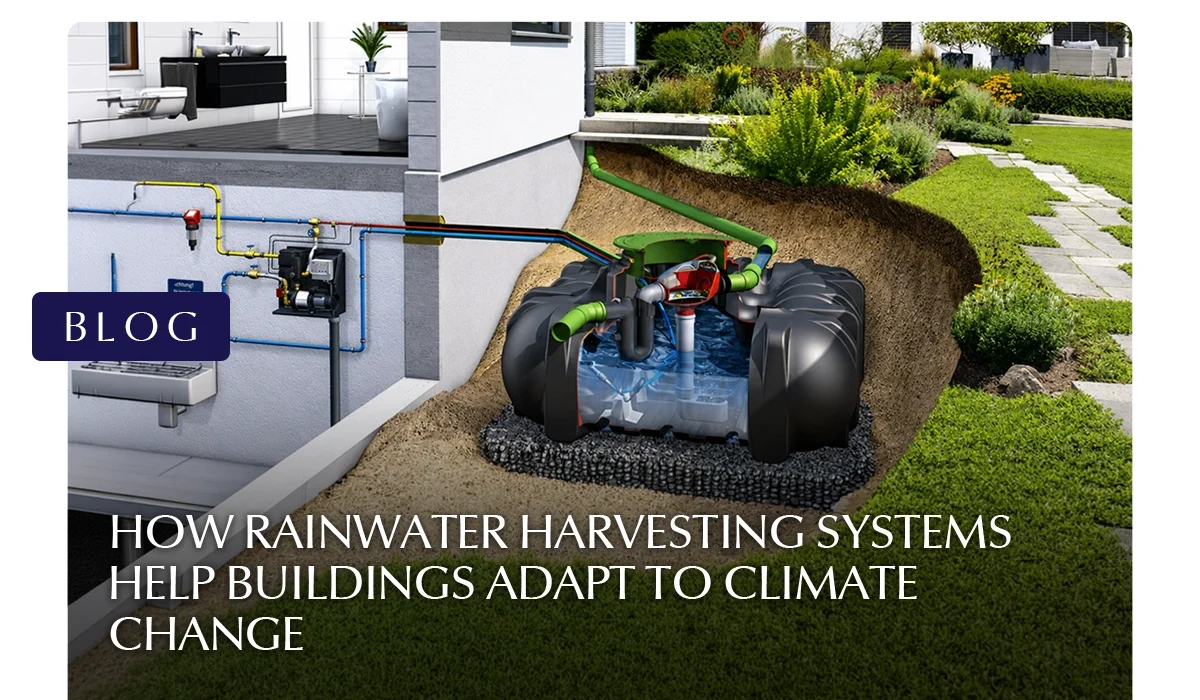
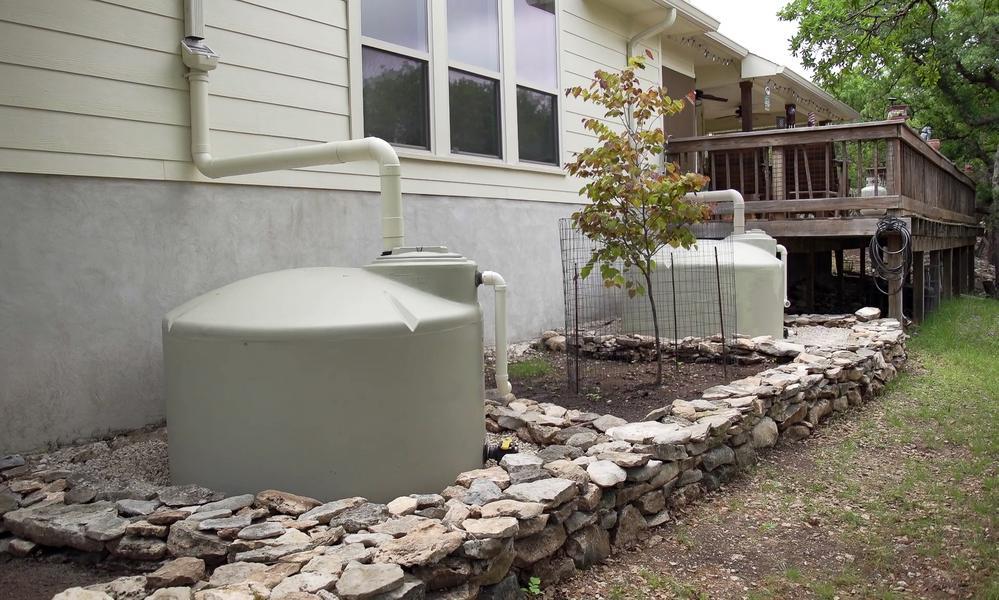
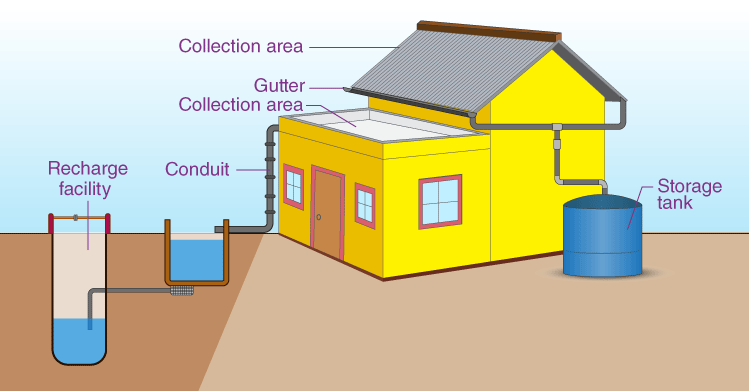
Instead of letting rain run into the street or drain away, a rainwater harvesting system directs it through gutters and pipes into a storage tank or into the ground. Researchers describe every rainwater harvesting system (RWHS) as sharing four core parts: a catchment area, gutters, pipes, and a storage system. Everything else- filters, pumps, recharge wells, treatment units- builds on that basic four-part foundation.
The idea itself is old. People have collected rainwater for thousands of years. Ancient cisterns dating back to 2500 BC have been found in the Middle East, and rainwater harvesting for irrigation dates back to roughly 4500 BC in southern Mesopotamia. Roman cities used rooftop channels and aqueducts long before modern gutters existed.
Farming communities in Balochistan practiced rainwater harvesting around 300 BC. The method has simply been refined with better tanks, filters, and monitoring tools, and in some university research projects today, even Building Information Modeling (BIM) and augmented reality.
Why a Rainwater Harvesting System Matters Right Now
Water stress is no longer a distant concern. Reports cited by industry sources suggest more than half the world’s population will be living in water-stressed regions by 2050.
Pakistan is a clear example. According to Abamet Pakistan, an environmental engineering firm, Pakistan is technically a “water-stressed” country rather than a “water-scarce” one, but it wastes nearly 10 trillion gallons of water every year due to poor conservation.
A rainwater harvesting system is one of the most direct ways to close that gap, because it captures free water at the exact point where it is needed most.
In Semarang, Indonesia, a city badly affected by climate-driven flooding and drought, a rainwater harvesting system built into public schools now channels collected water into daily use and groundwater recharge, directly benefiting more than 20,500 people.
This shows how a single, simple technology can serve two opposite climate problems at once: it eases drought by storing water, and it eases flooding by capturing runoff before it overwhelms drains.
How Does a Rainwater Harvesting System Work?
A rainwater harvesting system works in four simple stages: catchment, conveyance, filtration, and storage or recharge.
Catchment: Rain falls on a roof, terrace, or paved surface. This surface is called the catchment area.
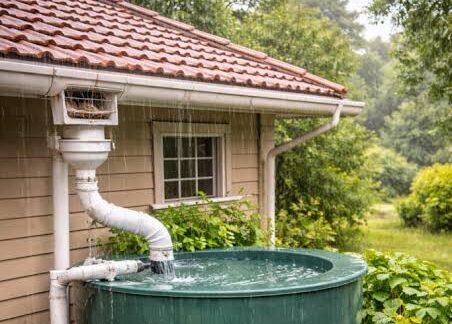
Conveyance: Gutters and downpipes carry the water from the roof to the storage point.
Filtration: Before the water reaches the tank, it passes through a first-flush diverter and a filter. This removes dust, leaves, and bird droppings.
Storage or recharge: Clean water is stored in a tank for reuse, or it is directed into a recharge well or pit so it seeps into the ground and refills the water table.
Gravity does most of the work in a well-designed rainwater harvesting system. Pumps are only needed when water must move uphill, into upper floors, or through pressurised taps.
Methods of Rainwater Harvesting
There are two broad methods used in any rainwater harvesting system, and within each, two purpose-based categories worth knowing.
1. Rooftop Rainwater Harvesting
This is the most common method for homes, apartments, schools, and offices. Rain falling on the roof is captured through gutters and either stored in a tank or directed to a recharge well.
Roof runoff is generally of higher quality than surface runoff and can often be used with only basic treatment. It is simple, affordable, and works well for houses, mosques, factories, hotels, and multi-storey buildings.
2. Surface Runoff Harvesting
This method collects rainwater flowing across the ground, such as from a courtyard, driveway, or open plot. The runoff is channelled into a storage tank or recharge pit below ground level.
It works well for larger plots and is often used alongside rooftop systems to capture every drop of rain falling on a property, while also cutting soil erosion, water pollution, and street flooding.
Domestic vs. Agricultural Rainwater Harvesting
Beyond catchment type, rainwater harvesting is also split by purpose. Domestic rainwater harvesting (DRWH) serves household needs: drinking, washing, gardening, and flushing.
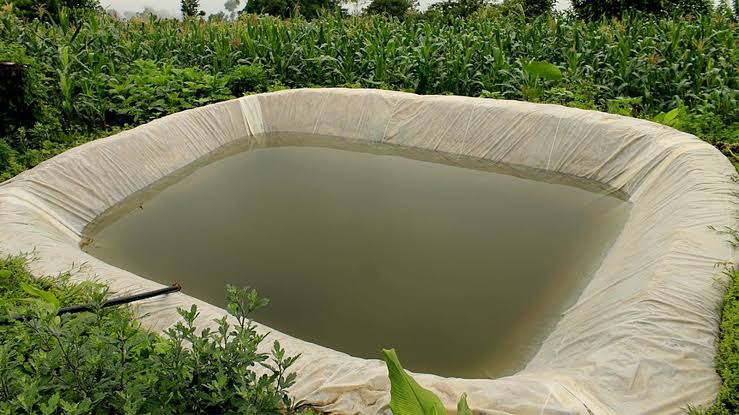
Agricultural and livestock rainwater harvesting (ARWH) serves larger-scale needs through pans, hafir dams, birkads, check dams, sand dams, and agricultural bunds, structures built to trap surface runoff for crops, livestock, and groundwater recharge in arid and semi-arid regions.
Both approaches share the same underlying goal: intercept rain before it is lost, and put it to productive use.
Key Components of a Rainwater Harvesting System
Every rainwater harvesting system, small or large, domestic or industrial, is built from a similar set of parts.
Catchment surface: Usually a roof, terrace, or courtyard. Roofing material affects water quality. Metal sheets and glazed tiles perform well; thatched roofs discolour the water and lower quality.
Coarse mesh: A screen at the roof or tank inlet that prevents leaves and large debris from entering the system.
Gutters: Channels fixed along the roof edge that collect rain and guide it toward a downpipe. Gutters should be sized 10–15% larger than the expected peak flow so they do not overflow, and given a gentle slope of about 10 mm fall per metre to avoid standing water.
Downpipes (conduits): Pipes, usually PVC or galvanised iron, that carry water from the gutter down to ground level. Pipe diameter should match rainfall intensity and roof area; a larger, high-intensity roof needs a wider downpipe to avoid backflow during heavy storms.
First-flush diverter: A valve that discards the initial rainfall, which carries the most dust, pollen, and pollutants washed off a dry roof.
Filter: A chamber filled with sand, gravel, charcoal, or fine mesh that removes suspended particles before water enters the tank. Filter designs range from simple household charcoal and sand filters to advanced multi-chamber units like the Dewas filter, the VARUN drum filter, horizontal roughing and slow sand filters (HRF/SSF), and compact potable-conversion units such as the RainPC, which combines screening, flocculation, and membrane filtration to bring rainwater up to WHO drinking-water standards.
Storage tank: Can be built above ground, underground, or partly buried. Common materials include reinforced concrete, ferrocement, masonry, HDPE plastic, fibreglass, and galvanised steel. Tank scale varies enormously, from small garden water butts of a few hundred litres to large underground commercial tanks holding well over 100,000 litres.
Overflow pipe: Directs excess water away safely once the tank is full, so it does not flood the roof, driveway, or a building’s boundary wall.
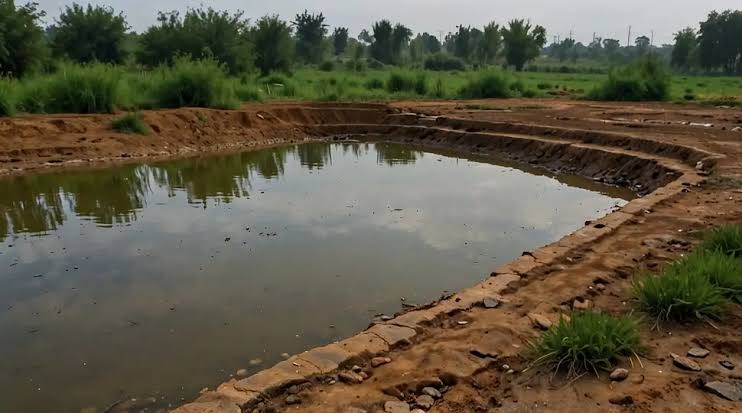
Recharge structures: Where storage is not the only goal, surplus filtered water can be sent into recharge wells, recharge pits, recharge trenches, recharge troughs, or modified injection wells, all designed to let water percolate into the ground and restore the local aquifer rather than run to waste.
Pump and controls (optional): Used when water needs to reach upper floors or pressurised taps. A water level indicator and flow meter with a data logger help track usage and detect problems early.
Backflow preventer: Stops rainwater from flowing backwards into a municipal or well water supply under negative pressure, an important safety feature for any hybrid system.
Treatment unit (optional): UV lights, chlorination, or fine membrane filters, needed only if the water will be used for drinking. Full potable treatment typically removes at least 99% of particles 3 microns or larger and includes daily water-quality testing.
Step-by-Step: How to Set Up a Rainwater Harvesting System
Installing an efficient rainwater harvesting system generally follows four practical steps:
Determine and clean your catchment area. Identify the terrace, courtyard, or roof section that will feed the system, and clean it thoroughly to prevent contamination at the very first stage.
Plan the layout. Decide where tanks and pipelines will sit to make the best use of your available collection surfaces. Common layouts include a single large tank or a cluster of smaller linked tanks.
Set up storage. Every drainpipe and collection point should include a mesh filter and first-flush diverter, a filtration stage before the tank, an air gap to prevent backflow, and an overflow route, ideally connected to a recharge system rather than a storm drain.
Install the pipes and tanks. Lay pipes with a single, consistent fall to avoid sediment traps that are hard to clean. Secure the tanks on a stable stand, connect them so they function as a single storage volume, install isolation valves for maintenance, and finish with a tank gauge so water levels can be monitored at a glance.
How Much Water Can You Actually Collect?
You can estimate the water your roof can capture with a simple formula, essentially the same one used by both the U.S. Department of Energy’s Federal Energy Management Program and independent engineering manuals:
Water collected (litres) = Roof area (m²) × Rainfall (mm) × Runoff coefficient
For example, a 300 m² roof catching 25 mm of rain, with a runoff coefficient of 0.9 for a smooth metal or tiled roof, would collect roughly 6,750 litres in a single rain event, before losses from the first-flush diverter and minor leaks. The U.S. Department of Energy recommends applying a collection factor of 75–90% to account for real-world system losses.
The runoff coefficient changes with roof material:
Roof Type
Runoff Coefficient
Metal (GI) sheet
0.8–0.9
Glazed tiles
0.6–0.9
Concrete/RCC roof
0.7–0.8
Asbestos (existing roofs only)
0.8–0.9
Thatched roof
0.2
There are three broad approaches used to size a storage tank:
Common-side approach: Uses mean annual rainfall to estimate how much water a roof can realistically supply, then sizes the tank to meet roughly a quarter’s worth of demand.
Demand-side approach: Bases tank size on daily consumption per person, household size, and the longest expected dry spell, useful where rainfall is plentiful and reliable.
Supply-side approach: Compares monthly rainfall potential against monthly demand across a full year, useful in low-rainfall or uneven-rainfall regions where storage must bridge real seasonal gaps.
Whichever method is used, tank size should reflect realistic demand, not the theoretical maximum a roof could ever collect.
Benefits of a Rainwater Harvesting System
Research reviews covering the environmental, economic, and social aspects of rainwater harvesting systems consistently find the same core advantages, echoed across engineering, government, and NGO sources alike.
Lowers water bills. Once the upfront cost of the system is paid off, harvested rainwater is essentially free. UK homes with rainwater systems commonly cut mains water use by 20–30%, and sometimes by 50% or more, a figure matched by European tank manufacturers who report up to 50% savings on drinking-water demand for homes using underground rainwater harvesting.
Supports groundwater levels. Directing surplus rainwater into recharge wells helps restore water tables that have dropped due to overuse of borewells, and reduces the risk of saltwater or brackish intrusion in coastal and low-lying aquifers.
Reduces flooding and stormwater runoff. Capturing rain before it reaches the street lowers the load on stormwater drains and reduces non-point source pollution reaching rivers and lakes, especially valuable during monsoon downpours.
Improves water security during drought. Stored rainwater acts as a backup source when mains supply is cut, a well runs low, or a drought hits. It can also serve as a main supply for new homes with no access to municipal water.
Requires low maintenance. Once installed, a system needs only routine gutter cleaning and periodic tank inspection; tanks and pipework can last 15 to 30 years with basic upkeep.
Reduces energy use and emissions. Because rainwater is used close to where it falls, it cuts the energy needed to pump and transport water across a city, and lowers the broader carbon footprint of urban water supply.
Adds long-term property value. Buildings with a working rainwater harvesting system often score points under green-building rating programs, and some municipalities offer rebates, tax exemptions, or property-tax reductions for installing one.
Supports climate adaptation. International climate bodies now class rainwater harvesting as a formal adaptation measure: it simultaneously builds drought resilience and reduces flood risk, which is why it appears in UN-backed community projects from Indonesia to Jamaica.
Cuts soil erosion. In open plots and agricultural land, capturing runoff reduces the speed and volume of water that would otherwise wash away topsoil.
Cost of a Rainwater Harvesting System and Return on Investment
Cost depends on tank size, excavation depth, pipe length, filtration quality, and whether the project is new construction or a retrofit. Broadly, price rises with:
Tank material (plastic tanks generally cost less than reinforced concrete)
Underground versus above-ground placement
Filtration and disinfection equipment, especially if the water will be used for drinking
Pump requirements
Site conditions, such as soil type and depth to the water table
Independent studies looking at hospital, residential, and office installations found payback periods of roughly 1 year for a hospital-scale system, up to 8 years for an office block, and around 21 years for a smaller residential system, showing that larger, higher-demand buildings generally see a faster return on a rainwater harvesting system than single homes.
Some cities also offer direct incentives: rebates covering up to half the system cost, sales-tax exemptions on harvesting equipment, and property-tax reductions tied to construction costs, all of which shorten the payback period further.
Retrofitting an existing building costs more than planning the system during original construction, since pipe runs and tank pits must work around finished structures.
Architects and engineers recommend including rainwater harvesting in the design stage, alongside plumbing and drainage drawings, rather than adding it as an afterthought.
Water Quality and Safety
Rainwater itself is naturally low in salinity and, scientifically as well as traditionally, considered one of the cleanest available water sources. However, once it touches a roof, it can pick up dust, bird droppings, moss, airborne pollutants, and even trace pesticides during the first rain after a dry spell. This is why filtration matters at every stage of a rainwater harvesting system.
For non-potable use, such as flushing, gardening, and washing, a first-flush diverter plus a basic sand, charcoal, or mesh filter is usually enough. For drinking water, additional treatment is required: fine filtration down to a few microns, plus disinfection through UV light, chlorination, or ozone, often used in combination.
Health authorities recommend boiling harvested rainwater as an added safety step where treatment systems are basic. Regular water testing is essential if a system is intended to supply drinking water, since contamination can occur even in a well-designed setup, and cisterns should also be checked periodically to prevent mosquito breeding.
Recent engineering research has gone a step further, developing integrated rainwater harvesting units that combine collection with on-site disinfection and mineral fortification to produce drinking water directly at the household level, with reported economic payback periods of around eight years for such compact potable units.
Maintenance of a Rainwater Harvesting System
A rainwater harvesting system needs simple, regular upkeep to keep working well:
Weekly: Clear debris from gutters and the roof surface, especially after storms, and check inlet filters for blockages.
Monthly: Check the first-flush diverter, overflow pipe, water level indicator, and any pumps or controls for proper function.
Annually: Inspect the storage tank for cracks or sediment buildup, and have backflow preventers tested by a qualified professional if the system connects to mains water.
As needed: Replace filter cartridges and UV lamps per the manufacturer’s schedule, particularly for systems used for drinking water, since a UV lamp typically loses effectiveness after about a year.
Storage tanks and pipework typically carry warranties of 15 to 30 years, while pumps last 2 to 10 years depending on use.
Rainwater Harvesting in Pakistan
Pakistan faces serious water stress, and a rainwater harvesting system is increasingly part of the national response, both in cities and in dry rural regions.
In arid zones like the Cholistan Desert, groundwater is often unusable due to salinity, so rainfall is the main source of drinking water for people and livestock. The Pakistan Council of Research in Water Resources (PCRWR) has developed a rainwater harvesting network of 110 specially designed reservoirs spread across 26,000 sq. km of Cholistan, storing around 440 million gallons of water.
Twenty deep tubewells add roughly 1,405 million gallons of annual discharge where groundwater is usable. Together, these measures have significantly cut seasonal migration among nomadic communities searching for water and are estimated to save around Rs. 6 billion a year.
In urban Pakistan, the picture is different but just as urgent. Falling groundwater levels in cities like Lahore, Islamabad, and Rawalpindi have pushed local authorities to act. The Capital Development Authority (CDA) has made rooftop rainwater harvesting mandatory for new buildings in Islamabad under updated building bylaws, aiming to raise groundwater levels and reduce water wastage.
Academic and engineering institutions are also pushing the technology forward locally. A recent civil engineering project at COMSATS University Islamabad’s Wah Campus designed a full rainwater harvesting system using Building Information Modeling (BIM), GIS, and integrated AR/VR technology, drawing on precipitation data from NASA and the Pakistan Meteorological Department, and applying the SCS Curve Number and Rational Method to estimate runoff.
The project paired a designed recharge well and anthracite filtration system with pre- and post-filtration water quality testing, illustrating how modern design tools are now being applied to a very old technology in a Pakistani context.
For homeowners and developers in Pakistan, practical design guidance includes:
Combine a storage tank (for reuse in gardening, washing, and flushing) with a recharge well (to support groundwater levels).
Always install a first-flush diverter and filter chamber before the water reaches a recharge well, so silt and pollutants do not enter the aquifer.
Keep gutters, downpipes, and tanks accessible for regular cleaning and inspection.
Plan the system with the architecture and plumbing drawings, not after construction has already started.
Size storage and recharge separately for different property types. A 5-marla house, a 1-kanal villa, a farmhouse, and an apartment building all need different catchment and storage strategies.
Harvested rainwater in Pakistani homes is generally safe for gardening, car washing, floor cleaning, and toilet flushing. It should not be used for drinking unless it undergoes proper filtration, disinfection, and water quality testing, in accordance with both PCRWR guidance and international drinking-water standards.
Frequently Asked Questions
Is a rainwater harvesting system worth it for a single home?
Yes. Even a basic setup with a storage tank and filter can meaningfully cut water bills and provide backup supply during shortages, especially in areas with unreliable mains water. Studies show payback periods for residential systems can run longer than for commercial buildings, but the system still pays for itself over its 15–30-year lifespan.
Can I drink harvested rainwater directly?
Not without proper treatment. Rainwater needs filtration and disinfection to meet drinking-water standards, ideally with regular testing. Most households use it for non-potable purposes like gardening, washing, and flushing.
Is rainwater harvesting mandatory in Pakistan?
It is mandatory for new buildings in Islamabad under CDA bylaws. Other cities and housing societies are increasingly encouraging or requiring it as groundwater levels continue to fall, echoing similar mandatory rules already applied in several Indian cities.
What is the difference between a storage tank and a recharge well?
A storage tank holds water for direct reuse. A recharge well, recharge pit, or recharge trench sends filtered surplus water underground to restore the water table. Most well-designed systems use both together.
How long does a rainwater harvesting system last?
With regular maintenance, storage tanks and pipework can last 15 to 30 years. Pumps and filters need more frequent servicing or replacement, typically every 2 to 10 years.
Does a rainwater harvesting system help with climate change?
Yes. International climate bodies, including the IPCC, list rainwater harvesting as a recognised adaptation measure, since it builds drought resilience while also reducing flood risk from heavy rainfall events.
Final Thoughts
A rainwater harvesting system turns a free, renewable resource into real savings and long-term water security. Whether it is a small rooftop setup for a single home, a BIM-designed university project, or a large recharge network across a desert region, the basic principle stays the same: catch the rain, filter it, and use every drop wisely. With water stress rising across Pakistan and beyond, installing a rainwater harvesting system is no longer just an environmental choice. It is a practical and increasingly necessary one.
BBC-featured Content Specialist with a sharp eye for search intent and a proven ability to turn content into a growth engine. I leverage cutting-edge digital marketing tools to craft strategies that fuel organic traffic, amplify brand growth, and own the local SEO landscape, particularly across the competitive real estate market. I help brands dominate search rankings and convert visibility into measurable business success.
LAHORE: CM Punjab Maryam Nawaz has placed all provincial line departments on high alert following the onset of the monsoon season, directing commissioners, deputy commissioners and field officers across the province to maintain round-the-clock preparedness and ensure rapid emergency response.
The Chief Minister emphasised that all concerned officers and staff must remain vigilant, stating there would be no tolerance for negligence or irresponsibility during the monsoon period.
Rescue 1122 and WASA have been directed to keep personnel and machinery on standby, with priority given to swift-water drainage from low-lying areas and identified choke points. Continuous monitoring of stormwater drains and nullahs was also ordered to prevent water stagnation in urban areas.
The Irrigation Department has been instructed to keep teams on high alert to monitor canal water flow, while authorities were directed to ensure all manholes across urban and rural areas remain properly covered.
Additional safety arrangements were ordered at construction sites, alongside special monitoring of dilapidated and structurally vulnerable buildings. The Safe City Authority and Chief Traffic Officer teams have been directed to ensure smooth traffic flow on highways and main roads during periods of rainfall.
Field teams have been instructed to remain fully prepared to support public guidance, traffic management, and the protection of lives and property throughout the monsoon season.
BBC-featured Content Specialist with a sharp eye for search intent and a proven ability to turn content into a growth engine. I leverage cutting-edge digital marketing tools to craft strategies that fuel organic traffic, amplify brand growth, and own the local SEO landscape, particularly across the competitive real estate market. I help brands dominate search rankings and convert visibility into measurable business success.
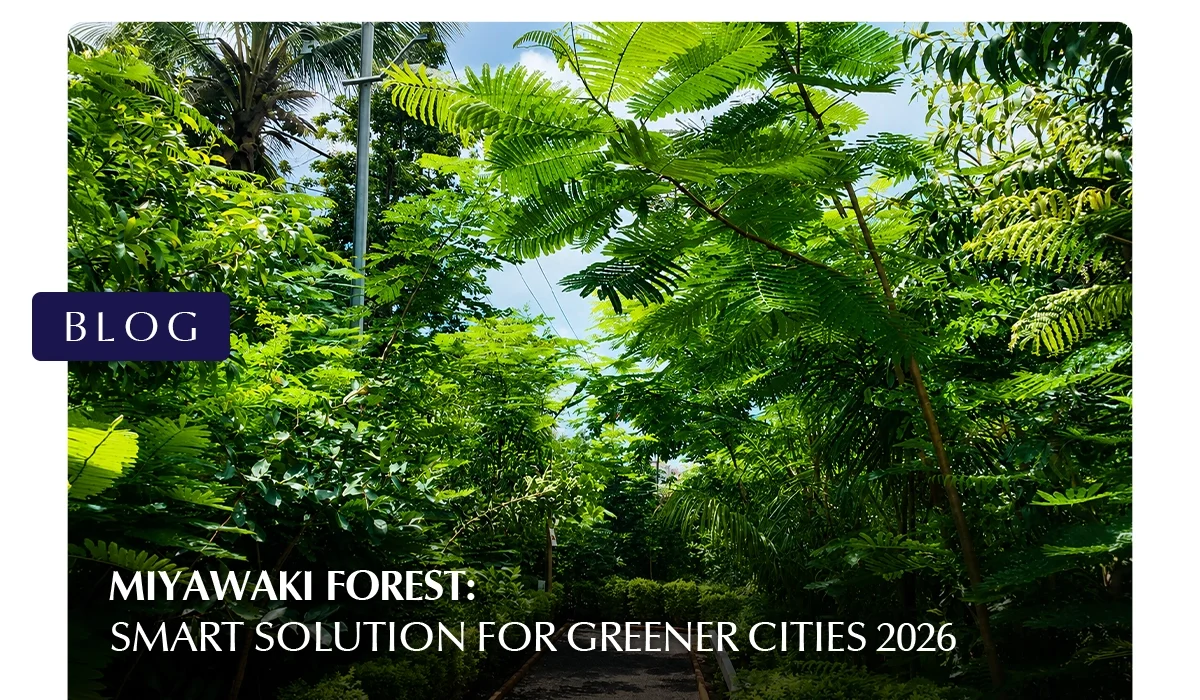
Cities are getting hotter. Green spaces are shrinking. Biodiversity is disappearing from urban landscapes at an alarming rate. The world urgently needs a smart, scalable, and proven solution. The Miyawaki Forest is exactly that.
This rapid urban reforestation method is transforming roadsides, school grounds, and barren plots into thriving ecosystems. It is gaining momentum across Asia, Europe, the Americas, and the Middle East.
Quick Facts: Miyawaki Forest at a Glance
Factor
Detail
Invented By
Professor Akira Miyawaki, Japan (1970s)
Minimum Land Required
As small as 9 sq meters
Planting Density
3 saplings per square meter
Growth Speed
Up to 10x faster than conventional forests
Self-Sustaining After
2–3 years
Global Trees Planted
40+ million native trees worldwide
Also Known As
Pocket Forest, Tiny Forest, Urban Mini-Forest
What Is a Miyawaki Forest?
A Miyawaki Forest is a dense, multi-layered plantation of native trees and shrubs. It is grown on very small plots of land. The method recreates the structure of a natural, mature forest but in a fraction of the time. It is also known as a Tiny Forest or Pocket Forest. These names all refer to the same core concept: planting diverse native species in close proximity to mimic how nature builds forests.
The minimum land required is 9 square meters. This makes it perfect for cities where open land is scarce.
Who Was Akira Miyawaki?
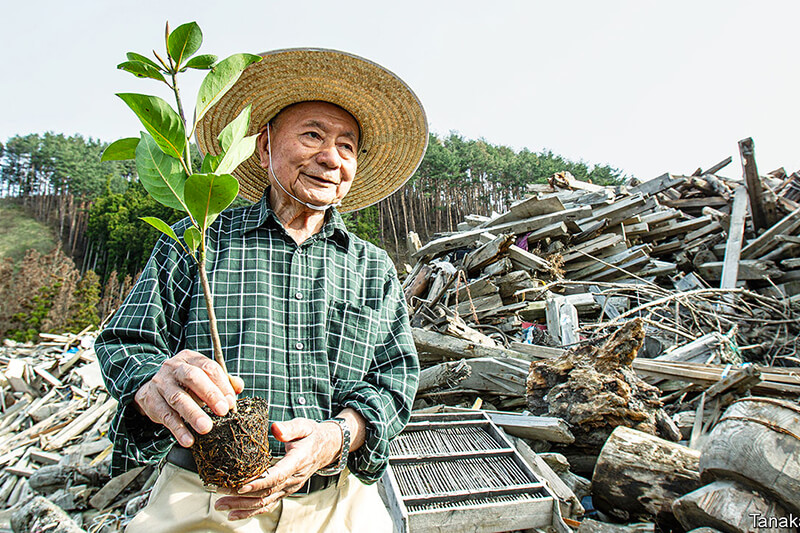
The method is named after Professor Akira Miyawaki. He was a Japanese botanist and plant ecology expert. He spent over 40 years studying how native forests naturally regenerate.
His research led him to a powerful conclusion. If you plant the right native species, in the right density, the forest takes care of itself. He educated people on planting across more than 1,700 sites worldwide. Over 1,400 of those were in Japan alone. His work has resulted in the protection of more than 3,000 primary forests and the planting of over 40 million native trees globally. His legacy is now growing faster than ever.
The Core Principle: Potential Natural Vegetation
Every region on Earth has a natural plant community that would thrive there without human interference. Scientists call this the Potential Natural Vegetation (PNV).
The Miyawaki Forest method is built on this concept. Only species that belong naturally to a given area are selected. These indigenous plants have spent thousands of years adapting to the local soil, rainfall, and climate. They do not need fertilisers. They do not need pesticides. They simply grow.
This is what makes the approach fundamentally different from conventional tree planting.
How Does the Miyawaki Method Work?
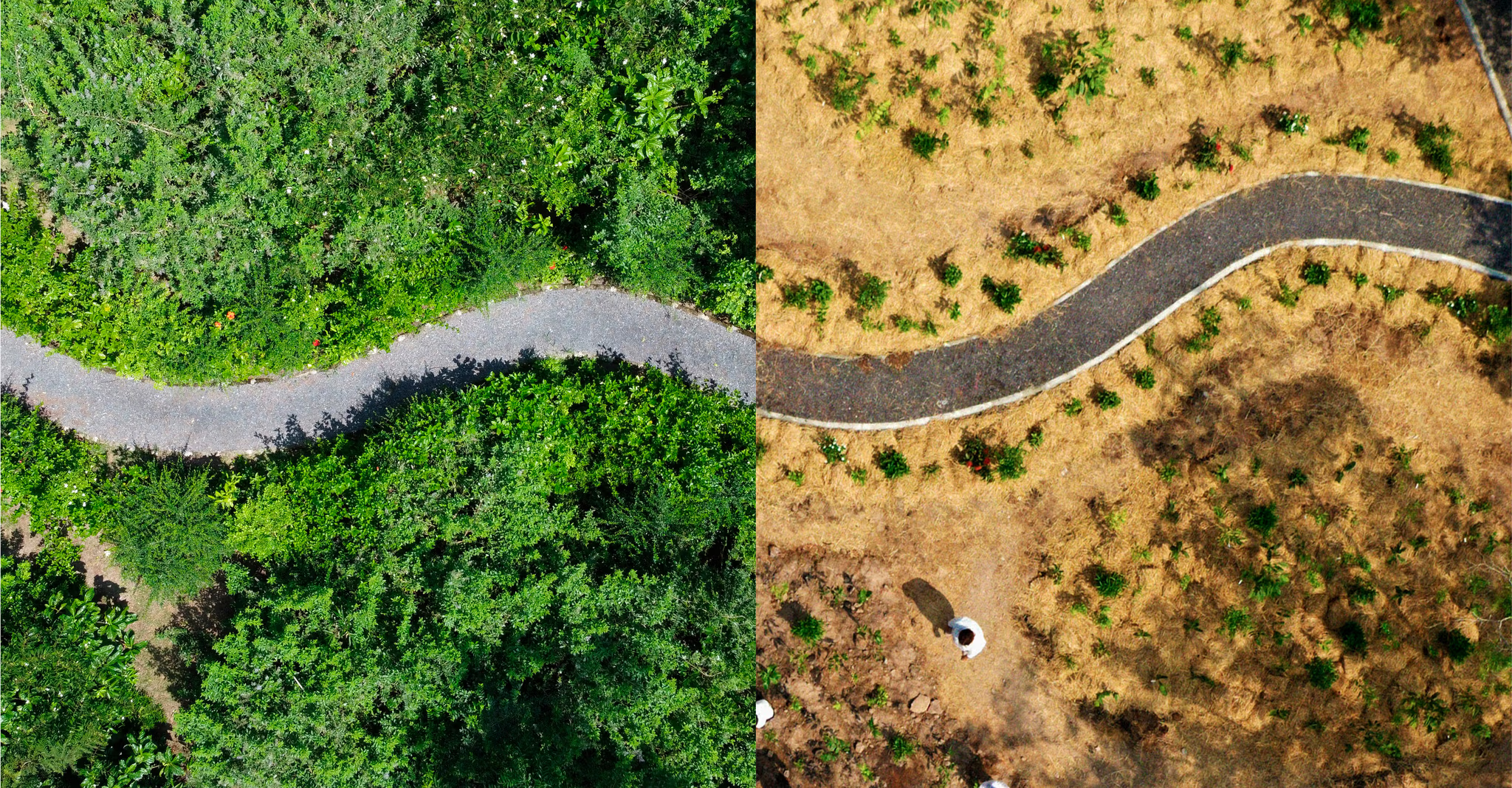
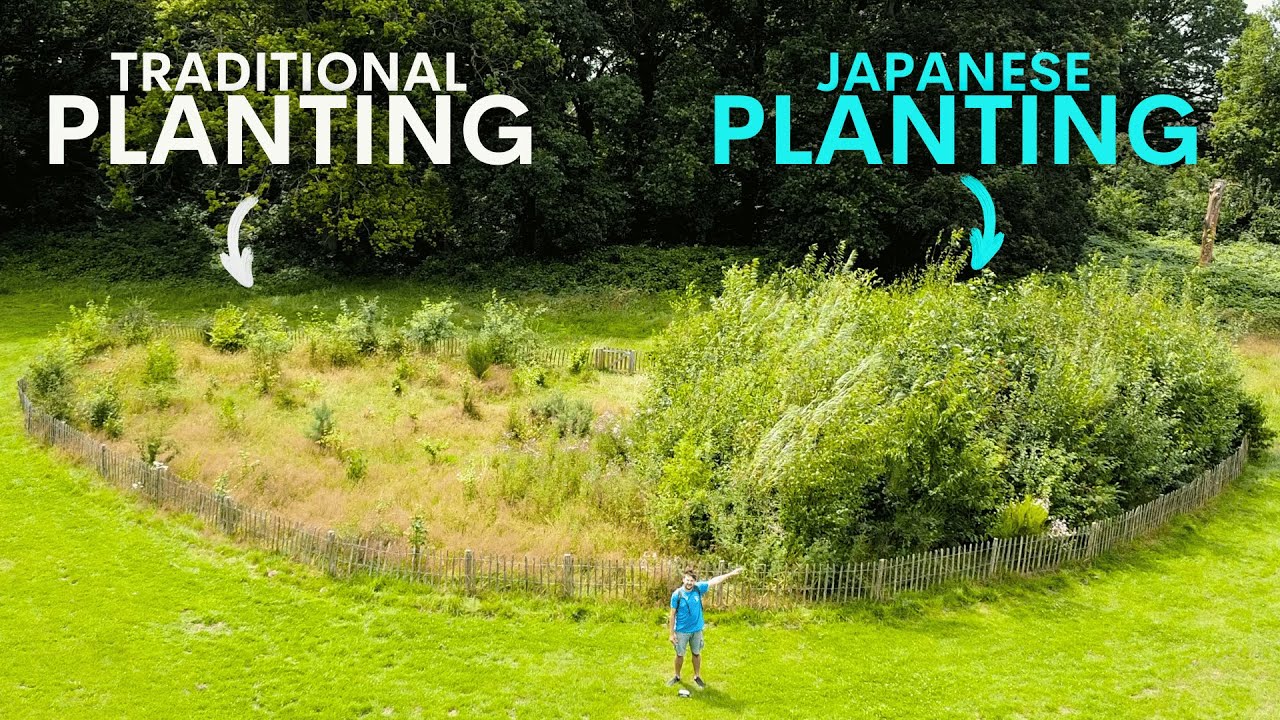
The science behind a Miyawaki Forest is elegant. When native trees are planted very close together, they compete for sunlight. This competition forces them to grow rapidly upward rather than spread sideways.
The result is fast, dense, vertical growth. The canopy closes quickly. It shades out weeds. Leaf litter builds up. Soil fertility improves. Insects, birds, and beneficial fungi arrive naturally. The entire ecosystem assembles itself.
After just two to three years, the forest becomes completely self-sustaining. No watering. No weeding. No maintenance required.
Studies and practitioners report that a Miyawaki Forest can grow up to 10 times faster than a conventional plantation. It can also support up to 30 times more biodiversity. It is worth noting that some ecologists have raised questions about these figures. The faster growth may reflect quicker ecological succession rather than raw tree height. This distinction matters for setting realistic expectations.
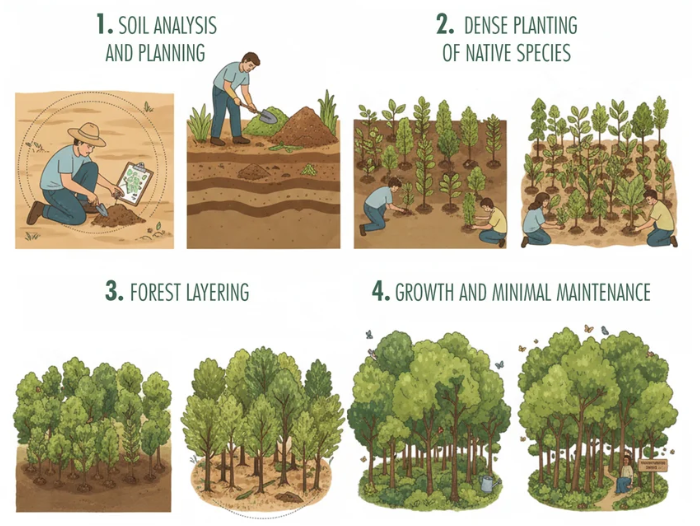
The 4-Step Planting Process
Planting a Miyawaki Forest follows a clear, structured process.
Step 1: Survey and Identify Native Species
The first step is to study the site carefully. Botanists identify which species would naturally grow within about 20 kilometres of the location. A recommended diversity range is 50 to 100 native species. Local and indigenous knowledge is invaluable at this stage.
Step 2: Prepare the Soil
Urban soils are often compacted and nutrient-poor. The soil is improved by digging pits and incorporating organic matter. Compost, manure, and dead vegetation are commonly used. A slight mound is sometimes built to mimic the natural forest floor. Cardboard and a thick layer of wood chips or compost are placed on top to suppress weeds and retain moisture.
Step 3: Dense Planting
Saplings up to 80 centimetres tall are planted at approximately 3 per square metre. No two saplings of the same species are placed next to each other. All species are planted at the same time. This random, diverse arrangement mirrors how a natural forest seed bank works.
Step 4: Early Maintenance
The forest needs watering and weeding for the first two to three years. This is the most demanding phase. After that, the forest becomes independent. The investment of time and effort in the early years pays off for decades.
Key Benefits of a Miyawaki Forest in Urban Areas
A Miyawaki Forest delivers rapid environmental, social, and economic benefits, making it one of the most effective nature-based solutions for modern cities.
Environmental Impact
A Miyawaki Forest delivers measurable environmental benefits quickly.
It sequesters carbon faster than slow-growing conventional forests. It creates a cooling microclimate that directly reduces the urban heat island effect. Dense canopy cover lowers local temperatures. Root systems improve water infiltration and reduce surface run-off. Soil erosion is significantly reduced on previously bare urban land.
Biodiversity Recovery
Urban areas are biological deserts for most wildlife. A Miyawaki Forest changes rapidly. The dense, layered structure provides habitat for birds, insects, pollinators, and soil organisms. Biodiversity appears within months of planting.
Community and Social Benefits
The benefits extend beyond ecology. UNESCO has actively endorsed the use of Miyawaki Forest planting within urban schools. Children learn directly about native ecosystems. Communities come together during planting events. Access to green space improves mental health and physical well-being.
Barren roadsides, abandoned lots, school yards, and even landfills have been transformed through this approach.
Long-Term Cost Efficiency
The upfront cost is higher than that of conventional tree planting. However, the long-term cost is very low. Once established, the forest needs almost no maintenance. It functions entirely on its own. For municipalities managing tight budgets, this is a significant advantage.
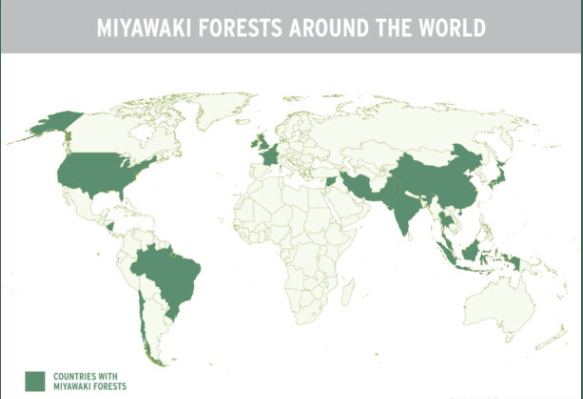
Miyawaki Forests Around the World
The global adoption of the Miyawaki Forest method tells a compelling story.
Japan remains the origin and heartland of the method. Thousands of sites have been established across the country since the 1970s.
India has seen rapid scaling. Shubhendu Sharma founded Afforestt and applied the Miyawaki method to urban plots across Indian cities. The model attracted global attention and inspired organizations worldwide.
Pakistan has embraced the method at a governmental level. The Parks and Horticulture Authority of Lahore announced plans to develop what was described as Asia’s largest Miyawaki urban forest. The project planned to plant 112,500 indigenous trees across 100 Kanals in China Park near Saggian Bridge. An additional 15 locations across Lahore were included in the plan. The Nature Conservation Society of Pakistan has also established Miyawaki Forest plots in Sialkot, within Shahab U Din Park.
The United States has seen projects in Cambridge, Massachusetts, where a forest was planted over a landfill in Danehy Park, and in Los Angeles, inside Griffith Park.
Brussels, Belgium, has planted a 770-square-meter pocket forest of 20 native species within the city.
The Yakama Nation in Washington State planted seven pocket forests of 47 native species on a rehabilitation facility, totalling over 23,000 square feet.
These examples span continents, climates, and cultures. The method adapts wherever the right expertise and commitment are applied.
Honest Assessment: Pros and Cons
No solution is without limitations. A balanced view of the Miyawaki Forest method is important for anyone considering it.
Advantages
Rapid establishment of a dense, functional forest on small urban land
High biodiversity from the earliest stages
Self-sustaining after just two to three years
Applicable on plots as small as 9 square meters
Builds community engagement and environmental awareness
Effective across diverse climates, including arid and semi-arid zones
Limitations and Criticisms
High upfront cost. Sourcing large numbers of native nursery saplings is expensive. Quality native stock is not always available.
Disputed growth claims. The widely cited “10x faster growth” figure has been questioned by forestry researchers. The evidence may reflect faster ecological succession rather than actual growth rates.
Not scalable for large areas. The method is intensive and impractical for reforesting vast tracts of land.
Water demands in early years. In dry or Mediterranean climates, the initial watering requirement can be costly and resource-intensive.
Expertise is essential. Without proper botanical knowledge, poorly chosen species can result in an ecologically weak or disorganized plant community.
Wildfire risk. In fire-prone regions, very dense planting can increase fire hazard. Modified, less dense planting is recommended in these areas.
CSR exploitation concerns. Some critics have raised concerns that the method has been promoted primarily to attract corporate social responsibility funding, without rigorous outcome monitoring.
Being aware of these limitations helps cities and organizations design better, more accountable projects.
Is a Miyawaki Forest Right for Your City?
Before starting a project, ask these practical questions.
Does the site receive adequate rainfall, or can water be supplied for the first three years? Is native nursery stock available locally? Is there a qualified botanist or ecologist available to guide species selection? Is the community willing to participate in early maintenance? Are there fire risk considerations that require adjusted planting density?
If the answers are largely yes, a Miyawaki Forest project is likely viable and worthwhile.
The Road Ahead: Miyawaki Forests in 2026
Urban heat, biodiversity collapse, and climate anxiety are defining challenges of this decade. City planners are under pressure to act. Nature-based solutions are moving from optional to essential.
The Miyawaki Forest fits perfectly into this shift. It works on small, affordable plots. It delivers results within years, not decades. It engages communities. It builds resilience.
In 2026, governments, schools, corporations, and neighbourhoods worldwide are increasingly choosing the Miyawaki method as part of their urban greening strategies. Pakistan’s large-scale government projects, UNESCO’s school programs, and grassroots NGO initiatives in dozens of countries all point in the same direction.
The question for cities is no longer whether to plant a Miyawaki Forest. The question is where to start.
Conclusion
The Miyawaki Forest is not a miracle solution. It is a well-researched, nature-based technique with a strong track record across diverse environments. It delivers rapid biodiversity gains, carbon sequestration, cooling effects, and community value to urban spaces that desperately need them.
Used thoughtfully, with proper expertise and honest expectations, it is one of the most powerful tools available to cities in 2026. Small forests can create large change. The time to plant is now.
Practitioners report growth up to 10 times faster than conventional forests. However, this figure refers to the rate of ecological development, not just tree height, and remains debated among scientists.
As little as 9 to 92 square meters is sufficient for a meaningful forest.
The standard density is approximately 3 saplings per square meter.
Yes, with adequate watering for the first 2 to 3 years. Projects have succeeded in Jordan, the Persian Gulf region, and parts of Pakistan.
Professor Akira Miyawaki, a Japanese botanist, developed and refined the method over four decades of research and field work.
Dedicated and detail-oriented SEO Content Writer, Real Estate Writer, and Research Analyst based in Islamabad, with proven expertise in developing accurate, valuable, and well-researched content. Skilled in analytical writing, market research, and reporting, with the ability to turn insights into clear, professional, and impactful content. Passionate about exploring new ideas, analyzing industry trends, and contributing to high-quality writing and research-driven projects.
A special report on the paper mulberry eradication campaign, the public backlash, competing claims of legality, and the long-term climate and economic cost of losing mature urban green cover.
ISLAMABAD: The drive along Shakarparian Road still feels familiar, until it doesn’t. One moment, the route is shaded by Islamabad’s old, settled tree canopy. Next, the green abruptly disappears, replaced by bare earth and freshly turned soil.
Along the roadside, labourers dig shallow pits. Nearby, pine saplings lie waiting for a plantation. A signboard makes its promise in bold letters: “Greener and Healthier Islamabad, Indigenous Tree Plantation.”
Yet, it is not the saplings that have captured the public’s attention; it is what is missing: decades-old, mature trees that once defined the capital’s identity.
In recent days, the cutting of trees in Islamabad has triggered widespread public anger, forcing explanations from the government, pushing environmental groups into the spotlight, and raising an uncomfortable debate about whether the city’s green cover is being sacrificed under the banner of public health and development.
LATEST UPDATE: “IHC Halts CDA from Cutting Trees in Islamabad”
On January 15, 2026, the Islamabad High Court directed CDA to immediately stop cutting of trees in Islamabad. The court issued this order after a petition alleging that the tree removal violated environmental laws was filed. The CDA is required to submit a detailed report, and notices were issued to the Pakistan Environmental Protection Agency and the Ministry of Climate Change. The hearing has been adjourned until February 2.
Why This Matters? | Cutting of Trees in Islamabad
Beyond the immediate controversy, the cutting of trees in Islamabad episode lays bare a deeper governance dilemma: how a modern capital balances public health, rapid development, and climate resilience. In urban terms, tree cover is not decoration; it is infrastructure.
It cools neighbourhoods, filters air, prevents soil erosion, buffers floods, and protects water resources. Its removal can have long-lasting economic and climate consequences that outlive any short-term administrative goals.
What Happened and Where? Cutting of Trees in Islamabad
Large-scale cutting of trees in Islamabad was reported at several locations in Islamabad, including:
H-8 (along a portion of the Islamabad Expressway, where a park is being upgraded)
Chak Shahzad (where decades-old trees were cut for the construction of a dual carriageway)
In Shakarparian, citizens claim at least four patches have been cleared, collectively spread over more than 15 acres near Lok Virsa, leaving large stretches resembling open, barren land.
The cutting of trees in Islamabad has remained a hot topic online, with residents sharing images and videos of deforested patches, questioning both the scale of the operation and the intent behind it.
The Official Position: Only Paper Mulberry Was Removed
The government’s defence rests on one central claim: that the cutting of trees in Islamabad is not arbitrary, but targeted and legally backed.
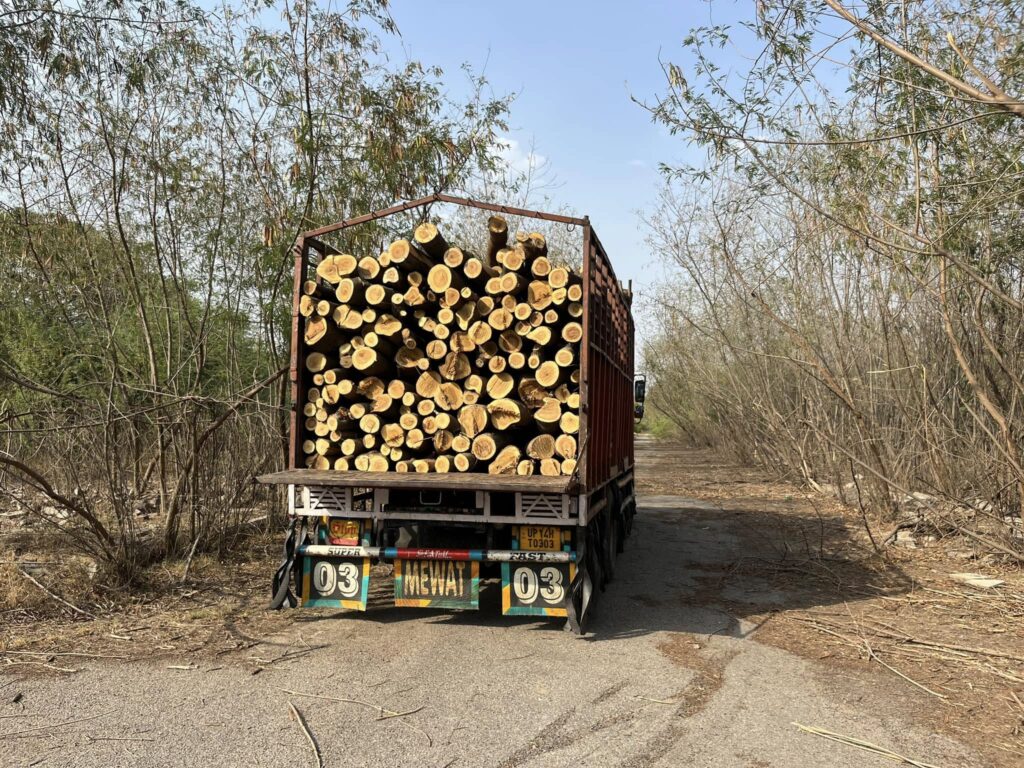
Minister for Climate Change and Environmental Coordination Dr Musadiq Malik, speaking on Friday after chairing a meeting on the issue, stated that around 29,000 paper mulberry trees had been removed in Islamabad in line with the Supreme Court’s orders issued in 2023.
The minister said the directive was implemented again in 2025 to rid the city of what he described as an invasive, non-indigenous, and life-threatening species.
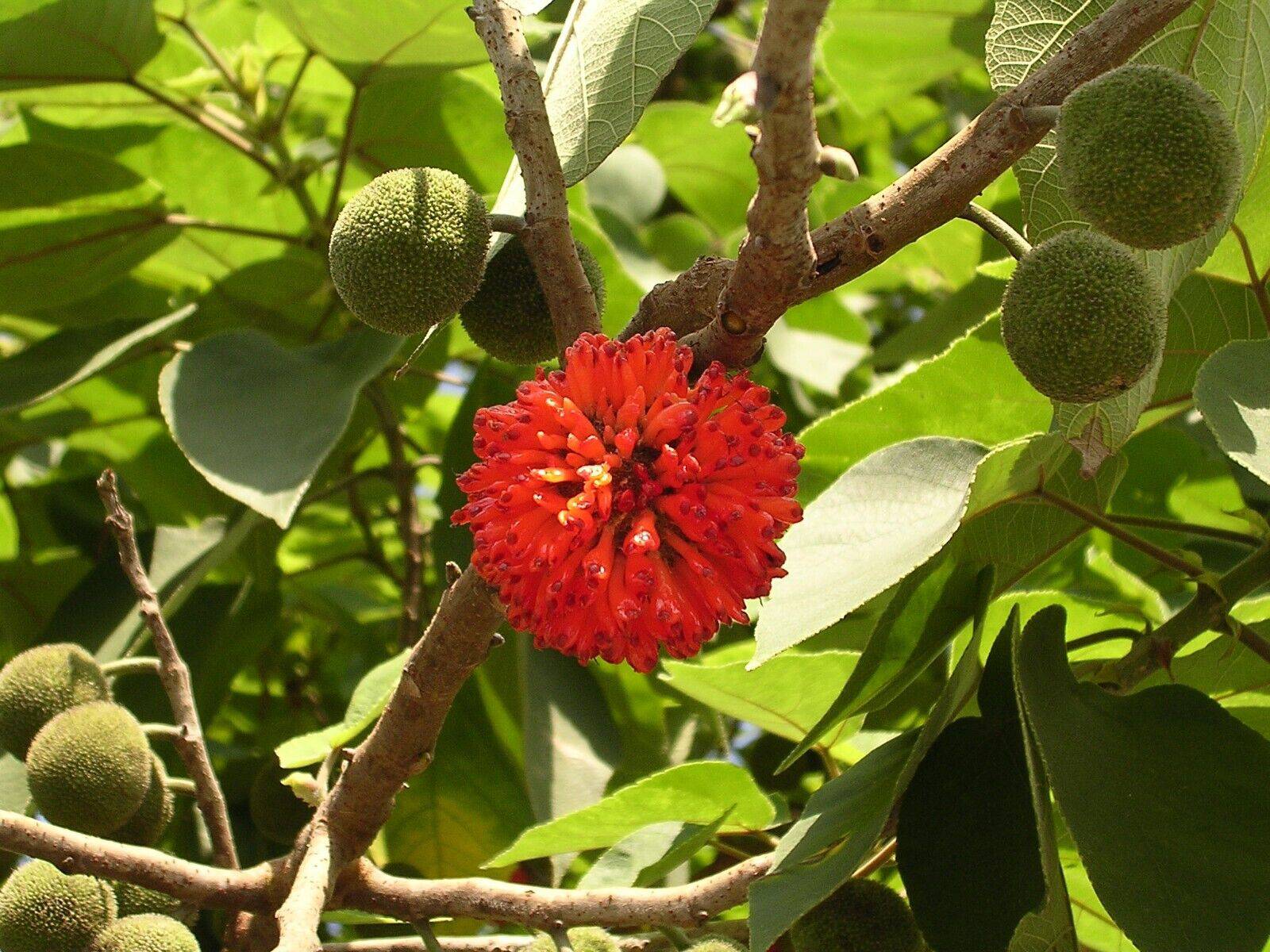
Paper mulberry, the minister claimed, is a major contributor to allergies and can cause fatal complications among chronic asthma patients. He added that the felling plan was finalised after confirming with the Ministry of Health that the species posed a major health concern.
“We are not planting non-indigenous species,” he said, adding that every tree chopped would be replaced at a ratio of one cut tree to three new saplings/trees.
The Capital Development Authority (CDA) also maintains that in Shakarparian, only paper mulberry trees were chopped down.
What the Numbers Say? | Cutting of Trees in Islamabad
According to CDA’s DG Environment Irfan Khan Niazi, the operation has proceeded under court directions with close supervision by CDA staff and documentation from cutting of trees in Islamabad to loading.
He stated:
approximately 12,000 paper mulberry trees were removed from F-9 Park
8,700 were cut in Shakarparian
Additional locations, including H-8, were also included
In total, the CDA reports that 29,115 paper mulberry trees have been removed to date.
The Public’s Concern: ‘This Was Not Only Paper Mulberry’
Despite official assurances, residents insist the reality on the ground looks far broader than a targeted health operation.
In Shakarparian, citizens stated that besides paper mulberry, other trees also appeared to have been cut down, and that large swathes of tree cover were cleared in a manner inconsistent with a selective removal drive.
For many, the question is not merely “why was paper mulberry removed?” but:
Why was the removal so abrupt?
Why did it involve such large patches of cleared land?
and whether decades-old green cover can truly be replaced by saplings in any meaningful timeframe?
Development Projects: The Road and Housing Link | Cutting of Trees in Islamabad
In Chak Shahzad, cutting of trees in Islamabad was carried out for the construction of a dual carriageway intended to connect to a CDA-DHA-owned housing scheme from Park Road, linking the controversy directly to Islamabad’s real-estate expansion and infrastructure development model.
Cutting of trees in Islamabad, H8, took place where a park is being upgraded alongside the Expressway.
This intersection, between ecological removal drives and physical development projects, has strengthened public suspicion that cutting of trees in Islamabad may not be purely a health-driven intervention.
The WWF Report and the ‘Bigger Reality’
Environmental groups argue that the issue is more complex than official explanations.
A WWF-Pakistan report criticised the recent removals and land clearing in Islamabad, stating that while the paper mulberry eradication drive is a major factor, extensive vegetation loss also stems from unchecked infrastructure development.
Field inspections conducted from December 2025 to January 2026 reportedly found large-scale clearing along:
H-8 Islamabad Expressway
Margalla Enclave Link Road
Shakarparian
The report raised concerns over:
lack of transparency
weak site-specific planning
monitoring gaps
incomplete restoration and exposed soil
Experts Warn: It’s Not Just Trees, It’s the City’s Climate System
Experts caution that even if paper mulberry removal is justified, the method matters.
Climate policy advocate Dr Zainab Naeem said the issue was not the removal itself but the alleged mismanagement, warning that the court-mandated phased approach, ecological assessment and prior afforestation steps appear to have been ignored. She stated native species such as shisham were reportedly also cut, as highlighted in WWF’s findings.
She described the move as climate misgovernance, warning that Islamabad is already developing an urban heat island effect due to concretisation and declining green buffers.
He stressed that even public-health-driven removal must follow proper mechanisms, because replacing trees with concrete accelerates heating, disrupts rainfall patterns, and accelerates degradation.
The Economic Cost Behind the Environmental Cost | Cutting of Trees in Islamabad
Beyond ecology, the cutting of trees in Islamabad canopy plays a direct economic role.
Urban analysts note that the loss of mature trees can lead to:
Higher electricity demand (cooling loads increase with higher temperatures)
Higher public health spending due to heat stress, dust, and air quality decline
increased stormwater runoff and greater risk of flooding, raising infrastructure repair costs
weaker livability, reducing quality-of-life indicators that sustain long-term urban value
In effect, while development projects may generate short-term economic activity through construction, poorly managed loss of ecological buffers can create long-term liabilities that quietly burden households and government alike.
Accountability Questions: What Was Approved, and Who Monitored?
The controversy has also revived core governance questions, especially in the context of environmental permissions:
Were site-specific ecological plans made public?
Were environmental assessments and approvals properly disclosed?
What independent monitoring existed beyond agency statements?
How was “only paper mulberry” verified on the ground?
Were permissions and licensing processes fully compliant?
Dr Malik directed that a transparent mechanism be developed to ensure compliance with laws, rules and procedures related to such campaigns, an indication that the current process may lack public confidence.
Notably, while official handouts discussed cutting in multiple sectors, they reportedly did not mention cutting of trees in Islamabad along Park Road in Chak Shahzad, raising further questions about disclosure.
CDA’s Plantation Response: A January Drive Amid Frost
Amid criticism, the CDA launched a plantation campaign in January, a month usually associated with frost and not traditionally viewed as ideal for mass plantation.
Historically, CDA plantation drives typically began around mid-February. This time, the plantation began over a month early in the Shakarparian area.
CDA officials defended the timing by stating that only suitable species, including Chir Pine, were being planted and that the drive aims to plant 30,000 trees, with greater momentum expected next month.
However, critics questioned whether the plantation effort was ecological restoration or merely damage control.
PM Takes Notice
After sustained pressure from citizens and civil society, Prime Minister Shehbaz Sharif took notice of the alleged cutting of trees in Islamabad and sought a report from the CDA.
The government’s response suggests recognition that public anger has moved beyond social media outrage into a politically sensitive urban governance issue.
The Bigger Debate: Health, Development and a City’s Identity
Islamabad’s paper mulberry dilemma is not a simple question of trees versus health. It is a debate about trust, transparency and what kind of capital Pakistan wants to build: one shaped by ecological planning, or one repeatedly “fixed” after irreversible damage.
So the question that arises here is: was this drastic approach truly necessary, or could public health have been protected without stripping the capital bare?
BBC-featured Content Specialist with a sharp eye for search intent and a proven ability to turn content into a growth engine. I leverage cutting-edge digital marketing tools to craft strategies that fuel organic traffic, amplify brand growth, and own the local SEO landscape, particularly across the competitive real estate market. I help brands dominate search rankings and convert visibility into measurable business success.