Automate Income Tax Collection Using AI
CategoriesNews Tax

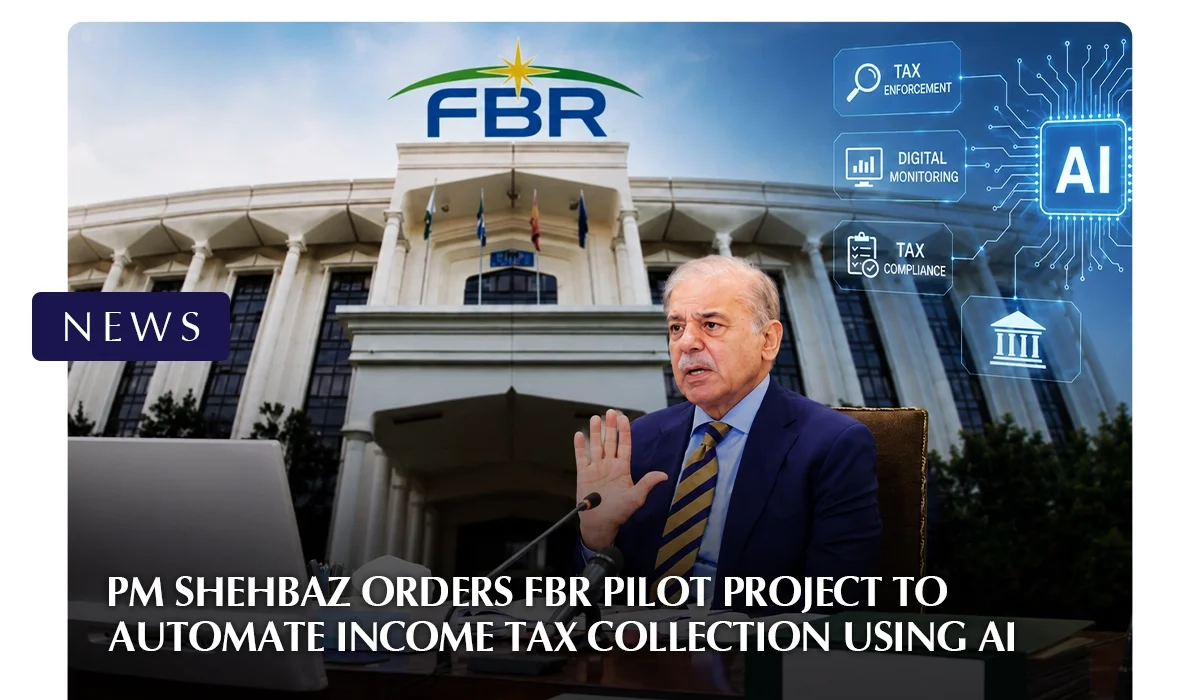
PM Shehbaz Orders FBR Pilot Project to Automate Income Tax Collection Using AI

ISLAMABAD: Prime Minister Shehbaz Sharif on Thursday directed the launch of a pilot project for a proposed automated income tax collection system in the federal capital, Islamabad, marking a significant step in the government’s ongoing efforts to modernise Pakistan’s revenue infrastructure.

The directive was issued during a high-level review meeting chaired by the Prime Minister at the Prime Minister’s Office, attended by Finance Minister Muhammad Aurangzeb, State Minister for Finance Bilal Azhar Kayani, and other senior officials. The meeting conducted a detailed assessment of the Federal Board of Revenue’s (FBR) ongoing reform measures to make inland revenue collection more effective, transparent, and faceless.

Addressing the gathering, Prime Minister Shehbaz described the initiative as a milestone in the government’s broader reform agenda. He stressed that minimising human intervention and curtailing discretionary powers within the tax collection mechanism were urgent priorities, as they would directly reduce corruption and improve institutional accountability.

The proposed system is designed to leverage modern technology and artificial intelligence to identify under-declared income and assets by cross-referencing data across property, vehicle, and banking records. To further strengthen the framework, the meeting proposed establishing three dedicated wings: a National Faceless Audit Wing, a National Assessment Wing, and a Field Operations Wing, each intended to streamline and safeguard the integrity of the tax process.

The Prime Minister affirmed that the successful implementation of this system would not only boost national revenue but also foster greater transparency, fairness, and public trust in the taxation system. He reiterated the government’s commitment to continuing FBR reforms to comprehensively document the economy and meaningfully expand the tax net.

On a separate note, the Prime Minister commended provincial governments for their decisive action against illegal cigarettes, with additional tax collection from the sector projected to reach Rs40 billion this fiscal year.

For moreย news on real estateย and special reports, visitย Chakor Ventures.

Sources:

CategoriesSpecial Report Construction Economy News Property Taxes Real Estate Real Estate Investment Tax

Pakistan Real Estate Sector Expects Major Tax Relief in Budget FY 2026-27

ISLAMABAD โ€” Pakistanโ€™s real estate and construction sectors are expecting major tax relief in the upcoming federal budget for fiscal year 2026-27, as the government considers proposals to reduce property-related taxes and revive investment activity.

The budget, expected to be presented on June 5, could bring significant changes for property buyers, sellers, investors, and overseas Pakistanis, according to industry representatives and media reports.

Government Signals Possible Relief in Real Estate Taxes

The real estate sector has been under pressure for several years due to higher taxes, rising costs, and a slowdown in property transactions. Industry stakeholders say the sector is directly linked with more than 80 other industries, including cement, steel, paint, glass, electrical fittings, tiles, transport, and construction services.

They argue that when real estate activity slows down, many connected businesses also suffer. For this reason, the sector is urging the government to reduce taxes in the upcoming budget to encourage buying, selling, and construction activity.

Prime Minister Shehbaz Sharif has also reportedly hinted at relief measures for the construction and real estate sectors during meetings with business representatives. These signals have increased expectations that the government may announce major policy changes in the new budget.

Key Tax Demands from the Sector

Real estate stakeholders are demanding reductions in withholding tax, capital gains tax, and rental income tax. They say the current tax structure has discouraged investment and reduced the number of property transactions.

Abolition of Section 7E

One of the sectorโ€™s main demands is the abolition of Section 7E of the Income Tax Ordinance. Section 7E imposes tax on deemed income from immovable property. In simple terms, it allows tax to be charged on an assumed income from property, even if the property owner has not actually earned rent from it.

Industry representatives say this discourages documented investors and creates an unfair burden on property owners. They have also called for property-buying and selling taxes to be reduced to 1%.

Business leader Kashif Chaudhry has said that Pakistanโ€™s economy cannot fully recover without restoring activity in the real estate market. He argued that reducing taxes would increase transactions and ultimately help the government collect more revenue.

FBR Proposals Under Consideration

According to reports, the Federal Board of Revenue has prepared proposals to provide relief to the real estate sector. These proposals include reducing taxes on property purchases and sales, while also making investment easier for overseas Pakistanis and local investors.

Under one reported proposal, withholding tax on property purchases for tax filers could be reduced from 1.5 percent to 0.25 percent. Tax on property sales may also be reduced from 4.5 percent to 1.5 percent.

The government has also reportedly briefed the International Monetary Fund on these proposed tax reductions. This is important because Pakistanโ€™s budget decisions are closely linked with IMF targets on revenue collection and fiscal discipline.

FPCCI Calls for Wider Reform

The Federation of Pakistan Chambers of Commerce and Industry has also supported tax relief for the real estate and construction sectors. FPCCI President Atif Ikram Sheikh has said that taxes imposed under Sections 236C and 236K are expected to be abolished.

He has also called for the removal of Section 7E, describing it as a long-standing demand of the business community.

The FPCCI has further proposed the creation of a Real Estate Regulatory Authority, known as RERA, in Pakistan. The chamber says such an authority would help regulate the sector, improve transparency, and protect investors.

In its shadow budget proposals, FPCCI has suggested reducing real estate taxes to a uniform 0.5 percent. The chamber believes this would encourage investment and help revive economic activity.

Experts Urge Balanced Policy

Tax experts and economists say the government should reduce taxes that discourage transactions, but they also warn that reforms must be carefully designed.

Experts Huzaima Bukhari, Dr. Ikramul Haq, and Abdul Rauf Shakoori have argued that Pakistanโ€™s tax system needs broader reform. They say the country should reduce pressure on productive economic activity while improving taxation of idle and speculative assets.

Their view is that transaction taxes should be rationalized, but the government should also modernize land records, improve property valuation systems, and tax speculative urban land more effectively.

Other analysts have warned that Pakistanโ€™s room for tax relief may be limited because of IMF conditions. If the government reduces taxes in one area, it may need to raise revenue from another area to meet fiscal targets.

Overseas Pakistanis Seen as Key Investors

The proposed relief is also being viewed as important for overseas Pakistanis. Industry representatives say lower taxes and simpler procedures could encourage Pakistanis living abroad to invest more in property and construction projects.

They believe this could bring more foreign exchange into the country through remittances and investment. For Pakistan, where remittances play an important role in supporting the economy, this could be a major benefit.

FPCCI Senior Vice President Saqib Fayyaz Magoon has also said that real estate can help attract more foreign exchange if investors are given confidence and clear rules.

Revenue Challenge for the Government

The government faces a difficult policy choice. On one hand, lower taxes may increase property transactions and revive economic activity. On the other hand, the government must also meet revenue targets and satisfy IMF conditions.

FBR data shows that withholding tax collection increased during the current fiscal year. However, higher taxes have also contributed to a decline in capital gains tax collection compared to the previous year. This shows that while higher rates may increase some tax collections, they can also reduce overall market activity.

Real estate stakeholders argue that lower rates could bring more people into the documented economy and increase tax collection through higher transaction volume.

Budget Could Mark Turning Point

The upcoming budget is being closely watched by builders, developers, property buyers, sellers, and overseas investors. If the government accepts key proposals, the real estate sector could receive one of its biggest relief packages in recent years.

However, experts say tax cuts alone will not be enough. They believe the government must also improve regulation, digitize land records, update property valuation systems, and discourage speculative investment in idle land.

For now, the sector is waiting for the June 5 budget announcement. The final decision will show whether the government is ready to make a major policy shift for real estate and construction, or whether fiscal pressure will limit the scale of relief.

References

Bukhari, H., Haq, I., & Shakoori, A. R. (2026, May 15). Budget 2026โ€“27 & fiscal justice. Business Recorder. https://www.brecorder.com/news/40421212

Bukhari, H., Haq, I., & Shakoori, A. R. (2026). Budget FY27: Out of the box solutions. Business Recorder. https://www.brecorder.com/news/amp/40422269

Federation of Pakistan Chambers of Commerce and Industry (FPCCI). (n.d.). Section 7E of Income Tax Ordinance should be abolished: Atif Ikram Sheikh. FPCCI Official Website. https://fpcci.org.pk/section-7e-of-income-tax-ordinance-should-be-abolished-atif-ikram-sheikh/

Khan, Z. A. (2026, June 1). Real estate sector seeks major tax relief in the budget. SAMAA TV. https://www.samaa.tv/2087351329-real-estate-sector-seeks-major-tax-relief-in-budget

Khyber News. (2026, June 1). Pakistan Federal Budget 2026-27 analysis raises questions over inflation, taxes, and IMF influence. Khyber News. https://khybernews.tv/pakistan-federal-budget-2026-27-analysis-raises-questions-over-inflation-taxes-and-imf-influence/

Pakistan Observer. (2026, June 1). Budget 2026โ€“27: Big relief expected for property buyers, sellers in Pakistan. Pakistan Observer. https://pakobserver.net/budget-2026-27-big-relief-expected-for-property-buyers-sellers-in-pakistan/

Pakistan Observer. (2026). FPCCI unveils Pakistan’s first shadow budget for 2026-27. Pakistan Observer. https://pakobserver.net/fpcci-unveils-paks-first-shadow-budget-for-2026-27/

Siddiqui, S. (2026, June 1). Major tax relief expected for real estate in Budget 26-27. Bloom Pakistan. https://bloompakistan.com/major-tax-relief-expected-for-real-estate-in-budget-26-27/

Talreja, S. (2025, June 11). In Pakistan targets passive incomes, foreign e-commerce in a push for a $50 billion tax haul. Arab News. https://www.arabnews.com/node/2604103/amp

TechJuice. (2026, June 1). Major property tax relief likely in Pakistan Budget 2026-27. TechJuice. https://www.techjuice.pk/major-property-tax-relief-likely-in-pakistan-budget-2026-27/

For moreย news on real estateย and Special Reports, visitย Chakor Ventures.

CategoriesSpecial Report Tax

Pakistan turns to AI to fix its tax enforcement crisis

The government is weighing AI-based return scrutiny, real-time digital tracking, and e-auctions for seized goods, a tech-first overhaul that officials say could transform how Pakistan collects revenue and confronts evasion.

ISLAMABAD: In a significant shift in how Pakistan approaches tax enforcement, the federal government is actively considering deploying artificial intelligence and digital monitoring systems to detect evasion, broaden the tax base, and reduce the human discretion that has long been blamed for corruption and revenue leakage.

The proposals, reviewed at a high-level meeting on May 13, mark the most explicit government commitment yet to technology-driven tax reform and come at a moment when Pakistan is under intense IMF pressure to raise revenues or risk jeopardizing its stabilization program.

The meeting was chaired by Federal Minister for Economic Affairs Ahad Cheema and attended by a cross-ministry lineup that included Federal Minister for Climate Change Musadik Malik, Adviser on Industries and Production Haroon Akhtar Khan, Minister of State for Finance Bilal Azhar Kayani, FBR Chairman Rashid Mahmood Langrial, and Attorney General Mansoor Usman Awan. The breadth of representation underscored that the government views this not as a narrow FBR administrative reform but as a whole-of-government priority.

The FBR’s briefing to the meeting identified five core problems that AI and digital tools are meant to address: underreporting of income and sales, non-reporting of taxable transactions, under-invoicing to lower declared values, outright tax evasion, and smuggling.

Together, these practices are estimated to cost the national exchequer hundreds of billions of rupees every year, though the government has not published a precise figure. What is clear is that Pakistan’s tax-to-GDP ratio remains among the lowest in the region, and officials increasingly believe that administrative failures, not just policy gaps, are a root cause.

“The government supports a tax system with minimum human interaction, one that reduces discretion, limits opportunities for corruption, and brings transparency to enforcement.” Federal Minister Ahad Cheema.

Among the specific proposals on the table, the most consequential is an AI-based system to scrutinize tax returns and flag false or anomalous data. Rather than relying on manual audits, a process that is slow, resource-intensive, and prone to selective enforcement, the system would use algorithmic pattern recognition to identify discrepancies between declared income and observable financial behaviour.

Tax reform specialists say this approach has shown measurable results in countries such as India, Rwanda, and several Eastern European states, where AI-assisted compliance checks have increased voluntary declarations and reduced audit backlogs. The question for Pakistan, analysts note, is not whether the technology works, but whether the institutional infrastructure to support it is ready.

Alongside AI-based return checking, the government is considering real-time digital tracking mechanisms across commercial and industrial sectors. This would mean continuous data feeds from point-of-sale systems, invoicing platforms, and supply chain records flowing into a centralised FBR database, a model that would make it significantly harder for businesses to report different figures to different authorities or to simply not report at all.

A further proposal involves an e-auction system for goods confiscated by customs, replacing a discretionary and often opaque process with a transparent public platform. Officials say the e-auction reform alone could both raise direct revenue and deter smugglers who currently factor in the low cost of having goods seized.

Fiscal policy analysts have offered a cautiously optimistic reading of the proposals, while flagging familiar implementation risks. Pakistan has announced digital tax reforms before track-and-trace systems, electronic invoicing mandates, and point-of-sale integration drives with uneven results.

The FBR’s capacity to build and maintain complex AI systems in-house is limited, and dependence on external vendors raises questions about data security, system continuity, and accountability.

“The design of these proposals is sound,” noted one Islamabad-based economist who follows tax administration closely. “The challenge is that every previous wave of FBR digitalisation has run into the same obstacles: resistance from within the bureaucracy, political interference in enforcement, and a lack of follow-through after the initial announcement.” Officials at the meeting acknowledged these concerns, with Cheema directing the FBR to ensure proposals are practical and technology-oriented before the Finance Bill is finalised.

The AI enforcement push sits within a broader fiscal consolidation framework that includes over Rs 1.1 trillion in additional taxes and levies for FY2027, a package linked directly to IMF targets and a government ambition to achieve a primary budget surplus of 2 percent of GDP.

The government has also assured the IMF that Pakistan’s provinces will not introduce any measures that could undermine reform commitments. But the AI component is being watched closely precisely because it represents a departure from the traditional approach of simply adding new tax rates to an already narrow base. If it works, it would expand who pays rather than just how much they pay, a structural shift that Pakistan’s revenue base has needed for decades.

For moreย news on real estateย and Special Reports, visitย Chakor Ventures.

References
Press Information Department, Government of Pakistan. (2026, May 13). Meeting on AI-based tax enforcement and digital monitoring reforms for the upcoming Finance Bill. https://pid.gov.pk/site/press_detail/32730
ProPakistani. (2026, May 19). Pakistanis may face over Rs. 1.1 trillion in new taxes in the upcoming budget. ProPakistani. https://propakistani.pk/2026/05/19/pakistanis-may-face-over-rs-1-1-trillion-in-new-taxes-in-upcoming-budget/
Dawn. (2026). FBR mulls AI-based monitoring. Dawn. https://www.dawn.com/news/2000063
Daily Times. (2026). The government plans AI-based tax reforms for digital monitoring. Daily Times. https://dailytimes.com.pk/1492964/government-plans-ai-based-tax-reforms-for-digital-monitoring/

CategoriesNews Budget Economy Investment Tax

IMF Seeks Rs500bn New Taxes, Rs15.264trn FBR Target for FY2026โ€“27

ISLAMABAD: Pakistan is facing mounting pressure from the International Monetary Fund (IMF) to introduce major tax reforms ahead of budget negotiations for fiscal year 2026โ€“27. According to recent reports, the IMF has asked the government to generate nearly Rs500 billion through additional tax measures while setting an ambitious Federal Board of Revenue (FBR) tax collection target of Rs15.264 trillion.

A key part of the IMFโ€™s proposal is the removal of all sales tax exemptions to create a more uniform taxation system. While the standard sales tax rate could be reduced from 22.8 percent to 18 percent, the withdrawal of exemptions is expected to widen the tax net and increase revenue collection. The IMF is also seeking around Rs778 billion through stricter enforcement measures.

The discussions include the expansion of the Third Schedule, which may bring products such as infant formula, dairy items, cooking oil, and other essential goods into a revised tax structure. This move alone is expected to generate around Rs100 billion in revenue.

In another major reform, authorities are considering making digital invoicing mandatory from July 1, 2026. Under the proposal, only digitally issued invoices would be accepted for tax purposes, a step projected to add another Rs100 billion to national revenue while improving transparency in business transactions.

The government is also reviewing a simplified taxation scheme for retailers and shopkeepers with annual turnover between Rs200 million and Rs250 million, potentially linked to electricity bills for easier collection.

Meanwhile, discussions on the controversial super tax suggest that an immediate withdrawal is unlikely, though a phased elimination over the next three years remains under consideration.

For moreย news on real estateย and special reports, visitย Chakor Ventures.

Sources:

CategoriesNews Budget Economy Tax

FPCCI proposes cut in salaried tax rate from 35% to 30% in budget 2026-27

ISLAMABAD: The Federation of Pakistan Chambers of Commerce and Industry has proposed major tax relief for the salaried class in the upcoming federal budget 2026-27.

In its budget proposals submitted to the Ministry of Finance, FPCCI recommended reducing the maximum income tax rate for salaried individuals from 35 percent to 30 percent. The business body also proposed abolishing the 9 percent surcharge currently imposed on salaried taxpayers.

FPCCI said the relief is needed because many salaried people are facing rising living costs due to inflation. It added that higher taxes have reduced the take-home income of workers, making it harder for families to manage everyday expenses.

The chamber also presented several other tax-related proposals for the business community. These include abolishing super tax, restoring the final tax regime for goods transport, and continuing the 25 percent export tax rate for the IT sector until 2035.

FPCCI further suggested increasing the SME turnover threshold from Rs250 million to Rs500 million. It also proposed reducing the income tax rate for manufacturers from 29 percent to 20 percent.

The proposals are aimed at reducing the tax burden on individuals and businesses, improving purchasing power, and encouraging economic activity in the country.

For moreย news on real estateย and special reports, visitย Chakor Ventures.

CategoriesBudget Economy Investment News Special Report Tax

Pakistan and IMF Chart Course for Budget 2026โ€“27: A Critical Analysis

Pakistan and IMF Chart Course for Budget 2026โ€“27: A Critical Analysis

By News Desk | May 14, 2026

Pakistan’s Finance Minister Senator Muhammad Aurangzeb met with a visiting International Monetary Fund (IMF) mission on May 13, 2026, in Islamabad for high-level discussions on the country’s macroeconomic outlook, the upcoming federal budget for fiscal year 2026โ€“27, and the broader structural reform agenda. The meeting comes at a pivotal moment: the IMF had just approved a fresh disbursement of approximately $1.3 billion five days earlier, and Pakistan is navigating a complex economic environment shaped by external debt pressures, a volatile global commodity landscape, and the ongoing fallout from the Middle East conflict.

The Meeting: What Was Discussed

The talks, held between Minister Aurangzeb and IMF Mission Chief Ms Iva Petrova, covered four broad areas: macroeconomic stabilisation, upcoming budget preparations, structural reform priorities, and Pakistan’s engagement with international development partners.

According to the Ministry of Finance, both sides exchanged views on “maintaining reform momentum, preserving macroeconomic stability, and advancing structural reforms to promote investment, productivity, and export-led growth.”ย 

The minister highlighted improvements in Pakistan’s external sector, citing month-on-month and year-on-year growth in remittances and exports as evidence of strengthening macroeconomic fundamentals.

Aurangzeb framed the government’s reform agenda as a long-term and technically grounded one designed to break Pakistan’s historical pattern of boom-and-bust economic cycles. He stressed the importance of structural reforms, productivity enhancement, deregulation, and improved export competitiveness. He also briefed the delegation on Pakistan’s economic cooperation with China and efforts to attract long-term foreign investment.

The meeting was attended by key institutional heads, including State Bank of Pakistan (SBP) Governor Jameel Ahmad, Finance Division Secretary Imdad Ullah Bosal, and Federal Board of Revenue (FBR) Chairman Rashid Mahmood Langrial.

The $1.3 Billion Disbursement: Context and Significance

The meeting followed the SBP’s announcement that it had received SDR 914 million, approximately US$1.3 billion under two IMF programmes: the Extended Fund Facility (EFF) and the Resilience and Sustainability Facility (RSF). This brings total disbursements under both arrangements to SDR 3,348 billion, or roughly $4.8 billion.

The IMF Executive Board had approved the disbursement on May 8, 2026, following the successful completion of the third review under Pakistan’s 37-month EFF arrangement, which was first approved on September 25, 2024.ย 

An additional SDR 154 million (approximately $220 million) was disbursed under the RSF, the climate-focused facility approved on May 9, 2025, aimed at helping Pakistan build resilience against natural disasters.

The funds were credited to SBP accounts on May 12, 2026, and will be reflected in Pakistan’s official foreign exchange reserve figures for the week ending May 15, 2026.

IMF Deputy Managing Director Nigel Clarke, speaking after the Executive Board meeting, offered a pointed message alongside the approval: “Pakistan needs to maintain strong macroeconomic policies while accelerating reform efforts, which are critical to managing external shocks and fostering higher sustainable medium-term growth.” Clarke specifically flagged that shocks from the Middle East conflict underline the continued urgency of structural reforms.

IMF’s Formal Assessment

In its end-of-mission statement from March 2026, following the third EFF review, the IMF noted that “programme implementation under the EFF remained broadly aligned with the authorities’ commitments through end-February 2026.” The Fund acknowledged progress on fiscal consolidation, monetary policy tightening, and energy sector reforms, while also noting that discussions on deepening structural reforms were still ongoing.

Pakistan has committed under the programme to maintaining a primary budget surplus of 1.6% of GDP for FY2026, moving toward a 2% surplus target by FY2027. The IMF has maintained these targets firmly, declining to ease them despite weak tax collection performance by the FBR earlier in the year.

IMF Mission Chief Iva Petrova acknowledged that Pakistan’s authorities “remain committed to pursuing sound and prudent macroeconomic policies to preserve the recent gains in macro-financial stabilisation, while deepening structural reforms to accelerate growth and strengthening social protection to mitigate the impact of volatile energy prices on the most vulnerable.”

Budget 2026โ€“27: What to Expect

According to sources cited by Business Recorder, the government is unlikely to introduce new taxes in the upcoming budget, instead aiming to meet its revenue targets through enforcement and administrative measures estimated at Rs 778โ€“780 billion. The budget is expected to offer some relief to the salaried class, with Aurangzeb reportedly seeking to lower tax rates and raise the taxable income threshold in recognition of salaried workers’ disproportionate contribution to tax revenue.

The IMF delegation is also expected to consult with the Ministry of Energy and other departments on structural reforms in the power sector and state-owned enterprises (SOEs), aligning expenditure planning and revenue targets ahead of the formal budget presentation.

Expert Opinions: Cautious Optimism Mixed With Structural Concerns

While the IMF approval has been broadly welcomed as a confidence-building signal, independent economists have urged caution.

Analysts cited by Energy Update noted that “the IMF approval will provide short-term stability to financial markets while reinforcing investor confidence in Pakistan’s economic reform agenda and long-term fiscal sustainability.” However, they stopped short of calling the situation structurally resolved.

Economist Sajid Amin, commenting on the FY2025โ€“26 budget earlier in the cycle, which set the framework now being built upon, offered a pointed critique: “Overall, I feel the budget falls short on structural and bold reforms; it is a stabilisation budget formed to meet revenue targets. The objective or principle guiding the budget is the incoming IMF tranche.” His view reflects a broader concern that Pakistan’s fiscal decisions are being shaped primarily by programme compliance rather than domestic economic strategy.

Economist Ali Hasnain echoed this, describing the prior budget as “relatively disciplined but within the status quo,” while warning that tariff reductions favouring import-dependent industries such as auto and mobile manufacturing do little for export competitiveness and remain “a road to nowhere.”

Perhaps most critically, economist and policy analyst Dr. Nadeem ul Haque, writing in a review of Pakistan’s economic press coverage, challenged the broader reform narrative head-on: “Pakistan has been in and out of IMF programs for four decades. Which structural reforms from earlier cycles actually survived?” He argued that the IMF’s diplomatic language, “accelerating reform efforts,” masks a recurring failure to build lasting institutional capacity.ย 

He described repeated cycles of tax reform, energy reform, privatisation, and governance reform returning under new labels, and characterised the programme’s revenue-heavy, expenditure-light architecture as potentially counterproductive: “Raising rates while undermining the productive base that generates the denominator of the very ratio being targeted is not fiscal reform, it is fiscal cannibalism.”

On the energy sector, one of the most critical areas of the reform agenda, Business Recorder’s editorial commentary noted that the circular debt, now approaching Rs 1.9 trillion, is not merely a cash-flow management challenge but rather “the accumulated financial residue of twenty years of politically driven IPP contracting, below-cost tariffs, and deep governance failure.”

The Bigger Picture: Stability Versus Transformation

The central tension in Pakistan’s current economic trajectory is one that the Aurangzeb-IMF meeting placed on full display: the difference between macroeconomic stabilisation and genuine structural transformation. Pakistan’s foreign exchange reserves have improved, reaching $16 billion by the end of December 2025, up from $14.5 billion in June 2025, and inflation has been brought progressively under control. These are measurable gains.

Yet the structural challenges, such as a narrow tax base, a bloated public sector, energy sector inefficiencies, high external liabilities, and a persistent inability to generate export-led growth, remain largely unresolved. The government’s stated commitment to moving Pakistan away from boom-and-bust cycles is not new; the same language has featured in reform agendas under multiple administrations.

What sets the current moment apart, analysts note, is the combination of continued IMF engagement, a Finance Minister with clear private-sector credentials, and crucially $4.8 billion in cumulative programme disbursements that have restored a degree of fiscal credibility.ย 

Whether this translates into durable transformation will depend on the content of Budget 2026โ€“27, the pace of SOE privatisation, and the government’s ability to broaden the tax base without further burdening an already stretched formal sector.

Conclusion

The May 13 meeting between Finance Minister Aurangzeb and the IMF mission was substantive and, by official accounts, constructive. Pakistan has made measurable progress on macroeconomic stabilisation, a point the IMF itself has acknowledged. The $1.3 billion disbursement reflects continued programme compliance and offers near-term support to foreign exchange reserves.

However, the harder work of structural transformation in taxation, energy, governance, and SOE reform remains incomplete. As Budget 2026โ€“27 takes shape, the critical question is whether the government will use this window of relative stability to introduce genuinely bold reforms, or whether, as critics have cautioned, the budget will once again be calibrated primarily around programme targets rather than Pakistan’s long-term economic needs.

References

Clarke, N. (2026, May 8). Statement on the IMF Executive Board approval of third EFF review for Pakistan. International Monetary Fund. https://www.energyupdate.com.pk/2026/05/09/imf-approves-1-3bn-for-pakistan-warns-of-rising-risks-from-middle-east-conflict/

Dawn. (2026, May 13). Finance minister discusses budget preparations with visiting IMF mission. https://www.dawn.com/news/1999908

Dawn. (2025, June 10). ‘Short of structural, bold reforms’: Finance experts unpack 2025โ€“26 budget. https://www.dawn.com/news/1916314

International Monetary Fund. (2026, March 11). Pakistan: End-of-mission statement on the third review of the 37-month extended arrangement under the EFF and the second review of 28-month arrangement under the RSF. https://www.imf.org/en/news/articles/2026/03/11/pr-26075-pakistan

International Monetary Fund. (2026, March 27). IMF reaches staff-level agreement on the third review for the 37-month extended arrangement under the EFF and the second review under the RSF Pakistan. https://www.imf.org/en/news/articles/2026/03/27/pr-26095-pakistan

Kundi, I. A. (2026, May 14). Finance minister briefs IMF on upcoming budget. The Nation. https://www.nation.com.pk/14-May-2026/finance-minister-briefs-imf-upcoming-budget

Petrova, I. (2026, March 27). IMF reaches staff-level deal with Pakistan for $1.2bn tranche after third EFF review. The Express Tribune. https://tribune.com.pk/story/2599737

ul Haque, N. (2026, May 8). A review of economic journalism and opinion pages, May 1โ€“8, 2026: More information, limited inquiry. Nadeem ul Haque Substack. https://nadeemulhaque.substack.com/p/a-review-of-economic-journalism-and

Web Desk. (2026, May 13). FinMin Aurangzeb discusses upcoming budget preparations, economic reforms in meeting with IMF mission. The Express Tribune. https://tribune.com.pk/story/2607861

Web Desk. (2026, May 13). Pakistan, IMF discuss upcoming federal budget. Business Recorder. https://www.brecorder.com/news/40420959

CategoriesSpecial Report News Property Laws Property Taxes Real Estate Tax

Property Tax Section 7E Struck Down by Federal Constitutional Court

ISLAMABAD: In a landmark ruling that closes nearly four years of legal battles across Pakistan, the Federal Constitutional Court (FCC) has unanimously declared Section 7E of the Income Tax Ordinance, 2001, unconstitutional, wiping the controversial property tax off the books entirely and delivering a major blow to the Federal Board of Revenue (FBR).

Chief Justice Amin-ud-Din Khan, sitting alongside Justice Ali Baqar Najafi, delivered the short order in open court in Islamabad, marking one of the most significant tax rulings in Pakistan’s recent judicial history.

What Was Section 7E?

To understand why this ruling matters, you need to understand what Section 7E actually did and why so many people found it deeply unfair.

Section 7E was inserted into the Income Tax Ordinance through the Finance Act 2022. It introduced a “deemed income” tax on immovable property, essentially treating the value of real estate as if it were generating taxable rental income at a fixed rate, regardless of whether the owner had actually earned a single rupee from that property.

In plain terms, if you owned a plot or house that you weren’t renting out or selling, the tax authorities could still charge you income tax on what they assumed you should have earned. The law imposed this tax from tax year 2022 onwards, calculated at a rate of 5% of the property’s fair market value.

The law did carve out some exceptions. It excluded a person’s single self-owned property, business premises used by active taxpayers, agricultural land used for farming, properties owned by provincial or local governments, and assets allotted to armed forces personnel or war-wounded individuals. Properties with a combined fair market value below Rs. 25 million were also exempt.

But for everyone else, salaried professionals, retired civil servants, heirs to family property, and major business houses alike, unexpected tax demands quickly followed. In a country where real estate has historically been the default savings vehicle for the middle class, the provision struck a raw nerve almost immediately.

A Four-Year Legal War Across the Country

What followed Section 7E’s introduction was one of the most sprawling tax litigations Pakistan has ever seen. Over 200 petitioners, from individual homeowners in Karachi to major textile conglomerates in Lahore, from bar associations to listed corporations, challenged the law in High Courts across the country.

The results were deeply inconsistent, creating a confusing patchwork of legal rulings that differed province by province:

The Peshawar High Court and the High Court of Balochistan struck down Section 7E entirely as ultra vires the Constitution. The Islamabad High Court charted a middle course, declining to invalidate the entire provision but declaring subsection (2) unconstitutional.

The Lahore High Court initially sided with the taxpayers through a Single Judge, only for a Division Bench to reverse that verdict and uphold the law. The High Court of Sindh, for its part, dismissed constitutional petitions, leaving Karachi’s taxpayers with no relief.

The result was an absurd situation where your tax obligations depended not on the law itself, but on which province you happened to file your legal challenge in. This clearly called for a single, definitive ruling from the highest court.

The Federal Constitutional Court Consolidates the Cases

The Federal Constitutional Court took up the matter, consolidating a staggering array of cases, civil petitions from Karachi, Lahore, Peshawar, and Quetta; cases transferred from the Islamabad High Court; and freshly filed transfer cases into one grand consolidated hearing.

The bench heard arguments over seven intensive days in April 2026, the 13th, 14th, 15th, 27th, 28th, 29th, and 30th, with a formidable array of advocates on both sides. Senior counsel representing taxpayers included Rashid Anwer, Salman Akram Raja, and Faisal Siddiqi, among others. The Federation and FBR were represented by counsel, including Asma Hamid and Hafiz Ahsan Ahmad Khokhar.

The arguments revolved around several core constitutional questions: Could Parliament lawfully impose income tax on income that was never actually received? Did the provision violate the fundamental right to property? Was the concept of “deemed income” constitutionally valid without any genuine accrual of income? And critically, did the levy actually function as a disguised wealth tax, something Parliament does not have the legislative competence to impose under the Constitution’s legislative lists?

The Verdict: Void from Day One

The court’s decision, reserved on April 30, was read by Chief Justice Amin-ud-Din Khan, who noted that all actions taken by FBR under Section 7E are now void.

The court held that Section 7E is ultra vires the Constitution. It is struck down. It is void ab initio, meaning it is treated as if it never legally existed, from the very moment of its enactment in 2022.

This is a critical legal distinction. The ruling does not just stop the tax going forward; it retroactively erases the legal basis for every assessment, demand, and action taken under Section 7E since it was introduced four years ago.

The Federal Constitutional Court upheld appeals filed by citizens challenging the decisions of the Islamabad and Lahore High Courts, effectively reversing those courts’ conclusions that the provision was constitutional.

Who Benefits?

Taxpayers who received assessments or demands under Section 7E, ranging from salaried individuals to large listed companies, are now formally in the clear.

The decision is expected to provide significant relief to Pakistan’s real estate sector, which had been under pressure since the law came into force. With greater clarity and reduced tax-related concerns, investors are likely to show renewed interest in rental property opportunities within developments such as Citadel 7 and Citadel One3, projects by Chakor. Property owners who had delayed transactions or investment decisions due to this tax liability can now move forward with greater legal certainty.

The FBR, which had filed appeals seeking to reinstate the provision, lost comprehensively. The constitutional court dismissed all appeals filed by the FBR seeking its restoration.

What This Means Going Forward

The ruling is a clear constitutional signal to Parliament: you cannot tax income that does not exist. Fictionalizing income treating the notional rental value of a property as actual taxable earnings crosses a constitutional line between income tax and wealth tax, and Parliament does not have unlimited power to blur that boundary.

For property owners across Pakistan, the immediate takeaway is straightforward. Any tax demand, assessment, or penalty issued under Section 7E has no legal standing. The law is treated as if it never existed. And the FBR has no further recourse on this provision unless Parliament were to attempt a fresh, constitutionally compliant legislative approach a path that would face significant legal scrutiny given this ruling.

For the broader tax and real estate ecosystem, the verdict restores a degree of investor confidence that had been shaken since 2022, and removes what many had called an arbitrary and constitutionally dubious burden from millions of property owners across the country.

For moreย news on real estateย and Special Reports, visitย Chakor Ventures.

Citations

  1. Dunya News, โ€œFCC strikes down controversial Section 7E of income tax lawโ€, updated May 7, 2026.
  2. Mettis Global, โ€œFCC strikes down Section 7E tax on propertyโ€.
  3. ProPakistani, โ€œConstitutional Court Declares Section 7E Unconstitutional in Major Relief for Property Sectorโ€, May 7, 2026.
  4. HUM News English, โ€œFBR loses appeal as court scraps Section 7E tax ruleโ€.
  5. Federal Board of Revenue, Income Tax Ordinance, 2001 โ€” Amended up to 20.02.2026, Section 7E, โ€œTax on deemed income.โ€
FBR Gets Formal Mandate to Levy
CategoriesNews Economy Tax

FBR Gets Formal Mandate to Collect PDL and Climate Support Levy

ISLAMABAD: The federal government has officially authorised the Federal Board of Revenue (FBR) to collect the Petroleum Development Levy (PDL) and Climate Support Levy (CSL) on petroleum products across Pakistan. The move formally designates the tax authority as a collection agent of the Ministry of Petroleum and Petroleum Division, marking a significant shift in the administrative handling of energy-related levies.

The development follows the issuance of SRO 800(I)/2026 by the FBR, which introduces key amendments to the Sales Tax Rules 2006. The notification establishes a revised collection mechanism under which the FBR will operate on behalf of the relevant ministries, streamlining the levy collection process within the existing legal framework.

A central feature of the new framework is the introduction of a Domestic Sales Invoice (DSI) system, designed to standardise reporting and strengthen compliance throughout the petroleum supply chain. Under this arrangement, all registered purchasers of petroleum products, including petrol pump operators, are now required to submit comprehensive transaction data in a prescribed format.

The mandatory disclosures include buyer details such as National Tax Numbers (NTN) and Computerised National Identity Card (CNIC) numbers, alongside HS codes, transaction dates, quantity sold in litres, total sales value, and separately itemised PDL and CSL amounts. Where exemptions or zero-rated supplies apply, relevant statutory references must also be provided.

The amendments specifically update Annexure-L of the monthly sales tax return form STR-7. Officials noted that the Climate Support Levy, introduced in the Finance Bill 2025 and effective since July 1, 2025, is intended to fund measures to address environmental and climate-related challenges.

Importantly, FBR officials clarified that no changes have been made to existing tax rates or the overall levy structure. The revision is purely administrative, aimed at improving documentation, transparency, and reporting standards across the petroleum sector.

For moreย news on real estateย and special reports, visitย Chakor Ventures.