
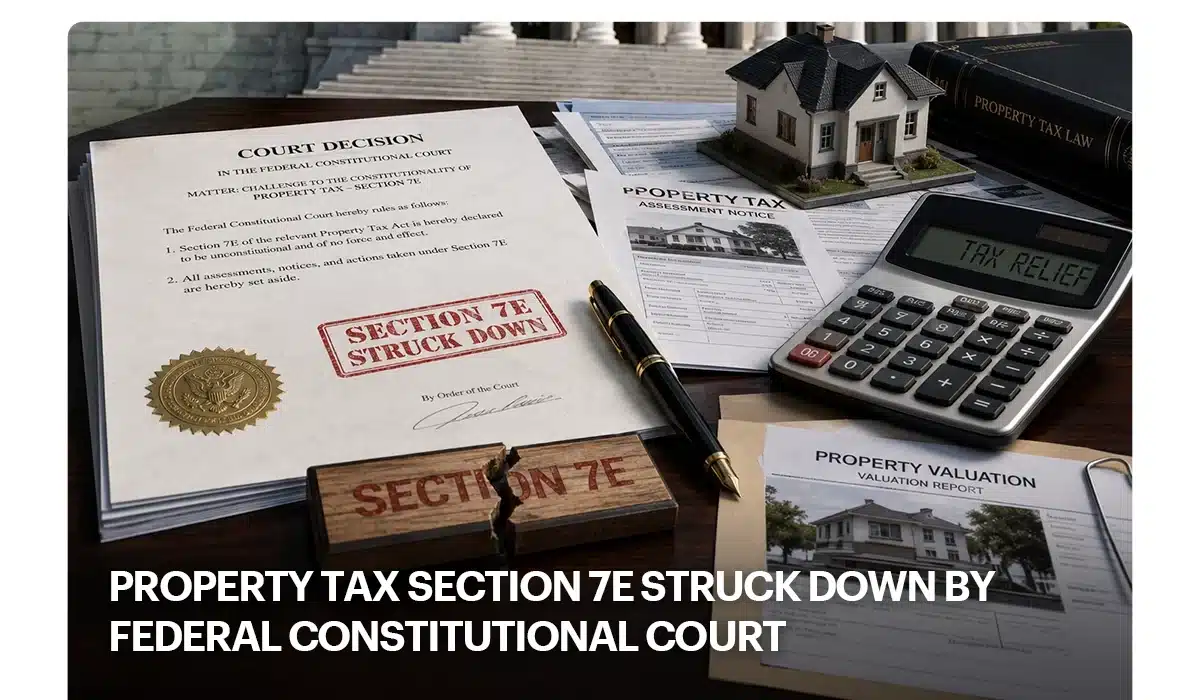

ISLAMABAD: In a landmark ruling that closes nearly four years of legal battles across Pakistan, the Federal Constitutional Court (FCC) has unanimously declared Section 7E of the Income Tax Ordinance, 2001, unconstitutional, wiping the controversial property tax off the books entirely and delivering a major blow to the Federal Board of Revenue (FBR).
Chief Justice Amin-ud-Din Khan, sitting alongside Justice Ali Baqar Najafi, delivered the short order in open court in Islamabad, marking one of the most significant tax rulings in Pakistan’s recent judicial history.
What Was Section 7E?
To understand why this ruling matters, you need to understand what Section 7E actually did and why so many people found it deeply unfair.
Section 7E was inserted into the Income Tax Ordinance through the Finance Act 2022. It introduced a “deemed income” tax on immovable property, essentially treating the value of real estate as if it were generating taxable rental income at a fixed rate, regardless of whether the owner had actually earned a single rupee from that property.
In plain terms, if you owned a plot or house that you weren’t renting out or selling, the tax authorities could still charge you income tax on what they assumed you should have earned. The law imposed this tax from tax year 2022 onwards, calculated at a rate of 5% of the property’s fair market value.
The law did carve out some exceptions. It excluded a person’s single self-owned property, business premises used by active taxpayers, agricultural land used for farming, properties owned by provincial or local governments, and assets allotted to armed forces personnel or war-wounded individuals. Properties with a combined fair market value below Rs. 25 million were also exempt.
But for everyone else, salaried professionals, retired civil servants, heirs to family property, and major business houses alike, unexpected tax demands quickly followed. In a country where real estate has historically been the default savings vehicle for the middle class, the provision struck a raw nerve almost immediately.
A Four-Year Legal War Across the Country
What followed Section 7E’s introduction was one of the most sprawling tax litigations Pakistan has ever seen. Over 200 petitioners, from individual homeowners in Karachi to major textile conglomerates in Lahore, from bar associations to listed corporations, challenged the law in High Courts across the country.
The results were deeply inconsistent, creating a confusing patchwork of legal rulings that differed province by province:
The Peshawar High Court and the High Court of Balochistan struck down Section 7E entirely as ultra vires the Constitution. The Islamabad High Court charted a middle course, declining to invalidate the entire provision but declaring subsection (2) unconstitutional.
The Lahore High Court initially sided with the taxpayers through a Single Judge, only for a Division Bench to reverse that verdict and uphold the law. The High Court of Sindh, for its part, dismissed constitutional petitions, leaving Karachi’s taxpayers with no relief.
The result was an absurd situation where your tax obligations depended not on the law itself, but on which province you happened to file your legal challenge in. This clearly called for a single, definitive ruling from the highest court.
The Federal Constitutional Court Consolidates the Cases
The Federal Constitutional Court took up the matter, consolidating a staggering array of cases, civil petitions from Karachi, Lahore, Peshawar, and Quetta; cases transferred from the Islamabad High Court; and freshly filed transfer cases into one grand consolidated hearing.
The bench heard arguments over seven intensive days in April 2026, the 13th, 14th, 15th, 27th, 28th, 29th, and 30th, with a formidable array of advocates on both sides. Senior counsel representing taxpayers included Rashid Anwer, Salman Akram Raja, and Faisal Siddiqi, among others. The Federation and FBR were represented by counsel, including Asma Hamid and Hafiz Ahsan Ahmad Khokhar.
The arguments revolved around several core constitutional questions: Could Parliament lawfully impose income tax on income that was never actually received? Did the provision violate the fundamental right to property? Was the concept of “deemed income” constitutionally valid without any genuine accrual of income? And critically, did the levy actually function as a disguised wealth tax, something Parliament does not have the legislative competence to impose under the Constitution’s legislative lists?
The Verdict: Void from Day One
The court’s decision, reserved on April 30, was read by Chief Justice Amin-ud-Din Khan, who noted that all actions taken by FBR under Section 7E are now void.
The court held that Section 7E is ultra vires the Constitution. It is struck down. It is void ab initio, meaning it is treated as if it never legally existed, from the very moment of its enactment in 2022.
This is a critical legal distinction. The ruling does not just stop the tax going forward; it retroactively erases the legal basis for every assessment, demand, and action taken under Section 7E since it was introduced four years ago.
The Federal Constitutional Court upheld appeals filed by citizens challenging the decisions of the Islamabad and Lahore High Courts, effectively reversing those courts’ conclusions that the provision was constitutional.
Who Benefits?
Taxpayers who received assessments or demands under Section 7E, ranging from salaried individuals to large listed companies, are now formally in the clear.
The decision is expected to provide significant relief to Pakistan’s real estate sector, which had been under pressure since the law came into force. With greater clarity and reduced tax-related concerns, investors are likely to show renewed interest in rental property opportunities within developments such as Citadel 7 and Citadel One3, projects by Chakor. Property owners who had delayed transactions or investment decisions due to this tax liability can now move forward with greater legal certainty.
The FBR, which had filed appeals seeking to reinstate the provision, lost comprehensively. The constitutional court dismissed all appeals filed by the FBR seeking its restoration.
What This Means Going Forward
The ruling is a clear constitutional signal to Parliament: you cannot tax income that does not exist. Fictionalizing income treating the notional rental value of a property as actual taxable earnings crosses a constitutional line between income tax and wealth tax, and Parliament does not have unlimited power to blur that boundary.
For property owners across Pakistan, the immediate takeaway is straightforward. Any tax demand, assessment, or penalty issued under Section 7E has no legal standing. The law is treated as if it never existed. And the FBR has no further recourse on this provision unless Parliament were to attempt a fresh, constitutionally compliant legislative approach a path that would face significant legal scrutiny given this ruling.
For the broader tax and real estate ecosystem, the verdict restores a degree of investor confidence that had been shaken since 2022, and removes what many had called an arbitrary and constitutionally dubious burden from millions of property owners across the country.
For more news on real estate and Special Reports, visit Chakor Ventures.
Citations
- Dunya News, “FCC strikes down controversial Section 7E of income tax law”, updated May 7, 2026.
- Mettis Global, “FCC strikes down Section 7E tax on property”.
- ProPakistani, “Constitutional Court Declares Section 7E Unconstitutional in Major Relief for Property Sector”, May 7, 2026.
- HUM News English, “FBR loses appeal as court scraps Section 7E tax rule”.
- Federal Board of Revenue, Income Tax Ordinance, 2001 — Amended up to 20.02.2026, Section 7E, “Tax on deemed income.”

BBC-featured Content Specialist with a sharp eye for search intent and a proven ability to turn content into a growth engine. I leverage cutting-edge digital marketing tools to craft strategies that fuel organic traffic, amplify brand growth, and own the local SEO landscape, particularly across the competitive real estate market. I help brands dominate search rankings and convert visibility into measurable business success.
