
Fire Safety Audit
CategoriesDevelopments News Urban Developments & Planning

Punjab CM Orders Fire Safety Audit After Tragic Gul Plaza Blaze in Karachi

LAHORE: In response to the tragic fire that claimed 26 lives at Karachi’s Gul Plaza, Punjab Chief Minister Maryam Nawaz Sharif has directed a province-wide audit of fire safety systems in both public and private buildings. The audit is part of a broader initiative to ensure public safety and prevent similar disasters.

The Chief Minister expressed her grief over the incident and extended condolences to the victims’ families. She urged the immediate implementation of safety measures, stating that fire safety systems in all buildings must be regularly inspected and upgraded where necessary.

As part of her ongoing efforts to improve infrastructure, CM Maryam Nawaz also announced a series of urban development initiatives. These include fully reconstructing roads after excavation for sewerage and drainage projects and ensuring that pits dug during development work are properly covered and fenced to avoid accidents.

The Chief Minister further emphasized the importance of transparency in ongoing development projects. Under the Punjab Development Plan (PDP), she highlighted that Phase-I projects had saved the government Rs 2.8 billion through effective transparency measures.

CM Nawaz also outlined plans for major sewerage, drainage, and water storage projects across various districts, including Sargodha, Dera Ghazi Khan, and Gujrat, as well as for developing green spaces and utility corridors in urban areas.

Punjab Emergency Services Minister Khawaja Salman Rafique also called for the complete enforcement of the Building Safety Regulations 2022, following a survey of 2,214 high-rise buildings in the province. He revealed plans to extend firefighting services to 39 additional tehsils, with an investment of Rs 2 billion. Rescue 1122 has already responded to over 280,000 fire emergencies, saving an estimated Rs 768 billion in potential damages.

These measures reflect the Punjab government’s commitment to improving public safety and urban infrastructure across the province.

For more news on real estate and development, visit Chakor Ventures.

CategoriesNews Construction Developments Urban Developments & Planning

Rawalpindi Ring Road Project & Transport Terminals Relocation: A Comprehensive Development Plan

In a major move to alleviate traffic congestion and improve infrastructure, the Rawalpindi Development Authority (RDA) is making significant progress on the Rawalpindi Ring Road Project and the relocation of 44 key transport terminals. The dual initiatives are set to reshape the city’s traffic management, boost regional connectivity, and transform Rawalpindi’s transport landscape.

Rawalpindi Ring Road: Progress and Impacts

construction site of ring road Rawalpindi

The Rawalpindi Ring Road, a crucial part of the city’s transportation overhaul, is a 38.3-kilometre, six-lane highway designed to connect key zones in Rawalpindi and Islamabad. The project aims to reduce congestion and improve access to regional economic zones.

  • Current Progress: As of the latest reports, the project is 70% complete, with structural work, road surfacing, embankments, and drainage systems progressing steadily. Key sections, including the Banth to Thallian Interchange, are already under construction.
  • Revised Timeline: The Rawalpindi Ring Road, initially slated for completion by December 2025, now has a new deadline of March 2026. The project’s total cost has been revised upwards to Rs. 50 billion due to the redesigning of the Thallian Interchange, a critical junction connecting the Ring Road to the M-2 Motorway.
  • Expected Benefits: The Ring Road will significantly ease traffic congestion in Rawalpindi, improve access to major highways, and facilitate smoother connectivity to Islamabad. Once completed, it will reduce traffic volume on city roads, benefiting both commercial and commuter traffic.
  • Project Management: The construction is being carried out by Frontier Works Organisation (FWO) under the oversight of the Rawalpindi Development Authority (RDA).

Relocation of Transport Terminals: Strategic Planning for Traffic Management

Pirwadhai Bus Stand

In line with the vision to streamline Rawalpindi’s transport system, the Punjab government has approved the relocation of major transport terminals to areas near the Rawalpindi Ring Road. This move aims to reduce traffic congestion within the city, particularly from heavy transport vehicles.

  • Pirwadhai Bus Stand: The prominent Pirwadhai General Bus Stand, along with other terminals, will be shifted to a more centralised location along the Ring Road. This relocation will accommodate inter-district buses and intra-city transport, improving traffic management and passenger operations.
  • New Terminal Locations: Other transport terminals, including those at Faizabad and Chungi No. 26, will also be closed, with all long-distance and goods transport hubs moved to strategic locations along the Ring Road.
  • Key Routes:
    • Transport coming from Peshawar will now operate from a new terminal near Islamabad Airport.
    • Vehicles from Azad Kashmir via Murree will stop at Bharakahu, while those coming from other districts will enter through Rawat.
  • Traffic and Fare Adjustments: The relocation will impact local travel. Fares for intra-city buses will range from Rs. 20 to Rs. 50, while passengers travelling to the newly relocated terminals may experience changes in travel time.
  • Policy Changes: To complement the relocation, the Punjab government will enforce a ban on heavy transport vehicles entering the city’s core. Any violating vehicles will face impoundment. Public transport buses and wagons will ferry passengers from the Ring Road terminals into the city centre, offering seamless connectivity.

Long-Term Impact: Urban Mobility and Economic Growth

ring road aerial view

Both the Rawalpindi Ring Road Project and the relocation of transport terminals are part of a comprehensive urban development strategy. By reducing congestion and improving connectivity, these initiatives are expected to enhance the city’s overall mobility, improve air quality, and stimulate local economic growth.

  • Environmental and Aesthetic Benefits: The Ring Road project incorporates green initiatives, including the creation of green belts, better drainage systems, and improved traffic safety measures. These will contribute to a cleaner, more sustainable urban environment.
  • Public Response: While many residents welcome the plan for its long-term traffic management benefits, some have expressed concerns about longer travel distances and the costs of relocating terminals. However, the shift is being framed as a necessary step to manage Rawalpindi’s increasing population and transport demands.

A Vision for a Modern Rawalpindi

With Rs. 50 billion invested in the Rawalpindi Ring Road Project and additional resources allocated for terminal relocations, the city is witnessing one of its most significant infrastructural transformations. 

The development of this vital infrastructure will not only ease traffic congestion but will also position Rawalpindi as a model for modern urban mobility in Pakistan.

As the project progresses towards its 2026 completion, Rawalpindi’s residents and visitors can look forward to enhanced connectivity, reduced travel times, and a cleaner, more efficient transport system.

For more news on real estate and development, visit Chakor Ventures.

CategoriesNews Construction Urban Developments & Planning

RDA Launches Major Beautification Project along Grand Trunk Road

RAWALPINDI: The Rawalpindi Development Authority (RDA) has officially launched a significant beautification project along the Grand Trunk Road, covering the stretch from Defence Housing Authority (DHA) Phase-I to Phase-II, as well as the area in front of Bahria Town. The project, which aims to transform this key corridor into an aesthetically pleasing and environmentally friendly route, has commenced under the directives of RDA Director General Kinza Murtaza.

The beautification efforts will include extensive plantation, the creation of green belts, and various aesthetic enhancements, such as painting and the installation of decorative pools. These improvements are designed to not only elevate the visual appeal of the area but also to contribute to environmental sustainability.

Director General Kinza Murtaza emphasised that the project aligns with the vision of Chief Minister Maryam Nawaz Sharif for Rawalpindi, focusing on a blend of beauty, functionality, and long-term sustainability in urban development. To ensure the project’s success, Murtaza has directed all relevant directorates to complete the work within the specified timeframe, uphold strict quality standards, and establish ongoing monitoring and maintenance protocols.

The beautification of the Grand Trunk Road is expected to significantly enhance the city’s aesthetic and environmental landscape, making it a more attractive route for both residents and visitors. The project is also aimed at contributing to Rawalpindi’s overall development strategy, improving the quality of life for its residents.

For more news on real estate and development, visit Chakor Ventures.

CategoriesConstruction News Urban Developments & Planning

Kachehri Chowk Project Set to Open by April 30 with New Completion Deadline

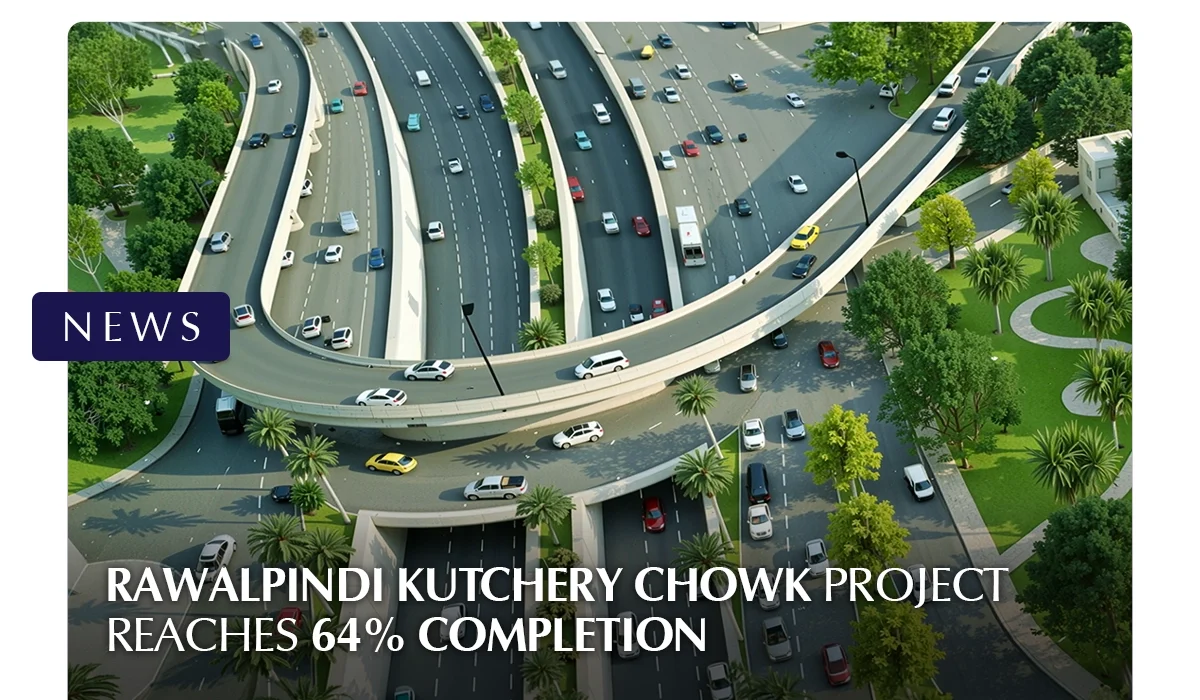
RAWALPINDI: The remodelling of Kachehri Chowk in Rawalpindi is progressing with a new deadline set for completion by April 30. The project, which includes the construction of two flyovers and three underpasses, is expected to open the busy junction to traffic by this date, following directives from the Punjab government.

According to Punjab Highway Department Executive Engineer Qamar Ali Saqib, over 45% of the work has been completed. Structural work, including the guide beam and piling at Kachehri Chowk and the Jinnah Park underpass, will be finished before Eid-ul-Fitr. The Frontier Works Organisation (FWO) is working around the clock to ensure the project meets its revised deadline.

The project includes several key features, such as a four-lane flyover between The Mall and Rashid Minhas Road, and underpasses at Kachehri Chowk and Mushtaq Baig Shaheed Road, aimed at managing traffic flows of over 250,000 vehicles daily. The total cost of the Kachehri Chowk flyover and underpass project is Rs5.974 billion, while the Annexy Chowk (Jinnah Park) project carries a budget of Rs4.672 billion.

In addition to roadwork, the Punjab Highway Department is collaborating with the Rawalpindi Parks and Horticulture Authority to enhance green spaces around the new flyovers and underpasses. Plantations will begin next month after the completion of road construction.

On Peshawar Road, work is underway to relocate electricity pylons for the construction of three underpasses at Race Course Park, Army Graveyard Square, and Charing Cross Square. The Rs8 billion project is designed to improve traffic flow for 250,736 daily commuters.

The remodelling of Kachehri Chowk and associated projects are expected to significantly ease traffic congestion and improve infrastructure in Rawalpindi.

For more news on real estate and development, visit Chakor Ventures.

FBR Valuation Bombshell
CategoriesNews Taxes

FBR Valuation Bombshell: Islamabad Property Rates Surge in 2026

ISLAMABAD: A major revision to Islamabad’s property valuation rates, first announced in December 2025, is once again being widely discussed in early 2026 due to its expected impact on taxes and real estate transactions. 

The Federal Board of Revenue (FBR) has sharply increased property valuation rates across the Islamabad Capital Territory (ICT) for 2026. The revision has surprised buyers, sellers, and investors. Many fear it will raise the overall cost of buying and selling property.

The increase was introduced through notification S.R.O. 2392(I)/2026. According to the updated valuation tables, rates have risen by 150% to 200% in many locations. The new valuations apply to 68 residential, commercial, and rural localities across Islamabad. Premium sectors and major housing schemes are among the most affected.

A major change is the introduction of a dual taxation approach. Property owners will now face tax calculations on both land value and superstructure (construction). FBR has also introduced fixed superstructure valuation rates. Buildings up to five years old will be assessed at Rs. 4,000 per square foot. Older structures will be valued at Rs. 3,000 per square foot.

In central Islamabad, the highest residential plot valuation is in Sector E-7, set at Rs. 600,000 per square yard. Sectors F-6 and F-7 are valued at Rs. 500,000, while F-8 stands at Rs. 450,000 per square yard. Other sectors such as F-10, F-11, and G-6 are valued at Rs. 350,000.

Commercial plots have seen the steepest jump. Valuations in E-7, F-6, F-7, and F-8 have reached Rs. 2.5 million per square yard. This is expected to affect commercial leasing and new construction plans.

Farmhouse and industrial areas have also been revised upward. Chak Shahzad farmhouses are now valued at Rs. 11.2 million per kanal. Industrial zones like I-9 and I-10 have been valued up to Rs. 18 million per kanal.

Market experts expect a short-term slowdown in transactions. Many investors may wait for clarity before making deals. The policy is seen as part of broader efforts to document real estate and increase tax collection.

For more news on real estate and development, visit Chakor Ventures.

Karachi to Chaman
CategoriesDevelopments News Urban Developments & Planning

Karachi to Chaman: New Highway Project Aims to Save Lives

KARACHI: Prime Minister Shehbaz Sharif has announced that construction work on the Karachi–Chaman highway has officially started. He said the project will be completed in one year. Earlier, it was expected to take two years.

The prime minister called the highway a major step for safer travel. He said the current route has a long history of deadly accidents. The new highway will improve road safety and regional connectivity.

PM Sharif told the federal cabinet that he recently visited Quetta. He laid the foundation stone of the highway there. The road will be nearly 850 kilometres long. It will link Karachi to Chaman through key areas of Balochistan.

He said the project will cost around Rs400 billion. The entire cost will be paid by the federal government. He explained that funds were arranged through savings. These savings came when the government did not reduce fuel prices despite falling global oil prices. He said this money is now being used for national development.

The prime minister also highlighted support for farmers. He said a Rs75 billion agricultural package for Balochistan has been completed. Out of this, Rs50 billion was provided by the federal government. He added that solar energy solutions are being introduced to reduce dependence on unreliable electricity. Farmers can now irrigate their lands using solar panels.

He also shared updates about Daanish schools in the province. He said construction has begun and contractors are mobilised. He added that the plan has expanded from five schools to seven. The goal is to improve education and opportunities in underserved areas.

For more news on real estate and development, visit Chakor Ventures.

CategoriesConstruction Developments News

Karachi’s Jahangir Road to Undergo Major Overhaul in 60 Days

KARACHI: Jahangir Road, a vital link between two districts in Karachi, is set for a major reconstruction. The road has long suffered from severe damage and drainage problems, affecting residents and commuters.

At the foundation-laying ceremony on Wednesday, Mayor Karachi Barrister Murtaza Wahab highlighted the importance of this project. He noted that while the road was initially built by the Karachi Development Authority (KDA), it had been repeatedly damaged during rains due to outdated drainage systems.

This time, the Karachi Metropolitan Corporation (KMC) will fully fund the reconstruction. The project will not only rebuild the road but also replace the old sewerage system. Stormwater drains will be added on both sides to prevent future flooding.

The road will feature a 3-inch asphalt base, a 2-inch asphalt concrete wearing course, and 50,000 square feet of new carpeting. Additionally, 2,000 feet of stormwater drains will be constructed, along with 252,000 square feet of 80mm paver blocks.

The original project timeline was 90 days, but it has been shortened to 60 days to reduce public inconvenience. Work will continue day and night to meet the deadline.

Once completed, the road will improve traffic flow, drainage, and overall infrastructure for local residents. This project is part of a larger initiative to develop over 400 roads across the city, with a total budget of Rs. 46 billion.

For more news on real estate and the economy, visit Chakor Ventures.

CategoriesEconomy News

Gold Hits New Peak in Pakistan After Rs9,000 Jump

KARACHI: Gold prices in Pakistan extended their rally on Tuesday, supported by strong local demand and a firm upward trend in international bullion markets amid ongoing global uncertainty.

According to data released by the All Pakistan Gems and Jewellers Association (APGJA), the price of gold surged by Rs9,000 per tola to Rs481,862, while the rate for 10 grams increased by Rs771 to Rs413,118.

Market experts attributed the continued rise to volatility in international markets and concerns over the global economic outlook, prompting investors to seek safe-haven assets. On the international front, gold prices edged up by $9, trading at $4,595 per ounce.

Traders said the local bullion market remains closely linked to international price movements, with domestic rates also influenced by currency fluctuations and investor sentiment, as gold continues to attract buyers amid heightened uncertainty.

For more news on real estate and the economy, visit Chakor Ventures.

cutting of tree in islamabad
CategoriesClimate Change Deforestation Economy Featured blog News

What Really Happened in Islamabad’s Tree-Cutting Drive?

A special report on the paper mulberry eradication campaign, the public backlash, competing claims of legality, and the long-term climate and economic cost of losing mature urban green cover.

ISLAMABAD: The drive along Shakarparian Road still feels familiar, until it doesn’t. One moment, the route is shaded by Islamabad’s old, settled tree canopy. Next, the green abruptly disappears, replaced by bare earth and freshly turned soil.

Along the roadside, labourers dig shallow pits. Nearby, pine saplings lie waiting for a plantation. A signboard makes its promise in bold letters: “Greener and Healthier Islamabad, Indigenous Tree Plantation.”

Yet, it is not the saplings that have captured the public’s attention; it is what is missing: decades-old, mature trees that once defined the capital’s identity.

In recent days, the cutting of trees in Islamabad has triggered widespread public anger, forcing explanations from the government, pushing environmental groups into the spotlight, and raising an uncomfortable debate about whether the city’s green cover is being sacrificed under the banner of public health and development.

LATEST UPDATE: “IHC Halts CDA from Cutting Trees in Islamabad”

On January 15, 2026, the Islamabad High Court directed CDA to immediately stop cutting of trees in Islamabad. The court issued this order after a petition alleging that the tree removal violated environmental laws was filed. The CDA is required to submit a detailed report, and notices were issued to the Pakistan Environmental Protection Agency and the Ministry of Climate Change. The hearing has been adjourned until February 2.

Why This Matters? | Cutting of Trees in Islamabad

cutting of trees in islamabad

Beyond the immediate controversy, the cutting of trees in Islamabad episode lays bare a deeper governance dilemma: how a modern capital balances public health, rapid development, and climate resilience. In urban terms, tree cover is not decoration; it is infrastructure.

It cools neighbourhoods, filters air, prevents soil erosion, buffers floods, and protects water resources. Its removal can have long-lasting economic and climate consequences that outlive any short-term administrative goals.

What Happened and Where? Cutting of Trees in Islamabad

cutting of trees in islamabad


Large-scale cutting of trees in Islamabad was reported at several locations in Islamabad, including:

  • Shakarparian National Park
  • H-8 (along a portion of the Islamabad Expressway, where a park is being upgraded)
  • Chak Shahzad (where decades-old trees were cut for the construction of a dual carriageway)

In Shakarparian, citizens claim at least four patches have been cleared, collectively spread over more than 15 acres near Lok Virsa, leaving large stretches resembling open, barren land.

The cutting of trees in Islamabad has remained a hot topic online, with residents sharing images and videos of deforested patches, questioning both the scale of the operation and the intent behind it.

The Official Position: Only Paper Mulberry Was Removed

Paper Mulberry cutting of trees in Islamabad

The government’s defence rests on one central claim: that the cutting of trees in Islamabad is not arbitrary, but targeted and legally backed.

Minister for Climate Change and Environmental Coordination Dr Musadiq Malik, speaking on Friday after chairing a meeting on the issue, stated that around 29,000 paper mulberry trees had been removed in Islamabad in line with the Supreme Court’s orders issued in 2023.

The minister said the directive was implemented again in 2025 to rid the city of what he described as an invasive, non-indigenous, and life-threatening species.

Paper mulberry, the minister claimed, is a major contributor to allergies and can cause fatal complications among chronic asthma patients. He added that the felling plan was finalised after confirming with the Ministry of Health that the species posed a major health concern.

“We are not planting non-indigenous species,” he said, adding that every tree chopped would be replaced at a ratio of one cut tree to three new saplings/trees.

The Capital Development Authority (CDA) also maintains that in Shakarparian, only paper mulberry trees were chopped down.

What the Numbers Say? | Cutting of Trees in Islamabad

According to CDA’s DG Environment Irfan Khan Niazi, the operation has proceeded under court directions with close supervision by CDA staff and documentation from cutting of trees in Islamabad to loading.

He stated:

  • approximately 12,000 paper mulberry trees were removed from F-9 Park
  • 8,700 were cut in Shakarparian
  • Additional locations, including H-8, were also included

In total, the CDA reports that 29,115 paper mulberry trees have been removed to date.

The Public’s Concern: ‘This Was Not Only Paper Mulberry’

cutting of trees in islamabad

Despite official assurances, residents insist the reality on the ground looks far broader than a targeted health operation.

In Shakarparian, citizens stated that besides paper mulberry, other trees also appeared to have been cut down, and that large swathes of tree cover were cleared in a manner inconsistent with a selective removal drive.

For many, the question is not merely “why was paper mulberry removed?” but:

  • Why was the removal so abrupt?
  • Why did it involve such large patches of cleared land?
  • and whether decades-old green cover can truly be replaced by saplings in any meaningful timeframe?

Development Projects: The Road and Housing Link | Cutting of Trees in Islamabad

In Chak Shahzad, cutting of trees in Islamabad was carried out for the construction of a dual carriageway intended to connect to a CDA-DHA-owned housing scheme from Park Road, linking the controversy directly to Islamabad’s real-estate expansion and infrastructure development model.

Cutting of trees in Islamabad, H8, took place where a park is being upgraded alongside the Expressway.

This intersection, between ecological removal drives and physical development projects, has strengthened public suspicion that cutting of trees in Islamabad may not be purely a health-driven intervention.

The WWF Report and the ‘Bigger Reality’

WWF-Pakistan report on cutting of trees in islamabad

Environmental groups argue that the issue is more complex than official explanations.

A WWF-Pakistan report criticised the recent removals and land clearing in Islamabad, stating that while the paper mulberry eradication drive is a major factor, extensive vegetation loss also stems from unchecked infrastructure development.

Field inspections conducted from December 2025 to January 2026 reportedly found large-scale clearing along:

  • H-8 Islamabad Expressway
  • Margalla Enclave Link Road
  • Shakarparian

The report raised concerns over:

  • lack of transparency
  • weak site-specific planning
  • monitoring gaps
  • incomplete restoration and exposed soil

Experts Warn: It’s Not Just Trees, It’s the City’s Climate System

Experts caution that even if paper mulberry removal is justified, the method matters.

Climate policy advocate Dr Zainab Naeem said the issue was not the removal itself but the alleged mismanagement, warning that the court-mandated phased approach, ecological assessment and prior afforestation steps appear to have been ignored. She stated native species such as shisham were reportedly also cut, as highlighted in WWF’s findings.

She described the move as climate misgovernance, warning that Islamabad is already developing an urban heat island effect due to concretisation and declining green buffers.

Water resources expert Dr Hassan Abbas warned that large-scale deforestation threatens:

  • groundwater recharge
  • temperature regulation
  • rainfall balance
  • ecological stability

He stressed that even public-health-driven removal must follow proper mechanisms, because replacing trees with concrete accelerates heating, disrupts rainfall patterns, and accelerates degradation.

The Economic Cost Behind the Environmental Cost | Cutting of Trees in Islamabad

cutting trees in islamabad

Beyond ecology, the cutting of trees in Islamabad canopy plays a direct economic role.

Urban analysts note that the loss of mature trees can lead to:

  • Higher electricity demand (cooling loads increase with higher temperatures)
  • Higher public health spending due to heat stress, dust, and air quality decline
  • increased stormwater runoff and greater risk of flooding, raising infrastructure repair costs
  • weaker livability, reducing quality-of-life indicators that sustain long-term urban value

In effect, while development projects may generate short-term economic activity through construction, poorly managed loss of ecological buffers can create long-term liabilities that quietly burden households and government alike.

Accountability Questions: What Was Approved, and Who Monitored?

The controversy has also revived core governance questions, especially in the context of environmental permissions:

  • Were site-specific ecological plans made public?
  • Were environmental assessments and approvals properly disclosed?
  • What independent monitoring existed beyond agency statements?
  • How was “only paper mulberry” verified on the ground?
  • Were permissions and licensing processes fully compliant?

Dr Malik directed that a transparent mechanism be developed to ensure compliance with laws, rules and procedures related to such campaigns, an indication that the current process may lack public confidence.

Notably, while official handouts discussed cutting in multiple sectors, they reportedly did not mention cutting of trees in Islamabad along Park Road in Chak Shahzad, raising further questions about disclosure.

CDA’s Plantation Response: A January Drive Amid Frost

Amid criticism, the CDA launched a plantation campaign in January, a month usually associated with frost and not traditionally viewed as ideal for mass plantation.

Historically, CDA plantation drives typically began around mid-February. This time, the plantation began over a month early in the Shakarparian area.

CDA officials defended the timing by stating that only suitable species, including Chir Pine, were being planted and that the drive aims to plant 30,000 trees, with greater momentum expected next month.

However, critics questioned whether the plantation effort was ecological restoration or merely damage control.

PM Takes Notice

After sustained pressure from citizens and civil society, Prime Minister Shehbaz Sharif took notice of the alleged cutting of trees in Islamabad and sought a report from the CDA.

The government’s response suggests recognition that public anger has moved beyond social media outrage into a politically sensitive urban governance issue.

The Bigger Debate: Health, Development and a City’s Identity

Islamabad’s paper mulberry dilemma is not a simple question of trees versus health. It is a debate about trust, transparency and what kind of capital Pakistan wants to build: one shaped by ecological planning, or one repeatedly “fixed” after irreversible damage.

So the question that arises here is: was this drastic approach truly necessary, or could public health have been protected without stripping the capital bare?

For more news on real estate and Special Reports, visit Chakor Ventures.

CategoriesNews Taxes

Rawalpindi faces 57% property tax shortfall as fake bill crackdown begins

RAWALPINDI: The Excise, Taxation and Narcotics Control Department has reported a 57 per cent shortfall in property and professional tax collection across Rawalpindi Division during the first six months of fiscal year 2025–26 (July 1 to December 31), amid mounting economic pressures, including inflation and unemployment.

During a visit to Rawalpindi, Additional Director General Rizwan Akram Sherwani conducted an open hearing to address complaints and petitions filed by taxpayers from Rawalpindi, Jhelum, Attock, and Chakwal. The petitions challenged property tax bills amounting to millions of rupees, with taxpayers alleging excessive and incorrect assessments.

The Additional DG approved all appeals and directed the immediate cancellation of inflated bills, ordering excise inspectors to issue revised and reduced bills strictly in line with applicable laws. Incorrect assessments were annulled, while inspectors found responsible for excessive or fictitious billing were issued strict warnings.

Authorities also initiated action against specific excise inspectors accused of sending fake property tax bills worth millions to major housing societies and later issuing reduced bills after alleged settlements.

In a separate incident, the department imposed a professional tax of Rs 1.5 million on a cricket ground owned by a private housing society near Taxila, prompting strong protests from the management.

Following continued underperformance, the director general of excise has issued show-cause notices to excise inspectors and directed them to recover tax targets within the next two months. Officials reiterated that excessive billing will not be tolerated and urged citizens to pay taxes on time, citing tax compliance as essential for public service delivery.

For more news on real estate, visit Chakor Ventures.