Navigating property ownership in Pakistan requires a clear understanding of the legal framework that governs it. At Chakor, our Property Laws section breaks down legislation, regulations, and legal updates affecting buyers, sellers, developers, and investors across the country.
Stay informed so your property decisions are not just smart financially but sound legally as well.
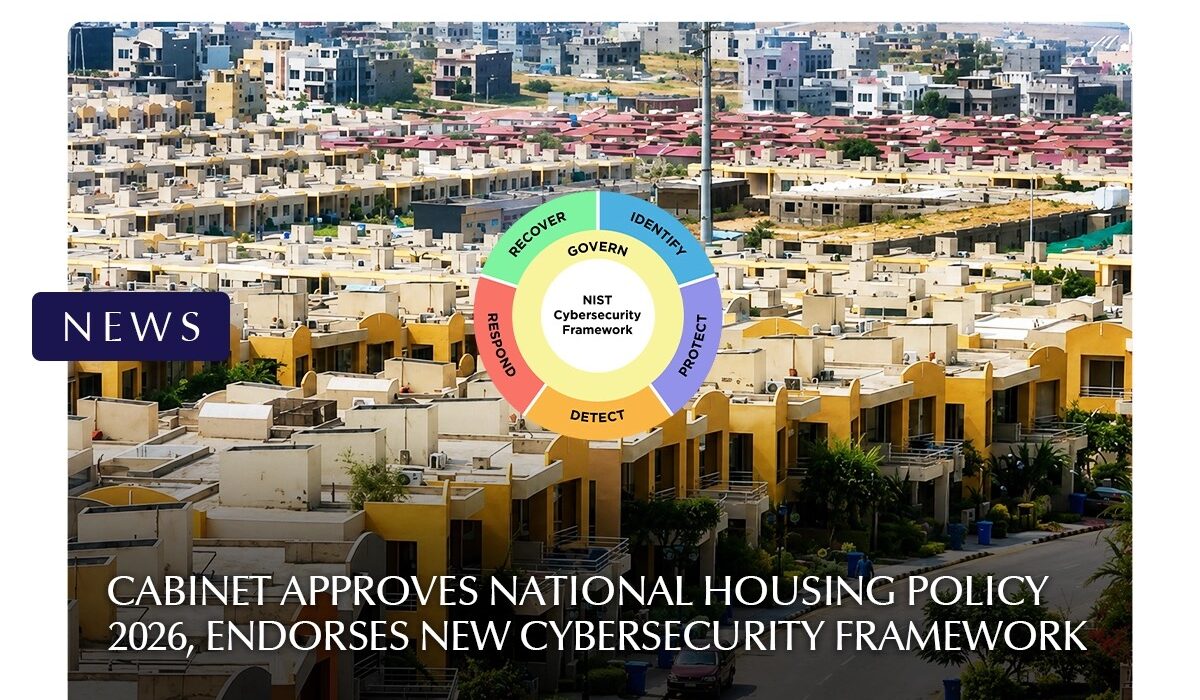
ISLAMABAD: The federal cabinet, chaired by Prime Minister Shehbaz Sharif, has approved the National Housing Policy 2026 together with a corresponding implementation plan. Under the policy, housing projects will be required to fully observe zoning regulations, with priority given to vertical construction to improve land-use efficiency.
Officials noted the policy was drafted with input from local and international experts, along with federal, provincial, and development-sector stakeholders, aiming to ensure sustainable and quality housing nationwide. Energy-efficiency standards have also been folded into the policy framework to align new construction with environmental goals.
The cabinet was additionally briefed on the Apna Ghar housing scheme, revealing that banks have sanctioned loans worth Rs220 billion for prospective homeowners, of which more than Rs32 billion has already been disbursed.
In a separate move, the cabinet approved withdrawing Pakistan’s earlier notice to terminate its 1981 bilateral investment treaty with Sweden, based on a summary presented by the Board of Investment.
On the technology front, the Ministry of Information Technology introduced the draft Pakistan Information Security Framework 2026 (PISF 2026), developed under the CERT Rules 2023. The framework is designed to establish unified baseline cybersecurity standards with centralized oversight. The cabinet approved it as a key policy document and directed its timely implementation.
Further ratifications included proposed amendments to the Pakistan Oil Refining Policy 2023, aimed at upgrading refineries to strengthen energy supply, along with decisions made during recent Economic Coordination Committee and Cabinet Committee on Legislative Cases meetings.
BBC-featured Content Specialist with a sharp eye for search intent and a proven ability to turn content into a growth engine. I leverage cutting-edge digital marketing tools to craft strategies that fuel organic traffic, amplify brand growth, and own the local SEO landscape, particularly across the competitive real estate market. I help brands dominate search rankings and convert visibility into measurable business success.
LAHORE: The Punjab Land Records Authority (PLRA), in collaboration with the Board of Revenue Punjab, has inaugurated the province’s first overseas property transfer desk in London, allowing overseas Pakistanis to complete land and property transactions without travelling to Pakistan.
The facility was formally launched at the Pakistan High Commission in London on August 3, 2026, marking the first international expansion of Punjab’s land transfer services for the Pakistani diaspora.
Under the new arrangement, overseas Pakistanis can process property transfers in Punjab through the London desk in a more convenient, secure, and transparent manner. The initiative is designed to simplify documentation requirements and reduce the need for costly and time-consuming travel for land-related transactions.
Officials said the facility aims to enhance transparency, convenience, and innovation in land administration, while ensuring secure record-keeping for the diaspora community.
The PLRA is now preparing to replicate the model in Saudi Arabia and the United Arab Emirates within the next 30 days, extending overseas transfer facilities to two of the largest hubs of Pakistani expatriates.
Authorities said the expansion is part of a broader push to digitise and internationalise Punjab’s land records system, with the goal of strengthening overseas Pakistanis’ confidence in the province’s property regulatory framework and improving the overall efficiency of land-related services beyond the country’s borders.
BBC-featured Content Specialist with a sharp eye for search intent and a proven ability to turn content into a growth engine. I leverage cutting-edge digital marketing tools to craft strategies that fuel organic traffic, amplify brand growth, and own the local SEO landscape, particularly across the competitive real estate market. I help brands dominate search rankings and convert visibility into measurable business success.
ISLAMABAD: Pakistan’s real estate sector is witnessing a notable resurgence, with market activity accelerating across major urban centres including Karachi, Lahore, and Islamabad. Industry analysts attribute the renewed interest to a combination of domestic tax relief measures and shifting global economic conditions, prompting both local and overseas investors to reconsider property as a preferred asset class.
At the centre of this shift is a reduction in property transaction taxes, which has lowered the overall cost of buying and selling real estate. This adjustment has made the market more accessible to genuine homebuyers as well as investors seeking stable returns.
Adding to the momentum, the federal government has proposed abolishing Section 7E, a tax provision long criticised by property stakeholders as an unnecessary financial burden on owners. Should this proposal advance, experts anticipate it could further stimulate transaction volumes in the months ahead.
External factors are also playing a role. Rising uncertainty in the Middle East has reportedly prompted a segment of overseas Pakistanis to reassess their international investment holdings, with many turning attention toward established, well-developed housing projects back home as a comparatively secure option.
The combined effect of these dynamics has been reflected in pricing trends, with residential property values in several key cities climbing by an estimated 10 to 15 percent in recent weeks. Analysts note, however, that this growth is uneven, shaped largely by limited inventory in high-demand locations rather than a uniform market-wide surge.
Looking ahead, real estate professionals are calling for continued reform, particularly simplified taxation procedures and modernised land record systems to sustain investor confidence.
At the same time, experts continue to urge caution, advising buyers to independently verify ownership documentation, project approvals, and development status before committing funds, rather than basing decisions solely on recent price appreciation.
Dedicated and detail-oriented SEO Content Writer, Real Estate Writer, and Research Analyst based in Islamabad, with proven expertise in developing accurate, valuable, and well-researched content. Skilled in analytical writing, market research, and reporting, with the ability to turn insights into clear, professional, and impactful content. Passionate about exploring new ideas, analyzing industry trends, and contributing to high-quality writing and research-driven projects.
RAWALPINDI: Property registration activities for residential and commercial properties have resumed across Rawalpindi Division following a month-long suspension, officials confirmed.
The newly appointed deputy commissioner has retained the previous fiscal year’s property valuation rates for 2026-27, keeping official property values unchanged. Registrations in Rawalpindi city, cantonment, and surrounding areas are now processed through biometric verification alongside the existing online system.
While valuation rates remain steady, several taxes and fees have been increased. Advance tax now stands at 10.5 percent for non-filers and 1.25 percent for filers, while capital gains tax has risen to 11.5 percent for non-filers and 2.75 percent for filers.
Stamp duty remains at one percent of property value, alongside a one percent corporation tax and three percent cantonment board tax. Additional charges include a Rs3,800 Punjab Land Revenue Authority services tax, Rs1,000 registration fee, and Rs1,100 mutation fee, among others.
Officials estimate the suspension resulted in an approximate Rs1.5 billion revenue loss for the government. Biometric verification of both buyer and seller has been made mandatory, and the upgraded online registration system became fully operational on Monday, July 27.
Industry representatives noted that while stable valuation rates benefit buyers, the increased taxes and processing charges are expected to raise overall registration costs by Rs30,000 to Rs50,000 for residential properties and Rs50,000 to Rs125,000 for commercial properties.
Separately, the Excise, Taxation and Narcotics Control Department has yet to finalize property tax bills for 2026-27, with dispatch to taxpayers now expected after August 14. District authorities have also ordered the transfer of registry staff at multiple offices following corruption-related complaints.
BBC-featured Content Specialist with a sharp eye for search intent and a proven ability to turn content into a growth engine. I leverage cutting-edge digital marketing tools to craft strategies that fuel organic traffic, amplify brand growth, and own the local SEO landscape, particularly across the competitive real estate market. I help brands dominate search rankings and convert visibility into measurable business success.
LAHORE: The Punjab government has directed all private housing societies across the province to transfer their complete property transaction records to the Housing Society Management System (HSMS) as part of a broader push to strengthen ownership documentation and curb real estate fraud.
Under the new compliance framework, the government has begun issuing Property Certificates for property buying and selling transactions. These certificates will serve as legal proof of ownership across both public and private housing schemes in Lahore, replacing the fragmented documentation practices that have long characterized the sector.
Housing society owners and management have been given until August 31, 2026, to upload their complete purchase and sale records to the HSMS platform. Officials said the initiative is designed to improve transparency in property transactions and secure ownership records against manipulation.
The Property Certificate system will be integrated with NADRA records, digital mapping systems, and the e-Registry platform, an interlinkage authorities say will strengthen ownership verification and significantly reduce the risk of fraudulent transactions.
Housing societies that fail to meet the August deadline face legal consequences under the LDA Act 1975. Enforcement measures under consideration include the sealing of non-compliant societies’ offices and the initiation of legal proceedings against their management.
Officials noted that several private housing schemes in Lahore have already completed the record transfer to HSMS ahead of the deadline, signaling early compliance from parts of the sector even as the broader rollout continues.
The directive follows a series of recent enforcement actions by the Lahore Development Authority against unregistered and non-compliant housing schemes, reflecting a wider provincial effort to formalize property records and tighten oversight of the real estate sector ahead of the new fiscal year’s regulatory cycle.
BBC-featured Content Specialist with a sharp eye for search intent and a proven ability to turn content into a growth engine. I leverage cutting-edge digital marketing tools to craft strategies that fuel organic traffic, amplify brand growth, and own the local SEO landscape, particularly across the competitive real estate market. I help brands dominate search rankings and convert visibility into measurable business success.
ISLAMABAD: The Federal Constitutional Court (FCC) has issued a comprehensive set of guiding principles directing civil and revenue courts nationwide to exercise greater diligence in cases involving the property and inheritance rights of minors, marking a significant step toward strengthening legal protections for vulnerable parties in litigation.
In a detailed judgement authored by Chief Justice Aminuddin Khan, a three-member bench also comprising Justice Ali Baqar Najafi and Justice Syed Arshad Hussain Shah ruled that courts must identify at the very outset of proceedings whether any litigant is a minor, and thereafter strictly adhere to Order XXXII of the Code of Civil Procedure, 1908, which governs suits involving minors.
The ruling arose from a long-running property dispute in Bahawalnagar, where a widow, Bushra Bibi, had contested a compromise decree on the grounds that minors involved in the settlement had not been afforded adequate legal safeguards.
While a revisional court had initially sided with her in 2017, the Lahore High Court’s Bahawalpur Bench reversed that decision in December 2024. The FCC has now set aside the High Court’s order and reinstated the revisional court’s findings, once again affirming the rights of the minor children and a parda nasheen woman involved in the case.
Among the newly issued guidelines, the court held that guardians appointed for minors must have no conflicts of interest, and that any compromise affecting a minor’s property must be independently verified by the court as lawful and in the child’s best interests.
Courts have also been instructed to apply heightened scrutiny in cases involving illiterate or otherwise vulnerable parties, and to avoid hasty rulings that could compromise the welfare of minors.
The court remarked that a judicial decree cannot validate an agreement inherently flawed under law, underscoring its intent to reinforce accountability across Pakistan’s judicial system.
Dedicated and detail-oriented SEO Content Writer, Real Estate Writer, and Research Analyst based in Islamabad, with proven expertise in developing accurate, valuable, and well-researched content. Skilled in analytical writing, market research, and reporting, with the ability to turn insights into clear, professional, and impactful content. Passionate about exploring new ideas, analyzing industry trends, and contributing to high-quality writing and research-driven projects.
PESHAWAR: The KPK government has unveiled a major overhaul of its revenue administration, including plans to digitise land records and introduce a real-time system to detect encroachments on state land.
The announcement came from Provincial Revenue Minister Tariq Mahmood Aryani, who chaired the first policy meeting of the Revenue Department on Thursday to outline a modernisation agenda to improve transparency and public service delivery.
The session was attended by Members of the National Assembly Muhammad Atif Khan and Arbab Sher, revenue expert Daud Khan, Senior Member Board of Revenue Zahir Shah Khan, and other senior officials.
Addressing participants, the minister stressed that the Revenue Department needed to keep pace with global technological trends, arguing that expanded use of digital systems would boost efficiency and make government services more accessible to the public.
He confirmed that the land mutation process, known locally as Intiqal, would be fully digitised and that records of government land would be integrated into a new monitoring platform capable of flagging encroachments as they occur.
Under the proposed framework, designated officers would be automatically notified whenever state land is illegally occupied, while the system would also track any delays in official response to strengthen accountability across the department.
Aryani also announced the creation of a dedicated grievance redressal cell to handle public complaints more efficiently, as well as plans to digitise inquiries and disciplinary proceedings involving revenue officials.
Beyond the technology-driven reforms, the minister instructed officials to prioritise resolving long-pending Khana Kasht disputes and directed the revenue administration to clear outstanding land cases within defined timeframes.
Concluding the meeting, Aryani ordered immediate implementation of the announced measures and asked relevant departments to present a detailed progress report at the next review session.
Dedicated and detail-oriented SEO Content Writer, Real Estate Writer, and Research Analyst based in Islamabad, with proven expertise in developing accurate, valuable, and well-researched content. Skilled in analytical writing, market research, and reporting, with the ability to turn insights into clear, professional, and impactful content. Passionate about exploring new ideas, analyzing industry trends, and contributing to high-quality writing and research-driven projects.
Inheriting property comes with more than just paperwork; it often raises a practical question families aren’t sure how to answer: what does the inheritedpropertytaxPakistan actually mean once a house, plot, or commercial property passes into your name? Is there a tax bill waiting immediately, or does it only apply later, when you decide to sell?
This guide clears up that confusion by explaining how the inheritedpropertytaxPakistan works today, including the key changes introduced through the Finance Bill 2026.
Is There Inheritance Tax in Pakistan?
When people search for inherited property tax Pakistan, the first thing they usually want to know is whether inheriting a property triggers an immediate tax bill. It doesn’t. Pakistan does not levy any inheritance tax, estate tax, or gift tax. This has been confirmed repeatedly by official sources, including PwC’s Worldwide Tax Summaries, which states plainly that there are no inheritance, estate, or gift taxes in Pakistan.
Selling Inherited Property Pakistan
This means that when a parent, spouse, or relative passes away and leaves behind immovable property, the legal heirs do not pay any tax simply for receiving their share. The Federal Board of Revenue (FBR) does not collect inheritance tax Pakistan on the transfer itself.
However, this doesn’t mean the topic of inherited property tax Pakistan ends there. The real complexity and the real tax exposure show up later, when an heir decides to sell that inherited asset. That’s where selling inherited property Pakistan becomes a very different conversation from simply receiving it.
Why the Inherited Property Tax Pakistan Conversation Has Changed in 2026
For years, the rules governing inheritedpropertytaxPakistan existed in something of a grey zone, especially regarding family settlements. The Finance Bill 2026 changed that. The Federal Government introduced a significant relief measure to address long-standing ambiguities in how the cost basis of inherited immovable property is determined and how family settlements following a death should be taxed.
Previously, when family members reached a mutual settlement about how to divide a deceased relative’s property rather than going through formal succession or probate, tax authorities often treated that settlement as a separate, fresh transaction subject to capital gains tax. This created real uncertainty around inherited property tax Pakistan for ordinary families simply trying to divide assets amicably.
Through the Finance Bill 2026, the government inserted an explanation into Section 79 of the Income Tax Ordinance, 2001, clarifying that the transmission of an asset to a beneficiary upon someone’s death also includes transmission through family settlements arrived at among family members following that death.
In other words, family settlements are now treated the same as direct inheritance for tax purposes. This clarification is declaratory, meaning it reflects how the law was always intended to work, thereby providing retrospective relief to families who may have faced adverse treatment in earlier tax years. For anyone researching inherited property tax Pakistan, this is one of the most important updates of the year.
The Second Major Shift: A Proposed Capital Gains Tax on Inherited Property Sales
While the family settlement clarification is a relief measure, another development in 2026 moves in the opposite direction. The National Assembly’s Standing Committee on Finance and Revenue approved a proposal to formally impose capital gains tax on the sale of inherited properties and plots, as part of the broader tax measures under the Finance Bill 2026.
FBR property tax officials explained the mechanism during committee deliberations: the property’s market value at the time of the original owner’s death would be treated as the acquisition cost for calculating capital gains tax when the property is eventually sold.
For example, if a plot was worth Rs. 8 million at the time of the owner’s death and is later sold for Rs. 10 million, capital gains tax would apply only to the Rs. 2 million increase in value, not the entire sale price.
The Valuation Date Debate: Death vs. Transfer
There was some debate within the committee about exactly which date should be used for valuation. Committee Chairman Syed Naveed Qamar suggested that the property’s original value should instead be calculated from the date ownership is formally transferred to the heir, rather than the date of death a recommendation the committee ultimately endorsed for standard inheritance cases.
However, for property transferred through family settlement arrangements, the valuation date would remain the original owner’s death date to provide legal certainty. This distinction matters a great deal for anyone trying to understand inherited property tax Pakistan in practical terms, since the exact valuation date directly affects how much capital gains tax will eventually be owed.
Tax authorities have framed this measure as a way to remove ambiguity and create a clear, consistent system for taxing gains from inherited assets, rather than leaving heirs and tax officers to argue over interpretation.
For families navigating inherited property tax Pakistan questions, this is a welcome move toward predictability, even if it formalises a tax obligation that previously existed in a more uncertain form.
How Capital Gains Tax Actually Works on Inherited Property
To fully understand the inheritedpropertytax inPakistan, it helps to separate two moments in time: the moment you inherit and the moment you sell.
At the moment of inheritance, there’s no tax. The property simply passes to you as a legal heir once the proper succession process is completed.
At the moment of sale, FBR applies what’s often called a “step-up basis.” Instead of calculating your capital gain from the original owner’s purchase price decades ago, FBR treats the fair market value of the property at the time of inheritance as your acquisition cost. You only pay capital gains tax on the increase in value from that inherited value to your eventual sale price. This is a fairer approach and a key reason why inherited property tax Pakistan obligations are often smaller than people initially fear.
The holding period for calculating your rate typically runs from the date the property was transferred into your name, the date of mutation or succession, not from when the original owner first purchased it. This detail matters a lot when working out your specific inherited property tax Pakistan liability.
Selling Inherited Property in Pakistan: The Practical Steps
Understanding inherited property tax Pakistan in theory is one thing; actually navigating the process of selling inherited property Pakistan is another. Here’s the general sequence heirs typically need to follow before a sale can legally proceed:
Record the inherited property in your FBR tax return.
Confirm current FBR compliance requirements before selling.
Settle any applicable taxes at the point of sale.
Throughout this process, maintaining organised documentation the death certificate, succession or heirship certificate, mutation confirmation, original property documents, CNIC copies of all heirs, and FBR valuation records makes the eventual sale far smoother.
Frequently Asked Questions
No. There is no inheritance tax, estate tax, or gift tax in Pakistan. The topic of inherited property tax Pakistan only becomes relevant when you later sell the property.
Capital gains tax applies to the difference between the property’s fair market value at the time of inheritance and its eventual sale price, not the original owner’s purchase price.
Yes, significantly. Active and late filers generally face a flat capital gains rate, while non-filers can face substantially higher rates depending on income.
Two major things: family settlements after a death are now explicitly treated the same as direct inheritance for cost-basis purposes, and a formal mechanism for taxing capital gains on inherited property sales has been endorsed, using either the death date or transfer date for valuation depending on the circumstances.
Final Thoughts
The reality of inherited property tax Pakistan in 2026 is more nuanced than a simple yes-or-no answer. Inheriting property remains tax-free at the point of transfer, which is genuinely good news for families. But selling inherited property Pakistan carries real capital gains tax implications, and the rules have just been sharpened through the Finance Bill 2026, bringing both new clarity for family settlements and a more formal framework for taxing gains on eventual sales.
Given how quickly these rules are evolving, it’s worth confirming the final enacted provisions with a tax professional or FBR-registered consultant before finalising any sale, so your understanding of inherited property tax Pakistan stays current with the latest legal position.
Dedicated and detail-oriented SEO Content Writer, Real Estate Writer, and Research Analyst based in Islamabad, with proven expertise in developing accurate, valuable, and well-researched content. Skilled in analytical writing, market research, and reporting, with the ability to turn insights into clear, professional, and impactful content. Passionate about exploring new ideas, analyzing industry trends, and contributing to high-quality writing and research-driven projects.
LAHORE: The Punjab government has rolled back its recently introduced requirement that property buyers and sellers obtain a Green Property Certificate (GPC) before completing land transactions, restoring the traditional Fard, or Record of Rights, as a valid transactional document across most of the province.
The reversal was formalised through a notification issued by the Punjab Land Records Authority (PLRA), invoking its powers under the Punjab Land Records Authority Act, 2017. The order declares the “Naqal Arazi Record” a legally recognised document for property transactions, effectively ending the compulsory GPC regime introduced just weeks earlier.
The Green Property Certificate became mandatory on July 1, 2026, for all sales, purchases, mortgages, gifts, and other transfers of immovable property in Punjab. It was billed as a flagship reform meant to digitise and modernise the province’s land administration system, gradually replacing the long-standing Fard-e-Bai.
To implement it, the PLRA deployed teams of surveyors, five per tehsil, and fifty across Lahore’s ten tehsils, tasked with physically verifying ownership and location before certificates could be issued, following a mandatory 15-day public objection period.
Officials say the rollback does not eliminate the GPC system entirely. Instead, its scope has been narrowed: the certificate will remain mandatory only in areas where land records have already been digitised, while manual Fard issuance resumes in regions where digitisation is not yet complete.
The abrupt policy shift, coming barely ten days after the certificate’s mandatory rollout, has raised questions about the pace and readiness of Punjab’s digital land-record transition. Authorities have not indicated whether the GPC will eventually be reinstated province-wide once digitisation is completed in remaining districts.
Dedicated and detail-oriented SEO Content Writer, Real Estate Writer, and Research Analyst based in Islamabad, with proven expertise in developing accurate, valuable, and well-researched content. Skilled in analytical writing, market research, and reporting, with the ability to turn insights into clear, professional, and impactful content. Passionate about exploring new ideas, analyzing industry trends, and contributing to high-quality writing and research-driven projects.
LAHORE: The Lahore High Court has ruled that final judicial orders cannot be nullified through subsequently obtained ex parte decrees, reinforcing statutory safeguards for overseas Pakistanis in property disputes.
Justice Jawad Hassan, presiding over the matter Javed Masih v. Amar Javed (Writ Petition No. 2345 of 2026, decided 24-06-2026), held that a litigant cannot obstruct the execution of orders that have already attained finality by later securing an ex parte decree through collateral proceedings, particularly when that decree’s operation remains suspended.
The Court further observed that repeated attempts to frustrate final orders constitute an abuse of the process of law and do not warrant interference under constitutional jurisdiction.
The dispute originated from an ejectment petition filed by the petitioner against Respondent 2, based on an alleged sale deed. This was initially accepted by the Special Judge, Rent Court, but was subsequently set aside after Respondent 1 claimed lawful ownership through a registered sale deed and challenged it.
The Special Court then directed the petitioner to hand over possession, an order the petitioner unsuccessfully contested before later obtaining an ex parte decree from the Civil Court, Rawalpindi, in an attempt to resist enforcement.
In its judgment, the Court examined the framework of the Overseas Pakistanis Property Act, 2024, noting that Sections 9 to 12 establish a comprehensive mechanism for the expeditious adjudication and enforcement of property rights of overseas Pakistanis, who often face significant hardship in litigating from abroad. The Court emphasised that their contribution to the national economy through remittances underscores the importance of timely justice in such matters.
Finding no illegality or jurisdictional defect in the Special Court’s order, the High Court declined to interfere and upheld the dismissal of the petitioner’s objections, effectively closing off further attempts to delay execution of the possession order.
Dedicated and detail-oriented SEO Content Writer, Real Estate Writer, and Research Analyst based in Islamabad, with proven expertise in developing accurate, valuable, and well-researched content. Skilled in analytical writing, market research, and reporting, with the ability to turn insights into clear, professional, and impactful content. Passionate about exploring new ideas, analyzing industry trends, and contributing to high-quality writing and research-driven projects.