
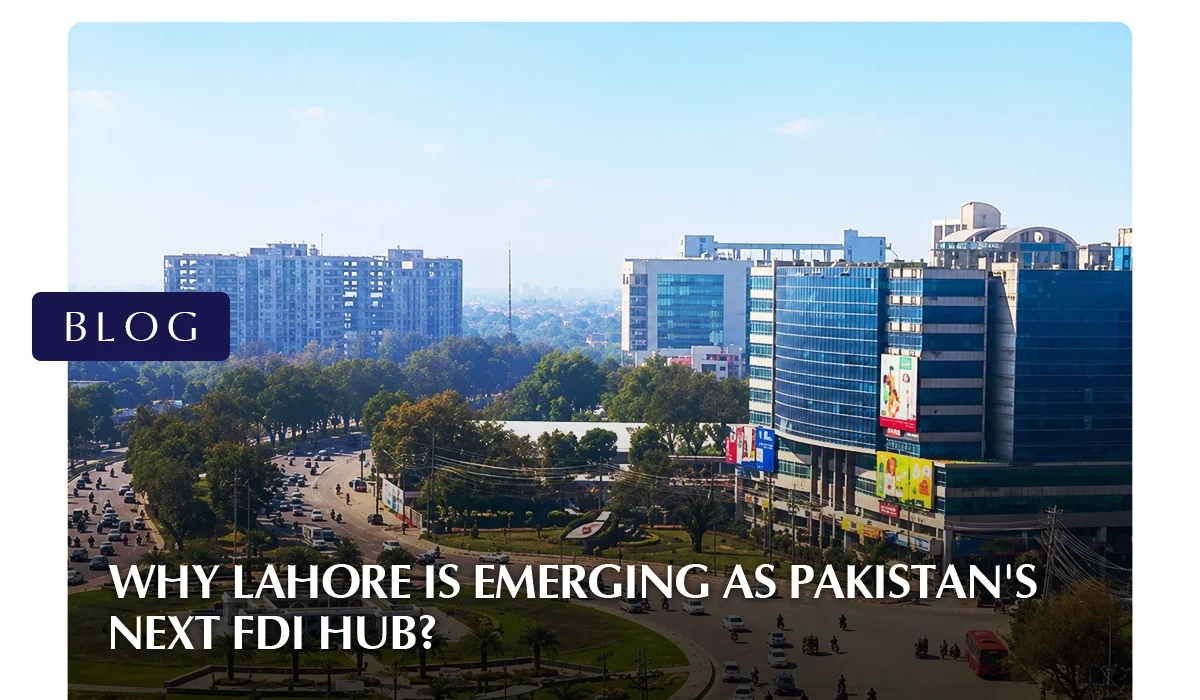

For decades, conversations about foreign direct investment in Pakistan have centred almost exclusively on Karachi and Islamabad. That narrative is shifting. Lahore, Pakistan’s cultural capital and economic heartland of Punjab, is rapidly carving out its own identity as a destination for serious, long-term foreign capital. The signals are converging: government-backed infrastructure, a maturing real estate builders market, and now, landmark private-sector investment events that are putting the city on the radar of global investors.
Pakistan’s FDI Trajectory: The Foundation Is Being Laid
Before examining Lahore specifically, it is worth understanding the broader economic backdrop. Pakistan’s total FDI reached approximately $2.567 billion in 2024, a 25% jump from the year prior, and the highest level since 2017. The construction and real estate sectors attracted a significant share of that inflow.
At the same time, the State Bank of Pakistan‘s benchmark interest rate came down sharply from a peak of nearly 22% in 2023, easing the cost of financing and injecting renewed confidence into the investment environment.
This is not a coincidence. The government has been working to make Pakistan’s investment climate more structured and transparent, from FBR valuation revisions in Lahore to REIT-friendly tax exemptions in the federal budget. The reforms are modest in isolation, but together they signal an intent to formalise a market that international investors have historically found opaque.
The real estate sector specifically is projected to grow at 8–10% annually over the next five years. Rental yields in Lahore, Islamabad, and Karachi are running at 5–7%, competitive against regional benchmarks and considerably better than saturated markets like Dubai, where yields have compressed to a similar range but at far higher entry costs.
Why Lahore, and Why Now
Lahore is Pakistan’s second-largest city and the provincial capital of Punjab, the country’s most populous and economically productive province. It houses a concentration of manufacturing, services, retail, and education that no other Pakistani city outside Karachi can match.
Yet until recently, its real estate market, particularly in the premium and commercial segments, remained largely underdeveloped relative to its economic weight.
That is changing fast, driven by two parallel forces.
The first is the emergence of Lahore’s Central Business District. The Punjab Central Business District Development Authority (PCBDDA) has undertaken a government-backed urban regeneration initiative spanning over 105 hectares in the heart of the city, along the Gulberg Main Boulevard and Ferozepur Road corridor.
The project, designed around vertical growth, smart infrastructure, and mixed-use zoning, has already generated over PKR 35.89 billion in revenue through the auction of commercial plots alone.
With a preliminary investment estimate ranging between PKR 2,700 billion and PKR 3,000 billion, it represents the most ambitious urban development undertaking in Punjab’s history.
Towers in the 500–700 feet range are planned. International-grade office space, luxury residences, retail podiums, and green mobility infrastructure are all part of the blueprint.
Gulberg itself, immediately adjacent to the CBD zone, is already among Pakistan’s most commercially valuable addresses. It serves as the operational hub for banks, multinationals, professional services firms, and luxury retail. The CBD development is effectively the formal next chapter of what Gulberg has been building organically for four decades.
The second force is private-sector momentum. Developers are increasingly committing capital to premium integrated projects in and around this corridor, projects that combine residences, corporate offices, and curated retail under one address, designed for an urban professional class that is growing in both size and purchasing sophistication.
Chakor’s $200 Million FDI Signing: A Signal, Not Just a Headline
In June 2026, Pakistan’s leading real estate developer Chakor concluded a landmark FDI signing with OLAE, a Portuguese investor delegation, at the Chakor Global Initiative event in Islamabad.
The signing formalised a combined European investment commitment of 200 million USD across two Chakor development projects, one of which is Citadel Prime, Chakor’s flagship mixed-use tower in CBD Lahore.
This is significant on multiple levels.
First, it is a European capital entering Pakistan’s real estate sector, a segment of FDI that has historically been dominated by Gulf and diaspora money. The involvement of OLAE, led by Prof. Dr. Jose Paulo Oliveira, points to broadening international interest in Pakistan’s investment story beyond its traditional feeder markets.
Second, and more relevant to Lahore’s FDI narrative specifically, is where the capital is going. Citadel Prime sits directly on Gulberg Main Boulevard, the heart of Lahore’s prime commercial corridor.
The project is a 50+ floor mixed-use development offering premium residences, government-backed business hubs, high-end retail across three podium levels, and smart infrastructure including EV-ready parking and advanced HVAC systems.
It is, in its conception, a product built for the kind of urban density and quality that global investors recognise.
That statement is worth sitting with. The demand for investable, institutional-quality real estate in Lahore exists. What has been missing until recently is the supply side keeping pace with that demand.
What Makes Lahore Attractive to Foreign Capital
Several structural factors underpin Lahore’s emergence as an FDI destination.
Its demographics are compelling. Lahore is rapidly urbanising, with a growing professional middle class demanding quality commercial and residential real estate.
The city is expected to be part of Pakistan’s urban-majority transition by 2030, sustaining long-term demand in a way that short-cycle investment in peripheral housing schemes cannot.
Its infrastructure is improving. The Orange Line metro, Ring Road expansions, and the Route 47 smart road link have materially improved connectivity within and around the city. The CBD zone specifically benefits from multiple public transport access points, reducing friction for businesses and residents alike.
Its regulatory environment is becoming more investor-friendly. Lahore’s FBR valuation rates were revised and harmonised with market values in late 2024, improving transaction transparency. The REIT framework has been strengthened, opening the door to institutional participation in the commercial property market.
And its geography matters. Lahore is Pakistan’s closest major city to the Indian subcontinent’s broader trade routes, and its position along the CPEC corridor gives it infrastructure adjacency that secondary cities lack.
The Road Ahead
Lahore is not yet a finished FDI story. It is, more accurately, a market at inflection where the foundational work of infrastructure, regulatory reform, and institutional real estate development is creating the conditions for sustained foreign capital inflow. The Chakor-OLAE signing is one data point in what is becoming a more credible trend.
For global investors evaluating South Asia’s real estate markets, Lahore now offers something that was previously absent: bankable projects in premium locations, backed by developers with the track record and credibility to deliver.
Citadel Prime is the most visible expression of that proposition today, a 50-floor landmark on Gulberg’s most coveted address, carrying European FDI into its foundations.
The city is ready. The projects are live. The capital is arriving.
For more information on types of property taxes, and real estate investment options, please visit Chakor.
Read More:

BBC-featured Content Specialist with a sharp eye for search intent and a proven ability to turn content into a growth engine. I leverage cutting-edge digital marketing tools to craft strategies that fuel organic traffic, amplify brand growth, and own the local SEO landscape, particularly across the competitive real estate market. I help brands dominate search rankings and convert visibility into measurable business success.
