
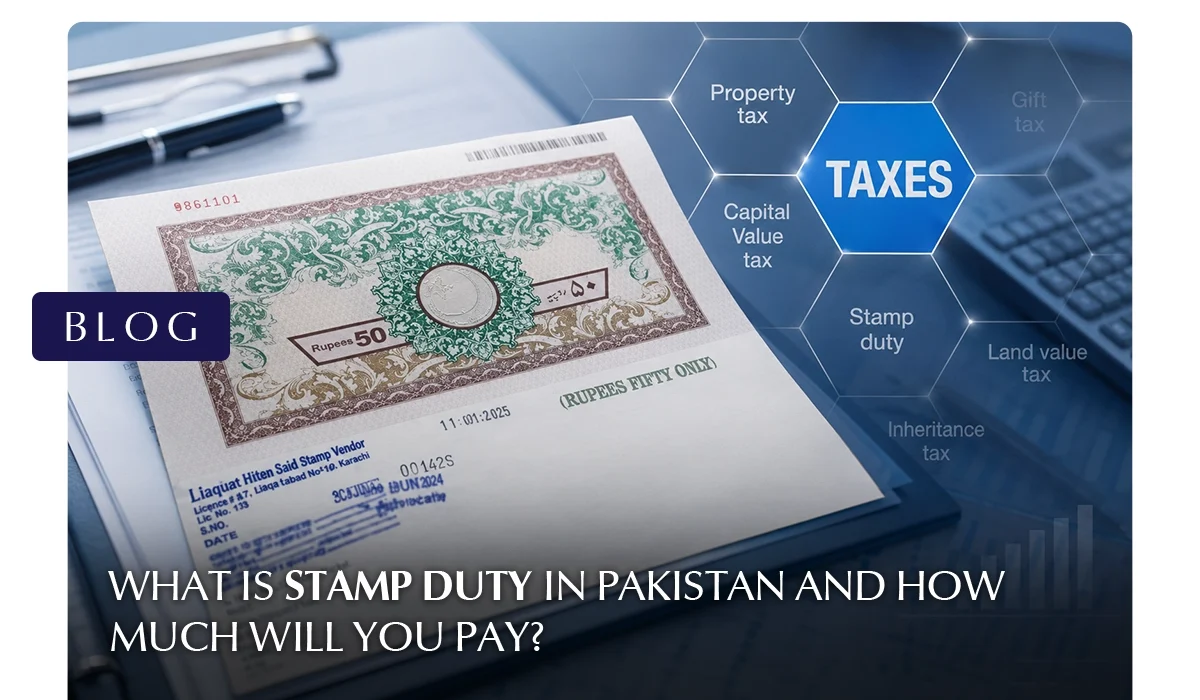

Buying or selling property in Pakistan comes with more costs than just the sale price. One charge that every buyer must understand and budget for is stamp duty. Yet many people complete an entire property deal without fully grasping what stamp duty is, how much they owe, or how it differs across Punjab, Sindh, KPK, and Balochistan. This guide covers everything: what stamp duty Pakistan is, the latest 2026 provincial rates, how it’s calculated, who pays it, available exemptions, and how to pay it online. Whether you’re a first-time buyer or a seasoned investor, this is your definitive reference.
What Is Stamp Duty Pakistan?
Stamp duty is a provincial tax levied on legal documents, most commonly those related to the transfer of immovable property, such as sale deeds, gift deeds, lease agreements, and affidavits.
It is primarily governed by the Stamp Act of 1899, with each province empowered to set its own specific rates and procedures through provincial Finance Acts.
Beyond being a government revenue tool, stamp duty serves a critical legal function: it validates ownership and makes your property documents admissible as evidence in court. Without paying stamp duty, a buyer cannot legally claim rights over the property, and no Sub-Registrar’s office will process the registration.
Rates of Stamp Duty Rates Pakistan 2026 – Province by Province
Stamp duty rates Pakistan are not uniform nationally. Each province sets its own schedule under the Stamp Act, and rates are revised periodically through provincial Finance Acts. Here is the current breakdown for FY 2025–26:
Punjab – Stamp Duty Pakistan
Punjab uses a fixed-amount stamp duty system for specific document types, rather than a universal percentage rate across all transactions. The Punjab Finance Act 2024–25 revised these amounts upward:
- Sale Deed: PKR 3,000 (increased from PKR 1,200 under the 2024–25 budget)
- Affidavit / Individual Deed: PKR 300 (increased from PKR 100)
- Lease Agreement: PKR 3,000
- Registration Fee: 1% of the DC/FBR-assessed property value
- PLRA Fee: PKR 3,300 flat for properties up to PKR 3 million; 0.1% above PKR 3 million
- Corporation / Municipal Fee: 1% of property value
Punjab is considering reforms to shift toward a unified percentage-based model for greater transparency, but until enacted, buyers should verify current document-specific charges through the Punjab e-Stamping portal or the Bank of Punjab’s Form 32 system.
Sindh – Stamp Duty Pakistan
Sindh levies a 2% stamp duty on property transactions, calculated on the DC (Deputy Commissioner) rate value. Rates can vary based on property type, location, and the nature of the transaction. Buyers should consult the Sindh Board of Revenue for specifics, particularly for commercial or agricultural land deals.
Khyber Pakhtunkhwa (KPK) – Stamp Duty Pakistan
KPK applies a 3% stamp duty on property transfers for FY 2025–26. Additional charges include:
- Capital Value Tax (CVT): 1%
- Registration Fee: 0.5%
For a PKR 10 million property in KPK, the CVT alone amounts to PKR 100,000, making comprehensive budgeting essential.
Balochistan – Stamp Duty Pakistan
Balochistan follows a 4% stamp duty rate, applied to the official DC rate value of the property rather than the market transaction price.
Islamabad Capital Territory (ICT) – Stamp Duty Pakistan
For property sales in ICT, stamp duty is currently charged at 2% of the DC Rate. This is separate from the registration fee, which stands at approximately 1% of the DC Rate. Buyers in Islamabad should budget for both charges alongside other applicable taxes.
Note: There were discussions and proposals regarding rate adjustments under the Finance Act 2025 for ICT, but the operative stamp duty rate confirmed by legal practitioners in Islamabad remains 2%. Always verify the current schedule directly with the ICT Sub-Registrar’s office or a qualified property lawyer before finalising any transaction.
Stamp Duty Pakistan – Rates by Province
| Province / Territory | Stamp Duty Pakistan | Calculated On |
| Punjab | Fixed per document type (e.g. PKR 3,000 for a sale deed) | Document / DC Value |
| Sindh | 2% | DC Rate Value |
| KPK | 3% | DC Rate Value |
| Balochistan | 4% | DC Rate Value |
| Islamabad (ICT) | 2% | DC Rate Value |
Note: Stamp Duty Pakistan rates are subject to revision each fiscal year. Always verify with your provincial Sub-Registrar or Board of Revenue before finalising a transaction.
What Is the DC Rate and Why Does It Matter?
Stamp duty Pakistan is calculated on the DC (Deputy Commissioner) rate, the government’s official assessed value of a property, rather than the actual market transaction price. DC rates are set annually by each province’s Board of Revenue.
Crucially, DC rates are typically 30–50% lower than the actual market value. This means your stamp duty liability is substantially less than it would be if calculated on the sale price you negotiate with the seller.
For example, a property transacting at PKR 20 million in Lahore may carry a DC rate of PKR 10–12 million, and stamp duty is computed on the latter figure.
Commercial properties are typically rated 2–3 times higher than residential properties in the same area, meaning the absolute stamp duty payable on a commercial transaction will be significantly larger even if the percentage rate is identical.
How Is Stamp Duty Calculated in Pakistan?
The basic formula is:
Stamp Duty = DC Rate Value × Applicable Provincial Rate
Example KPK Property:
- DC Value: PKR 10,000,000
- Stamp Duty (3%): PKR 300,000
- CVT (1%): PKR 100,000
- Registration Fee (0.5%): PKR 50,000
- Total: PKR 450,000
Example ICT Property:
- DC Value: PKR 10,000,000
- Stamp Duty (2%): PKR 200,000
- Registration Fee (1%): PKR 100,000
- Total: PKR 300,000
The difference between ICT’s rate and KPK’s rate on the same property is PKR 150,000, illustrating why understanding property stamp duty by province matters when choosing where to invest.
Who Pays Stamp Duty Pakistan?
The buyer is generally responsible for paying stamp duty at the time of property registration. This is established under Section 29 of the Stamp Act 1899, which provides that in the case of a conveyance, the expense of providing the proper stamp is borne by the grantee. The seller, meanwhile, is typically liable for other taxes such as Capital Gains Tax (CGT) and FBR advance tax under Section 236C.
For buyers, additional FBR advance tax under Section 236K is also payable at the time of transfer. Rates differ significantly depending on whether the buyer is on the FBR’s Active Taxpayer List (ATL):
- Active Filer: 1% of the transaction value
- Non-Filer: 2% of the transaction value
Being a registered tax filer can produce meaningful savings. Non-filers face double the withholding tax rate, and additionally face much steeper Capital Gains Tax exposure if they later sell the property.
When Must Stamp Duty Be Paid?
Stamp duty must be paid before the execution and registration of the property transfer deed. Under Section 35 of the Stamp Act 1899, no instrument chargeable with duty shall be admitted in evidence, acted upon, or registered unless it is duly stamped.
Attempting to register without first paying stamp duty will result in rejection by the Sub-Registrar’s office. Late payment attracts penalties, fines, and potential legal complications affecting the property’s title chain.
Stamp Duty Exemptions and Rebates in Pakistan
Certain categories of buyers and transactions are eligible for exemptions or reduced rates:
First-Time Buyers: May be eligible for relief from certain federal duties on their first property purchase. The specifics vary by province and should be confirmed with the relevant revenue authority.
Low-Value Properties: Properties below certain provincial thresholds may qualify for reduced or nil stamp duty, varying by province.
Agricultural Land: Generally exempt from stamp duty in most provinces, subject to specific provincial rules.
Gift Deeds (ICT): In Islamabad, gift deeds to immediate family members attract a reduced stamp duty rate of approximately 1% of the DC Rate, compared to 2% for outright sales.
Corporate Mergers (Punjab): The Lahore High Court has suspended stamp duty on corporate mergers in Punjab, bringing it in line with existing exemptions in Sindh and Islamabad, a significant development for M&A activity.
To claim any exemption, you will typically need:
- Valid CNIC
- Proof of eligibility (e.g., a first-time buyer affidavit)
- Property valuation documents
- Any additional documentation specified by the provincial revenue authority
Property Stamp Duty by Province: Online Payment & Portals
Most provinces now offer digital e-stamping facilities, reducing the need for physical visits to revenue offices:
- Punjab: Punjab e-Stamping Portal pay via designated bank branches or online challan. The Bank of Punjab’s Form 32 system is also widely used.
- Sindh: Sindh Board of Revenue Portal check valuations and generates challans.
- Federal / ICT: FBR Portal for federal-level guidance and ICT-specific rates.
These platforms have significantly improved transparency, reduced delays, and minimised opportunities for fraud at land registries.
Other Charges to Budget for Alongside Stamp Duty
Stamp duty is only one component of the total cost of a property transaction in Pakistan. A comprehensive budget must also include:
- Registration Fee: 1% (Punjab, ICT); 0.5% (KPK)
- Capital Value Tax (CVT): 1% in KPK; varies by province
- FBR Advance Tax (Section 236K): Paid by buyer 1% for active filers, 2% for non-filers
- FBR Advance Tax (Section 236C): Paid by seller
- Capital Gains Tax (CGT): 15% for filers on profit if property sold within the first year, reducing annually to zero after five years; non-filers face rates between 30–45%
- Mutation Fee / TMA Tax: Province-specific
Ignoring these associated costs is one of the most common mistakes buyers make, often leading to financial stress or legal delays at the registry.
Recent Developments and Upcoming Reforms
Several significant changes are shaping stamp duty Pakistan in 2025:
Lahore High Court Ruling: The court suspended stamp duty on corporate mergers in Punjab, potentially unlocking business consolidation activity and aligning Punjab with Sindh and Islamabad on this point.
Standardisation Discussions: Talks are underway at the federal level to harmonise stamp duty rates across provinces, with a potential shift toward a uniform percentage-based model. This would simplify transactions significantly, but has not yet been enacted.
Punjab Fixed-Amount Review: Punjab is actively considering replacing fixed rupee amounts per document type with a market-linked percentage system for greater transparency and consistency.
Buyers and investors should monitor provincial Finance Acts announced each June/July for the latest changes, and consult a qualified property lawyer before concluding any transaction.
FAQs About Stamp Duty Pakistan
Q: Is stamp duty the same as registration fee in Pakistan? No. Stamp duty P and registration fee are separate charges. Stamp duty validates the document legally under the Stamp Act 1899; the registration fee is paid under the Registration Act 1908 to record the transfer in official land records. Both are payable at or before registration.
Q: Can stamp duty be paid online? Yes, in Punjab and several other provinces, stamp duty can be paid via the e-stamping portal or through designated bank branches. Obtaining an e-stamp certificate is now the standard and preferred method.
Q: What happens if I don’t pay stamp duty? Under Section 35 of the Stamp Act 1899, the property transfer deed cannot be registered without stamp duty payment. If a document is later found to be insufficiently stamped, it can be impounded and subjected to penalties.
Q: Is stamp duty different for residential and commercial property? In most provinces, the percentage rate is the same, but DC rates differ significantly. Commercial properties carry a DC rate 2–3 times higher than residential, resulting in a larger absolute stamp duty payment.
Q: Does stamp duty apply to gifted or inherited property? Gift deeds attract stamp duty in most provinces, though family gift deeds in ICT benefit from a reduced 1% rate. Inherited property through succession is generally treated differently; consult the provincial revenue department for applicable charges.
Q: What is the stamp duty rate in Islamabad? The current operative rate for property sale in Islamabad (ICT) is 2% of the DC Rate, plus a 1% registration fee. Confirm the latest schedule with the ICT Sub-Registrar’s office before transacting.
Final Thoughts – Stamp Duty Pakistan
Stamp duty Pakistan is a non-negotiable part of any property transaction, but its complexity lies in the provincial variation in rates, the gap between DC value and market value, and the layers of additional taxes that accompany it. Whether you’re buying in Lahore, Karachi, Peshawar, or Islamabad, the total cost picture changes significantly.
The key takeaways:
- Always calculate stamp duty on the DC rate, not the market price
- Verify the current provincial Finance Act schedule before closing a deal
- Register as a tax filer with FBR, and the savings on Section 236K and CGT can be substantial
- Use official e-stamping portals for payment to avoid complications
- Budget for CVT, registration fee, and FBR advance taxes alongside stamp duty
- When in doubt, engage a qualified property lawyer; the cost is small relative to the transaction value
With the right preparation, stamp duty doesn’t have to be a surprise cost; it’s a manageable, knowable expense that smart property buyers factor in from day one.
For more information on types of property taxes and real estate investment options, please visit Chakor.
Sources:

BBC-featured Content Specialist with a sharp eye for search intent and a proven ability to turn content into a growth engine. I leverage cutting-edge digital marketing tools to craft strategies that fuel organic traffic, amplify brand growth, and own the local SEO landscape, particularly across the competitive real estate market. I help brands dominate search rankings and convert visibility into measurable business success.
