
If you own land or property in Punjab, there are three things you need to know right now. First, there is an official government portal where you can search your PLRA land record online. Second, the traditional Fard, the document Pakistanis have relied on for centuries to prove ownership, is being replaced. Third, the new replacement is called the Green Property Certificate, and it changes everything about how property ownership works in Punjab.
This guide covers everything in plain language. Whether you want to do a quick PLRA land search, understand what PLRA online Fard means, or learn how to get the new Green Certificate, you will find the answers here.
What is PLRA? Understanding the Basics
PLRA stands for Punjab Land Records Authority. It is a government body set up under the PLRA Act 2017, and it works under the Board of Revenue, Punjab. Its job is to manage, digitize, and maintain land records for the entire province.
Before PLRA, property records were kept manually by Patwaris — local officials who maintained physical registers. This old system was slow, easy to corrupt, and often led to forged documents and land disputes. PLRA was created to fix exactly that.
Today, PLRA runs a digital system that covers millions of properties across Punjab. It operates Arazi Record Centers (ARCs) in every district and tehsil, and it runs an online portal at punjab-zameen.gov.pk where citizens can access their records.
Quick fact: PLRA’s digital land project is backed by the World Bank with USD 150 million in funding. It includes a full GIS mapping survey of all state land in Punjab.
What is PLRA Online Fard and How to Get It?
Fard (فرد) is the extract of the Record of Rights. In simple terms, it is the document that proves you own a piece of land. For decades, getting a Fard meant visiting the Patwari’s office, dealing with middlemen, paying unofficial fees, and waiting days or weeks. The process was slow and open to corruption.
What Changed with PLRA Online Fard?
PLRA digitized the entire system. Now you can get your PLRA online Fard in minutes from your phone or computer. The digital Fard is:
- Legally valid and accepted for all property transactions
- Verify with a QR code scan to confirm authenticity instantly
- Free to download from the official PLRA portal
- Accessible to overseas Pakistanis using NICOP
The old days of paying touts or agents just to get a copy of your own property document are over.
How to Get Your PLRA Online Fard
- Visit rod.pulse.gop.pk
- Enter your CNIC number
- Select your district and tehsil
- Your property record will appear
- Click the Download or Print option to get your Fard
Every digital Fard has a unique QR code. You or anyone else can scan this code on the PLRA portal to instantly verify that the document is genuine.
Important Update — Fard is Being Replaced
As of 2026, PLRA has started replacing the traditional Fard with a new document called the Green Property Certificate. The pilot started in Sahiwal district on May 1, 2026. The province-wide rollout is expected to be complete by December 2026.
Once fully launched, property transactions in Punjab will no longer be done through Fard. The Green Property Certificate will be the only accepted ownership document for buying, selling, or transferring land.
This does not mean your existing Fard becomes worthless immediately but it does mean you should start understanding the Green Certificate process now.
What is a Green Property Certificate?
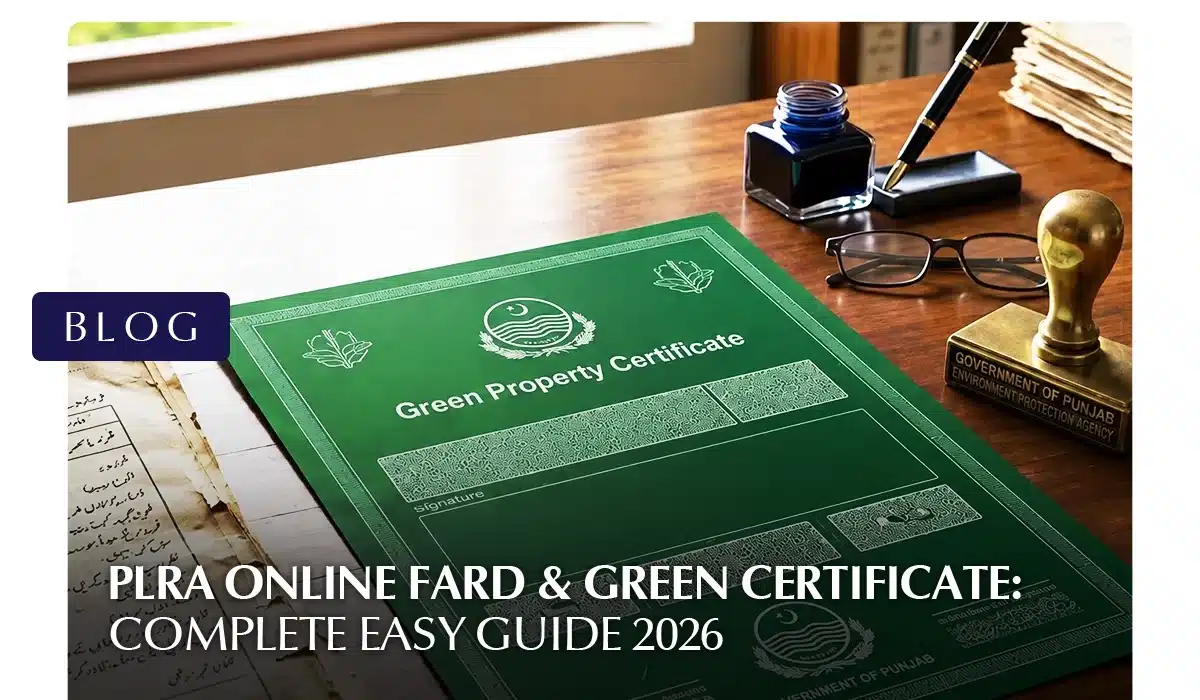
The Green Property Certificate (commonly called the Green Certificate) is a modern, electronically generated ownership document issued by PLRA. It verifies the legal status, ownership, and possession of a specific piece of land.
Unlike the old Fard, the Green Certificate does not just show who owns the land on paper. It also confirms:
- That the owner is in actual physical possession of the land
- That there are no unpaid taxes or government dues on the property
- That no bank mortgage or financial encumbrance exists
- That no active court case is attached to the property
- The exact boundaries of the land (measured using GPS/DGPS technology)
This makes it a far more complete and trustworthy document than the old Fard ever was.
Why Was the Green Certificate Created?
The Fard system served Punjab for centuries, but it had serious weaknesses. A Fard could be forged. It did not confirm possession. It did not check for mortgages or court orders. Property scams, fake registries, and duplicate documents were common.
The Green Certificate solves all of this in one document. It is tamper-proof, digitally signed, QR-coded, and stored in a cloud-based government database. No one can manually edit or overwrite it.
Punjab’s 485-year-old manual property registration system, introduced in 1540, is being replaced by this digital platform.
Green Certificate Program — How It Works (10-Step Process)
Applying for a Green Property Certificate is a thorough process. Here is every step explained in simple language, based on official PLRA information.
Step 1 — Token Issuance and Process Initiation
Visit your nearest Arazi Record Center (ARC) or Service Center. At the reception, tell the staff you want to apply for a Green Property Certificate. They will issue you a service token and open your case in the PLRA system.
Step 2 — Provide Property Details and Pay the Fee
Submit complete details of your land or property. The application fee is PKR 900. You can pay at the Bank of Punjab (BOP) counter inside the ARC, at any BOP branch, or through PSID using JazzCash, EasyPaisa, or online banking.
Step 3 — Identity Verification
Your identity is verified through NADRA biometrics. You must bring your original CNIC. Your registered mobile number and basic record details are also cross-checked with what is in the PLRA registry.
Step 4 — Ownership Record and Transaction History Review
The system reviews your full ownership history and checks for any complications, including unpaid taxes or government dues, bank mortgages or financial encumbrances, and active court orders or legal disputes.
Step 5 — Field Survey and Site Inspection
A PLRA surveyor visits your property in person. Using modern GPS/DGPS technology, they measure the exact boundaries and confirm the precise area of your land. This step ensures that what is recorded on paper matches what exists on the ground.
Step 6 — Neighbor / Witness Verification
At least two neighboring landowners from your area whose records are already in the PLRA computerized system must give statements confirming that you are in actual possession of the land. Their identity is verified through biometric scanning. This step protects against fake ownership claims.
Step 7 — Gazetted Officer and Revenue Staff Verification
Authorized supervisory officers at Grade 17 or above from the Punjab government review the complete case and all verification notes. Any issues or objections raised during this stage are handled as per official procedure.
Step 8 — 15-Day Public Notice
After the field survey, your property details are published on the PLRA website for 15 days. This gives anyone, a neighbor, a relative, or any third party, the chance to raise an objection. If no objection is filed within this period, the process moves forward.
Step 9 — Final Verification and Approval
The Assistant Director Land Records (ADLR) or an authorized officer reviews the entire case one final time and grants official approval. Once approved, the certificate is ready.
Step 10 — Green Property Certificate Issuance
After all ten stages are complete, your Green Property Certificate is issued through the Service Center. It includes a unique QR code and secure digital features to prevent fraud. The certificate is your official, government-recognized proof of ownership, possession, and legal status of the property.
PLRA Land Record — What It Contains and Why It Matters
A PLRA land record is the official digital file of your property. It is stored in the PLRA database and contains all the key details about your land or property, including:
- Owner name(s)
- Property size and boundaries
- Location (district, tehsil, village or area)
- Ownership history and transfer records
- Any encumbrances, mortgages, or court orders on the property
- Khasra number (a unique identification number for the plot)
This record is the foundation of every property transaction in Punjab. Before you buy, sell, transfer, or mortgage any land, the first step is always to check the PLRA land record.
Why You Should Check Your PLRA Land Record
Most property disputes in Pakistan happen because people skip this step. Checking the PLRA land record before any transaction helps you confirm that:
- The seller actually owns the property
- No bank has a mortgage on it
- There is no active court case against the property
- The property size and boundaries match what is being sold
- There are no unpaid taxes or government dues
A five-minute check on the PLRA portal can save you years of legal trouble.
PLRA Land Search — How to Find Any Property Record Online
The PLRA land search service lets you look up property records online without visiting any government office. It is free, available 24/7, and takes only a few minutes.
PLRA – The Official Portal
The official PLRA portal is punjab-zameen.gov.pk; this is the only authentic government website for Punjab land records. Citizens can also use the related portal at rod.pulse.gop.pk for the online ownership record search.
How to Do a PLRA Land Search — Step by Step
- Open your browser and go to rod.pulse.gop.pk
- Enter your 13-digit CNIC number (without dashes)
- Select your property’s district and tehsil from the dropdown menu
- The system will pull up all properties registered under your CNIC
- Select your property to view the full land record
- You can view or download your Fard (ownership document) from here
You can search by CNIC, property ID, or owner name. Overseas Pakistanis can also use their NICOP to search and download records from abroad.
What You Can Do Through PLRA Land Search
- View current ownership details
- Check transaction and transfer history
- Download a copy of your Fard
- Verify if a property is free of disputes before buying
- Check unpaid taxes or bank encumbrances
The PLRA land search is one of the most useful tools available to property owners in Punjab. Use it before every transaction, no exceptions.
Green Certificate — Important Rules and FAQs
Fee and Payment
Application fee: PKR 900. Payable at the BOP counter at ARC, any BOP branch, or via PSID through JazzCash, EasyPaisa, or online banking.
What Documents Do You Need?
- Original CNIC
- Existing Fard or Registry (proof of ownership)
- Property details (district, tehsil, Khasra number)
What Happens to Other Transactions During the GPC Process?
Once the Green Certificate process begins for a property, all other transactions on that property are temporarily suspended. You cannot sell, transfer, or mortgage the land until the process is complete.
What If Your Application is Rejected?
If a Green Certificate cannot be issued, you will receive a refusal letter explaining the reasons. You can file an appeal before the concerned Assistant Commissioner within 30 days. You can also reapply once the cause of rejection has been resolved.
Three Types of Property Reports Under the Green Certificate System
| Report Type | Purpose | Details |
| Non-Transactional | Information only | Shows ownership and land use. Does not create or transfer any legal rights. |
| Semi-Transactional | Legal/administrative use | Used for security documentation. May include encumbrance verification. |
| Transactional | Property transfer | Issued specifically for property transfer. Linked directly to the electronic registration system. |
Special Cases – Green Certificate
Can I get a GPC for agricultural land if I am a joint owner?
For agricultural land, all co-owners must agree. If they do not, legal partition of the land must be completed first under the Punjab Land Revenue Act 1967. After the partition, each owner can apply independently.
What if I am a co-owner of residential or commercial land?
If the land use has been converted from agricultural to residential, commercial, or industrial, a single co-owner may apply independently, without needing the consent of other owners.
Can one GPC cover multiple Khasra numbers?
No. Each property with its own boundaries and unique identification number requires a separate GPC. However, developed residential, commercial, or industrial land made up of multiple Khasras may be consolidated into a single unit through parcel-based mapping.
Can I get a GPC for built-up or urban property?
Yes. A Green Certificate can be issued for properties in built-up or urban areas, including unplanned developed areas, as long as ownership is confirmed through land records. Local land use laws must be followed.
How can I verify a Green Certificate?
Scan the QR code printed on the certificate using the PLRA verification app or portal. Verification is instant and free.
Rollout Timeline — When Does the Green Certificate Affect You?
| Phase | Districts | Timeline |
| Early pilot (8 districts) | Lahore, Sheikhupura, Kasur, Narowal, Mandi Bahauddin, Gujrat, Wazirabad + 1 | 2025 (complete) |
| Expanded (20 districts) | 20 districts across Punjab | January 2026 (complete) |
| Fard pilot replacement | Sahiwal (mandatory) | May 1, 2026 (active) |
| Next phase | Lodhran and Hafizabad | July 1, 2026 (planned) |
| Full Punjab rollout | All 36 districts | December 2026 (target) |
Always verify the latest dates directly at punjab-zameen.gov.pk before completing any property transaction, as implementation timelines may be updated.
ARC Helpdesk — How to Reach PLRA
PLRA Helpline: 042-111-22-22-77
Official Portal: punjab-zameen.gov.pk
Land Record Search Portal: rod.pulse.gop.pk
PLRA has over 150 Arazi Record Centers (ARCs) across Punjab. Walk in to any ARC in your district or tehsil for in-person assistance with PLRA land search, Fard download, or Green Certificate application.
Final Takeaway – PLRA Online Fard
Pakistan’s land record system is going through its biggest change in over 400 years. The PLRA has already moved PLRA land records online, made PLRA online Fard accessible to every citizen with a CNIC, and launched the Green Certificate program that is replacing the traditional Fard entirely.
If you own property in Punjab, the most important things to do right now are:
- Check your PLRA land record on the official portal to make sure everything is correct
- Download your PLRA online Fard and verify the QR code
- Understand the Green Certificate process and apply when your district is covered
- For any transaction, buying, selling, or transferring, always do a PLRA land search first.
For a more informative blog on real estate, property laws, or property taxes in Pakistan, visit Chakor blogs.
Source:

BBC-featured Content Specialist with a sharp eye for search intent and a proven ability to turn content into a growth engine. I leverage cutting-edge digital marketing tools to craft strategies that fuel organic traffic, amplify brand growth, and own the local SEO landscape, particularly across the competitive real estate market. I help brands dominate search rankings and convert visibility into measurable business success.
