
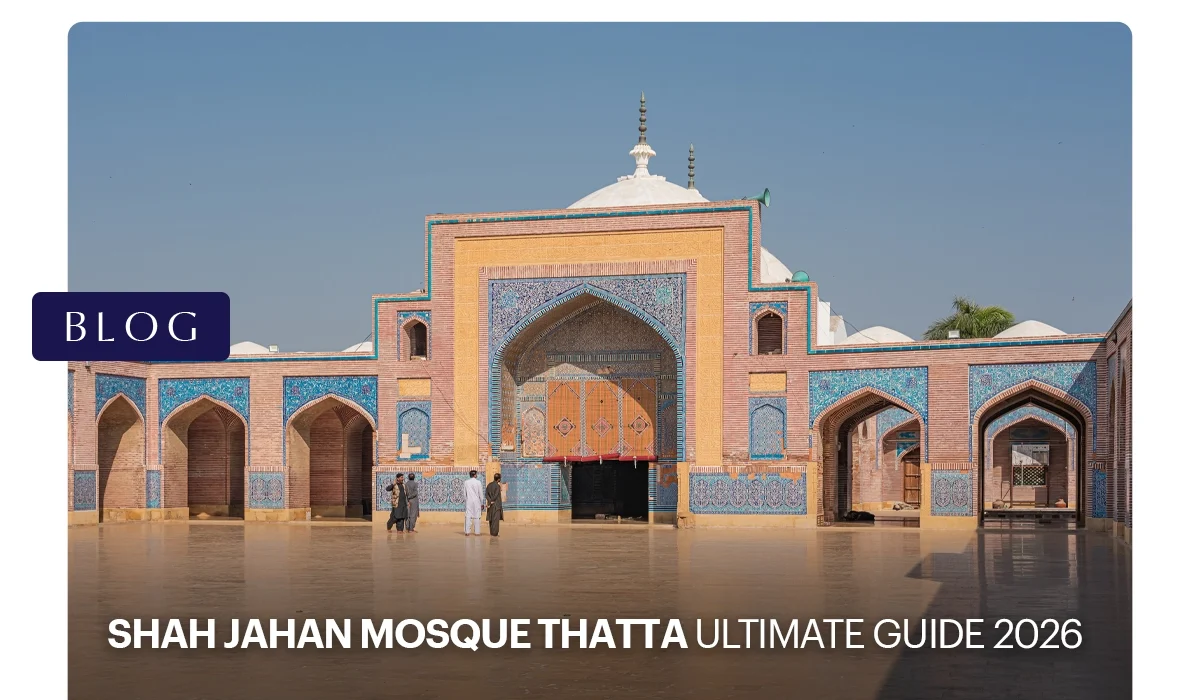

The Shah Jahan Mosque Thatta is one of the most unique Mughal-era mosques in Pakistan. Located in Thatta, it is famous for its 93 domes, intricate tile work, and remarkable acoustic design. Built in the 17th century by Shah Jahan, the mosque stands apart from other Mughal monuments due to its use of brick and glazed tiles instead of marble. If you are wondering where Shah Jahan Mosque is located, why it is famous, or what makes its architecture unique, this guide covers everything in detail.
What is Shah Jahan Mosque Thatta?
The Shah Jahan Mosque Thatta is a 17th-century Mughal mosque located in Thatta, Sindh, Pakistan. It is known for its 93 domes, blue tile decoration, and advanced acoustic design.
Shah Jahan Mosque Thatta Key Facts
| Also known as | Jamia Masjid Thatta, Shahjahani Mosque, Badshahi Mosque Thatta |
| Location | The Shah Jahan Mosque is located in Eastern Thatta, Sindh, Pakistan |
| Coordinates | 24°44′50″N, 67°55′41″E |
| Built | 1644–1647 CE (eastern addition 1659) |
| Commissioned by | Mughal Emperor Shah Jahan |
| Architectural style | Mughal, Timurid, Safavid Persian, Sindhi |
| Total domes | 93 (official); some sources cite 100, including smaller domes |
| Arches | 33 |
| Minarets | None |
| Total dimensions | 305 ft × 170 ft |
| Courtyard size | 169 ft × 97 ft |
| Prayer capacity | Up to 20,000 worshippers |
| Materials | Red brick, glazed blue tiles (from Hala, Sindh) |
| UNESCO status | Tentative list since 1993 (not yet fully inscribed) |
| Distance from Karachi | ~100 km (~1.5–2 hours by road) |
| Construction cost | 9 lakh rupees (17th-century value) |
| Entry fee | Free |
| Maintained by | Directorate General of Antiquities, Govt of Sindh |
Overview of Shah Jahan Mosque Thatta
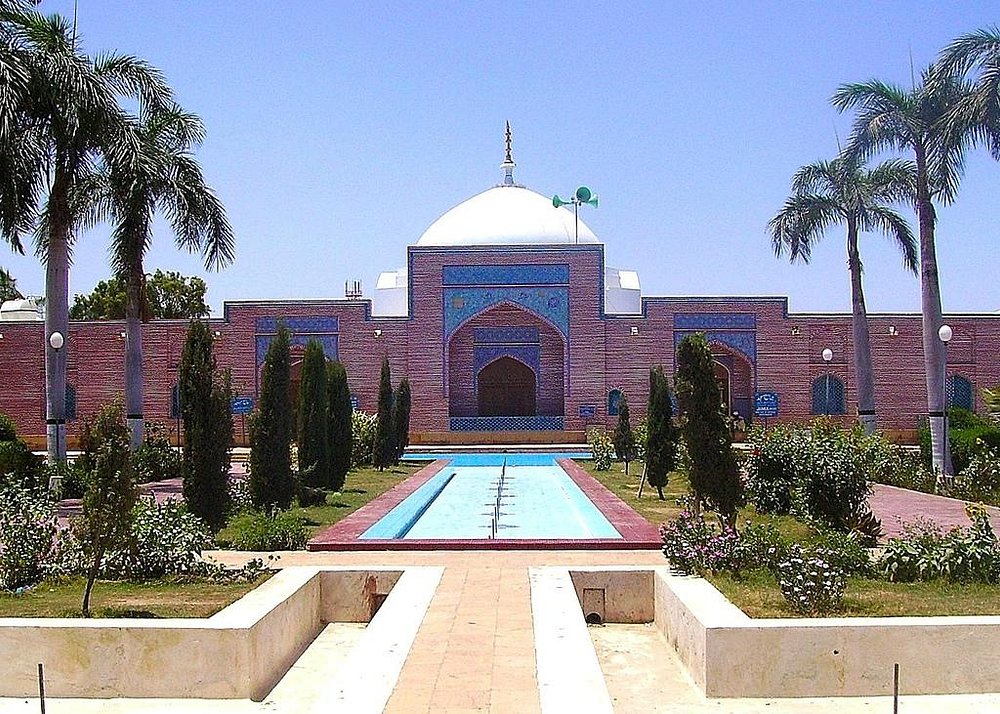
The Shah Jahan Mosque, also known as the Jamia Masjid of Thatta or Shahjahani Mosque, is the main congregational mosque in Thatta, Sindh. It was built during the Mughal period and remains one of Pakistan’s most important historic sites.
- Built between 1644 and 1647 CE
- Commissioned by Emperor Shah Jahan
- Eastern section completed in 1659 under Aurangzeb
- Serves as the central mosque of Thatta
Where is Shah Jahan Mosque Located?
- Situated on the eastern edge of Thatta
- Close to National Highway N-5
- About 100 km from Karachi
- Near the Makli Necropolis (UNESCO World Heritage Site)
- On UNESCO’s tentative list since 1993
Size and Structure of Shah Jahan Mosque
| Feature | Details |
| Total Size | 305 ft × 170 ft |
| Courtyard | 169 ft × 97 ft |
| Number of Domes | 93 |
| Capacity | Up to 20,000 people |
Shah Jahan Mosque Thatta History
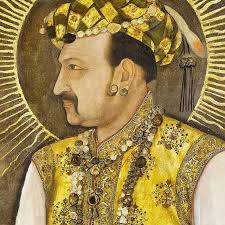
Before becoming emperor, Shah Jahan experienced exile, political conflict, and later returned to power. The mosque was built not just as a religious structure, but as a gesture of gratitude toward the people of Thatta who supported him during a difficult period.
| Person / Place | Role |
|---|---|
| Shah Jahan | Exiled prince who later became emperor |
| Jahangir | Mughal emperor and father of Khurram |
| Nur Jahan | Influential empress involved in succession politics |
| Thatta | City that hosted the exiled prince |
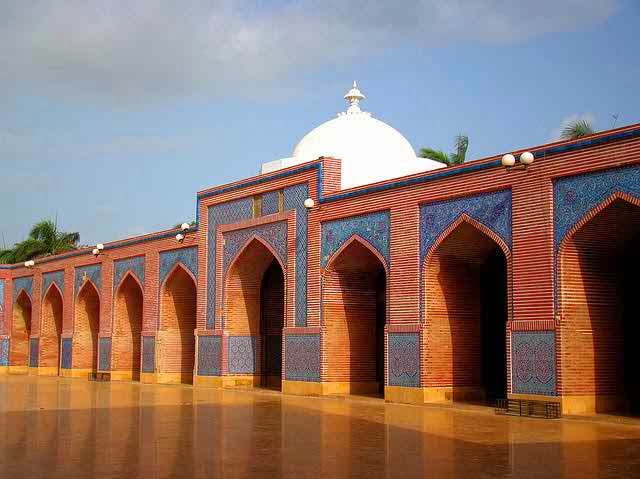
Architecture of the Shah Jahan Mosque Thatta
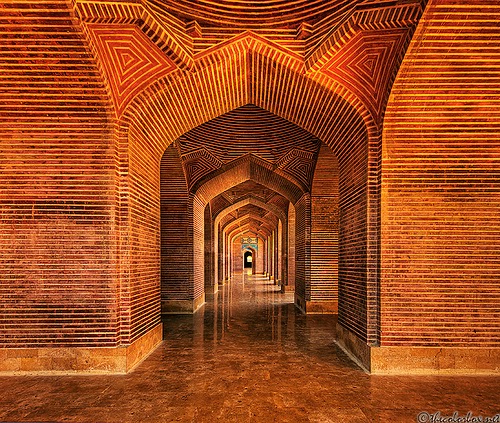
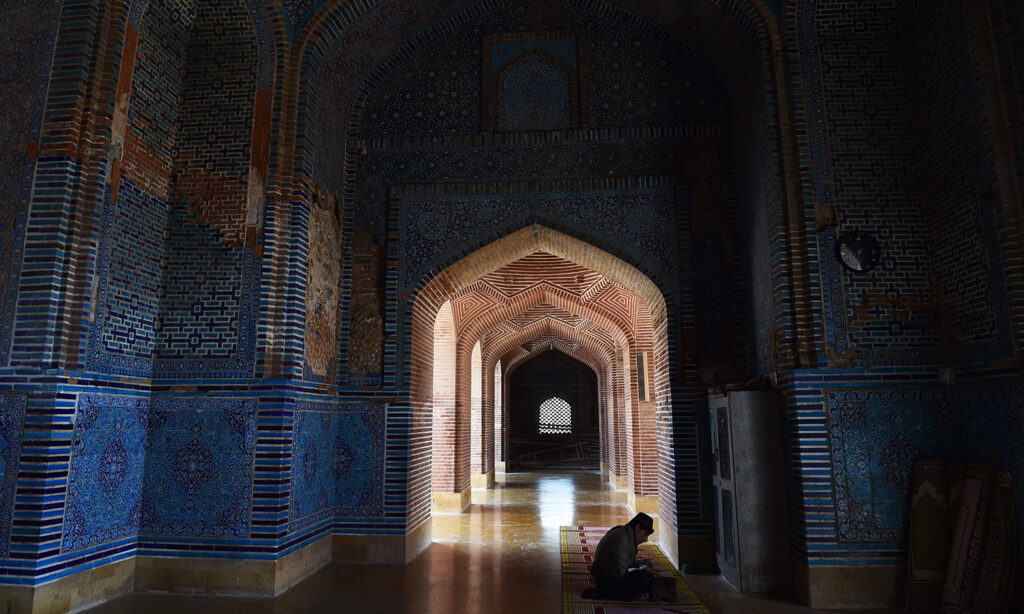
The mosque does not follow a single architectural tradition. Instead, it combines multiple influences into a balanced and functional structure. This blend gives the mosque a distinct identity among Mughal monuments.
Architectural Influences
The design reflects a combination of imperial and regional styles. It brings together Mughal planning with Persian and Central Asian aesthetics, while also adapting to local conditions in Sindh.
- Mughal influence can be seen in symmetry and layout
- Persian Safavid style appears in tile work and color schemes
- Timurid Central Asian elements are visible in dome design
- Local Sindhi techniques are reflected in the use of brick and climate adaptation
Compared to other Mughal mosques, the difference is clear. Wazir Khan Mosque focuses on painted decoration, while Badshahi Mosque emphasizes scale and grandeur.
The Caravanserai-Inspired Layout
The layout of the mosque is inspired by a caravanserai, which was a resting place for travelers along trade routes. This concept is rarely used in mosque architecture, making the design unusual.
The structure is built around a central courtyard, creating a sense of openness and balance. Surrounding this space are domed chambers that connect different sections of the mosque.
Key spatial features include:
- Central courtyard measuring approximately 169 ft × 97 ft
- 33 arches forming the boundary of the courtyard
- Two-aisled galleries on the north and south sides
- A large prayer hall facing the courtyard
This arrangement allows smooth movement and accommodates large gatherings.
Layout Overview
| Element | Description |
|---|---|
| Central courtyard | Open space with surrounding arches |
| Galleries | Two-aisled corridors on the north and south |
| Prayer hall | Large domed area facing the courtyard |
| Arches | 33 arches framing the courtyard |
Structural Design and the 93 Domes
One of the most remarkable aspects of the Shah Jahan Mosque Thatta architecture is its system of 93 domes. These domes are carefully arranged to serve both structural and functional purposes.
The building stands on a raised stone base, which provides stability. Thick brick walls and strong square pillars support the weight of the domes. This construction method has helped the mosque remain intact over centuries.
Acoustic Engineering
The mosque is widely known for its natural acoustic system. The shape and placement of the domes allow sound to travel efficiently across the prayer hall.
- A voice from the mihrab can be heard clearly across the mosque
- Sound spreads evenly without distortion
- No need for artificial amplification during prayers
This level of acoustic planning shows advanced understanding of sound behavior, even before modern science explained it.
Ventilation and Light
The mosque is designed to suit the hot climate of Sindh. Its structure allows natural cooling and lighting without relying on modern systems.
Features:
- Small openings allow air circulation
- Interior remains cool in hot weather
- Natural light enters through openings
- No need for artificial lighting during the day
This design reduces heat and improves comfort for visitors and worshippers.
Tilework and Decoration
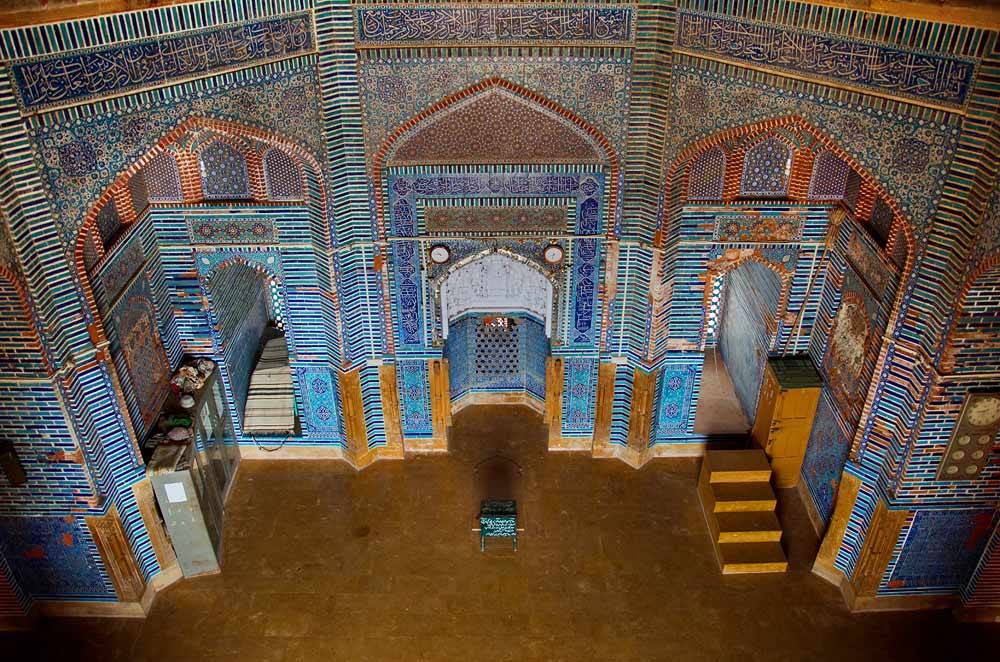
The decorative style of the mosque is one of its most visually striking features. The extensive use of glazed tiles gives the structure its distinct appearance.
- Colors include cobalt blue, turquoise, manganese violet, and white
- Patterns feature geometric shapes and floral designs
- Arabic and Persian calligraphy is used for decoration
- Domes often display star-shaped (stellated) patterns
These elements reflect Persian artistic influence while maintaining a strong regional identity.
What the Mosque Does Not Include?
No Minarets
- Most Mughal mosques have them
- This mosque does not
- Instead, it uses a large entrance gateway (pishtaq)
No Frescoes
- Unlike Wazir Khan Mosque
- Decoration relies on tiles and brickwork only
No Marble
- Other Mughal monuments use marble, such as:
- Taj Mahal
- Agra Fort
- Jama Masjid
- This mosque is built entirely of red brick
- Gives it a warmer and more earthy appearance
Ablution Courtyard Placement
The ablution area is placed differently from the usual mosque design.
Typical design:
- The ablution pool is in the center of the main courtyard
Here:
- Located in a separate square courtyard
- Positioned on the eastern side
- Originally accessed through an arched passage
Shah Jahan Mosque vs Other Mughal Mosques
| Feature | Shah Jahan Mosque | Badshahi Mosque | Wazir Khan Mosque |
|---|---|---|---|
| Material | Brick & tiles | Red sandstone | Tile & fresco |
| Domes | 93 | Few large domes | Smaller domes |
| Minarets | No | Yes | Yes |
| Style | Persian + Sindhi | Mughal imperial | Decorative |
Renovation and Conservation of Shah Jahan Mosque Thatta
The mosque’s physical history did not end with its completion in 1647. An eastern addition was completed in 1659 under Aurangzeb. Further repairs were conducted in 1692 under Emperor Aurangzeb’s orders, and again in 1812 by Murad Ali Khan Talpur, a local Sindhi chieftain.
During British rule, renovations took place in 1855 and 1894. The most recent significant restoration work was carried out in the 1960s and 1970s, with a conscious effort to match original tile styles.
Today, the mosque is maintained by the Directorate General of Antiquities, Government of Sindh. The conservator on site is Mr. Sarfaraz Jatoi (contact: +92-333-2750124).
The Sindh Antiquities Directorate has also initiated the “We Connect Makli” project with international partners ICCROM, the ALIPH Foundation, and EHRF, responding to flood damage in the broader Thatta heritage zone.
Despite being on the UNESCO tentative list since 1993, for over 30 years, the mosque has not yet received full World Heritage inscription. This remains one of Pakistan’s most significant gaps in heritage recognition.
Visitor Guide: How to Visit the Shah Jahan Mosque Thatta
Here is the visitor guide to Shah Jahan Mosque Thatta:
Getting There from Karachi
The Shah Jahan mosque Thatta is located in eastern Thatta on the National Highway N-5, at its intersection with the Sujawal-Thatta Road. From Karachi, take the M-9 Motorway (Karachi–Hyderabad) and exit towards Thatta the total journey is approximately 100 km and takes around 1.5 to 2 hours by car.
There is no dedicated public transport directly to the mosque, but coaches and minibuses from Karachi’s Lea Market and Sohrab Goth terminals run regularly to Thatta city. From Thatta’s main bus stop, the mosque is accessible by rickshaw.
Visiting Hours (2026)
- Summer (approx. April–September): 8:00 AM – 7:00 PM
- Winter (approx. October–March): 9:00 AM – 6:00 PM
- Open daily, including Fridays (though access may be restricted during Friday prayers)
Entry and Facilities
Entry to the mosque is free of charge. The site has a lawn and a footpath area around the main structure. The Sindh Tourism Development Corporation operates the Shah Jahan Restaurant near the site for visitors requiring food and refreshment.
Best Time to Visit the Shah Jahan Mosque Thatta
The best months to visit are November through February, when temperatures in Sindh are moderate (15–25°C). Summer temperatures regularly exceed 40°C, making an extended outdoor visit uncomfortable. Arriving in the morning avoids peak afternoon heat in all seasons.
Plan Your Full Day: Combining with Nearby Sites
Thatta rewards a full-day visit. The mosque pairs naturally with these nearby attractions:
- Makli Necropolis (2–3 km away): One of the world’s largest Islamic funerary complexes and a fully inscribed UNESCO World Heritage Site, containing around 125,000 tombs spanning four centuries.
- Keenjhar Lake (25 km away): Pakistan’s second-largest freshwater lake, offering boat rides and birdwatching.
- Chaukundi Tombs (29 km from Karachi on the way to Thatta): Remarkable carved sandstone funerary monuments from the 15th–18th centuries.
Suggested itinerary from Karachi:
Depart by 7:00 AM → Chaukundi Tombs (30-minute stop) → Makli Necropolis (2 hours) → Shah Jahan Mosque Thatta (1.5 hours, including lunch at the site restaurant) → Keenjhar Lake (optional, 1 hour) → return to Karachi by early evening.
FAQs – Shah Jahan Mosque Thatta
Following are some of the FAQs regarding Shah Jahan Mosque Thatta.
Where is the Shah Jahan Mosque located?
The Shah Jahan Mosque is located in the city of Thatta, Sindh province, Pakistan, approximately 100 km from Karachi on National Highway N-5, at its intersection with the Sujawal-Thatta Road.
How old is the Shah Jahan Mosque in Thatta?
Construction began in 1644 and the main structure was completed in 1647, making it approximately 379 years old as of 2026. An eastern addition was completed in 1659.
Is the Shah Jahan Mosque Thatta a UNESCO World Heritage Site?
The Shah Jahan Mosque has been on UNESCO’s tentative list since 1993 but has not yet received full World Heritage inscription. It is one of Pakistan’s most significant pending heritage nominations.
How many domes does the Shah Jahan Mosque Thatta have?
The officially recognised count is 93 domes. Some sources cite 100 when including smaller subsidiary domes. Either way, it is the highest concentration of domes on any single mosque structure in Pakistan.
Is entry to the Shah Jahan Mosque Thatta free?
Yes, entry to the Shah Jahan Mosque is free of charge for all visitors.
What is the best time to visit the Shah Jahan Mosque Thatta?
November through February, when temperatures in Sindh are moderate (15–25°C). Summer heat can exceed 40°C. Arriving in the morning avoids peak afternoon heat in all seasons.
Does the Shah Jahan Mosque Thatta have minarets?
No. The Shah Jahan Mosque in Thatta has no minarets, an unusual feature distinguishing it from most Mughal mosques. The entrance is dominated by a tall semi-domed pishtaq gateway, a feature borrowed from Timurid Central Asian architecture.
Why was the Shah Jahan Mosque Thatta built?
Emperor Shah Jahan built it as a token of gratitude to the people of Thatta, who had sheltered him during his exile as Prince Khurram. A devastating cyclone that nearly destroyed Thatta in 1637 provided an additional motivation to rebuild and give back to the city.
Why is Shah Jahan Mosque Thatta famous?
The mosque is famous for its 93 domes, Persian-style tile work, unique acoustics, and the absence of minarets.
How far is the Shah Jahan Mosque Thatta from Karachi?
The Shah Jahan Mosque in Thatta is approximately 100 kilometres from Karachi around 1.5 to 2 hours via the M-9 Motorway and National Highway N-5.
What are the visiting hours of Shah Jahan Mosque Thatta?
Summer (approx. April–September): 8:00 AM to 7:00 PM. Winter (approx. October–March): 9:00 AM to 6:00 PM. The mosque is open daily.
For more informative blogs on topics like Lok Virsa Heritage Museum and Shakarparian, visit Chakor Blogs.
Read More
- Saidpur Village: A Hidden Gem in Islamabad
- Reviving History: Restored Heritage Properties in Islamabad
- 10 Incredible Haunted Places in Pakistan to Explore

BBC-featured Content Specialist with a sharp eye for search intent and a proven ability to turn content into a growth engine. I leverage cutting-edge digital marketing tools to craft strategies that fuel organic traffic, amplify brand growth, and own the local SEO landscape, particularly across the competitive real estate market. I help brands dominate search rankings and convert visibility into measurable business success.
