

What is landscaped living ROI?
U.S. research shows that good landscaping increased a property’s perceived appeal to buyers by roughly 5% to 11%, and some low-cost items, such as regular lawn care, recouped more than they cost at resale in U.S. Realtor surveys.
The return isn’t just about resale price. Shade, lower cooling bills, easier rentals, and everyday enjoyment all add to the landscaped living ROI. This guide explains how landscaped living ROI is measured, which upgrades pay back fastest, what they cost, and how to plan a landscape for Pakistan’s climate.
Note on data: We did not find widely available, published studies on landscaped living ROI in Pakistan. Where a figure is U.S. data, we say so. Please treat these figures as benchmarks, not predictions, for Pakistani property.
Key Takeaways
- A Michigan State University study of seven U.S. states found that participants perceived a 5% to 11% increase in home value when a property had good landscaping. It measured perception from photographs, not actual sales, and no equivalent Pakistani study is widely available.
- In the 2023 NAR/NALP Remodelling Impact Report, U.S. Realtors estimated that standard lawn care recovers about 217% of its cost, while a full landscape upgrade roughly breaks even at about 100%. These are U.S. survey figures in US$.
- According to U.S. Department of Energy guidance, a well-planned landscape can cut an unshaded U.S. home’s summer air-conditioning costs by 15% to 50%. We found no comparable published figure for Pakistan, and the effect on a high-rise’s upper floors is likely much smaller.
- Design quality and plant size mattered more than plant variety in the U.S. study, so a planned landscape beats a random one.
- Most ROI data comes from the U.S. Use it as a benchmark, not a promise, for Pakistani property.
Citadel One3 by Chakor: Premium High-Rise Living in Blue Area
Citadel One3 has received CDA approval and will rise as a 45-storey tower on Main Jinnah Avenue in Islamabad’s Blue Area, making it the area’s tallest residential tower. The project brings together 1-, 2-, and 3-bed apartments, penthouses, and a retail and restaurant floor, with a cantilevered pool as a signature feature.
What Is the ROI on Landscaping?
Return on investment (ROI) for landscaping is the financial benefit you gain from a landscape compared with what you spend on it. Benefits can include a higher sale price, higher rent, lower running costs, or all three.
A simple way to calculate it:
Landscaping ROI = (value added + savings − upkeep cost − installation cost) ÷ installation cost × 100
For example, if a landscape costs 1,000,000 PKR to install, adds 1,300,000 PKR in value and saves 100,000 PKR in cooling and water costs over the holding period, with 150,000 PKR in upkeep, the net gain is 250,000 PKR, or a 25% return. These numbers are a hypothetical illustration, not Pakistani market data. Your real figures depend on your market, property type and design.
What Is Landscaped Living?
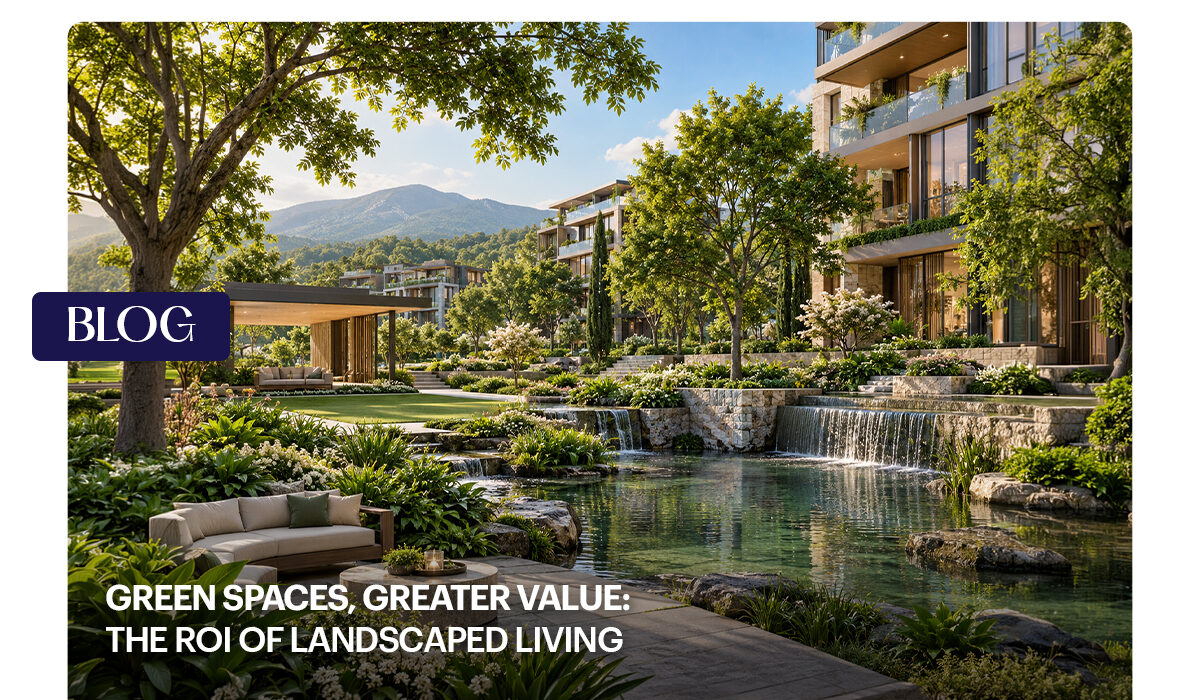
Landscaped living means designing outdoor space as part of how a property is used and valued, not as an afterthought. It includes gardens, trees, lawns, paths, terraces, lighting, water features and shared green spaces in apartment towers and housing communities. The goal is a property that looks better, feels cooler and gets used more.
Does Landscaping Increase Property Value?
Yes, in most studies it does, though by less than some marketing claims suggest. Here is what the evidence shows. Keep in mind that this evidence is almost entirely from the United States.
What the Research Says
The most cited academic work is a 2005 study by Michigan State University researchers, published in the Journal of Environmental Horticulture. Across seven U.S. states, 1,323 participants perceived that a home with good landscaping was worth 5% to 11% more. The study also found that design sophistication and plant size mattered more than plant type.
Three cautions apply. The study measured perceived value from photographs, not actual sale prices. It was conducted in the United States, with U.S. participants and U.S. housing styles, so the percentages may not transfer to Pakistan. And we found no comparable published study of Pakistani buyers. The finding still holds as a general idea: buyers pay attention to the outdoors.
The National Association of Realtors (NAR) and the National Association of Landscape Professionals (NALP) added another angle in their 2023 Remodeling Impact Report: Outdoor Features. This is a U.S. survey: costs were estimated by U.S. landscape professionals for an average U.S. house, and cost recovery was estimated by U.S. Realtors, with all figures in US$. The survey found that homeowners rated every outdoor project highly for enjoyment, and that the most commonly recommended pre-sale projects were landscape maintenance, standard lawn care and tree care.
The Arbor Day Foundation, a U.S. non-profit, also estimates that mature street-side trees can raise a property’s value by as much as 15%. Treat this as an upper-end U.S. estimate, since results vary by tree size, health and neighbourhood. We found no Pakistani equivalent.
Why the 100% to 400% ROI Claims Need Caution
You will often see claims that landscaping returns 200% to 400%, or 171%, on its cost. These figures appear widely on contractor websites, almost all of them U.S.-based, but they are rarely traced to a primary source, and they mix different things: perceived value, cost recovery and total benefit.
Before quoting any ROI figure, check what it measures, who produced it, where it applies and when. If you can’t trace a figure, it’s better to leave it out.
Why Landscape Matters for Housing Development
For housing developers and buyers, landscape is part of the product, not decoration. There are four main reasons.
- Value and marketability. Well-kept outdoor space improves first impressions and helps a property stand out from similar ones.
- Liveability. Shade, greenery and open areas make a neighbourhood more comfortable, especially in hot summers.
- Environment. Trees and planted areas reduce heat, support drainage and improve air quality around a building.
- Long-term appreciation. Trees and shrubs grow more valuable as they mature, unlike fixtures and finishes that wear out.
Note on data: these four points are general principles rather than measured Pakistani results. We did not find published Pakistani data quantifying them.
What Kind of Landscape Is Best for People to Live In?
The best residential landscape is one people can actually use and easily maintain. That usually means a mix of large shade trees, evergreen planting for year-round structure, seasonal colour, usable paths and seating, and well-lit outdoor spaces.
Plants should suit the local climate so they survive without heavy watering. A balanced design performs better than a single feature, in line with the Michigan State (U.S.) finding that design sophistication carries a lot of weight.
Soil, Drainage and Erosion Control
Can soil erosion ever be beneficial? In nature, yes. Erosion and deposition create fertile river floodplains. On a property, though, erosion is a risk. It can undermine foundations, clog drains and strip topsoil.
Ground cover, terracing, retaining walls and proper drainage protect the property and the value of the landscape you have built, so they belong in any serious landscape plan. This is especially relevant on sloped sites and in areas with heavy monsoon rain.
Landscaping Projects Ranked by ROI
The table below uses cost and cost-recovery estimates from the 2023 NAR/NALP Remodeling Impact Report. This is U.S. data in US$. Cost estimates come from landscape professionals in the United States, and cost-recovery estimates come from U.S. Realtors, so they reflect opinion and survey data, not guaranteed returns. No equivalent Pakistani table is widely available.
| Project | Typical cost (US$) | Estimated cost recovered at resale |
| Standard lawn care service | About $415 | About 217% |
| Landscape maintenance | About $4,800 | About 104% |
| Overall landscape upgrade | About $9,000 | About 100% |
| Outdoor kitchen | About $15,000 | Roughly break-even (about 100%) |
Note on data: the lawn care figure assumes six fertiliser and weed-control applications on a 5,000 sq ft U.S. lawn. Many Pakistani homes, particularly apartments, have little or no private lawn, and lawn care in a water-scarce climate has different costs and benefits, so this 217% figure should not be applied directly to Pakistan.
Highest-return upgrades: Low-cost, high-visibility work gives the best return in the U.S. data. Keeping a lawn and planting beds healthy costs little and shows immediately.
Upgrades that pay back slowly: Large, expensive features such as outdoor kitchens tend to recover about what they cost, so they make sense when you plan to enjoy them, not only to resell.
Most Valuable Outdoor Living Upgrades, Ranked by Cost Recovery
In NAR’s 2018 U.S. estimates, lawn and tree maintenance recovered about 100% of their cost, and irrigation, a planned landscape upgrade, and a well-built deck were the next best performers, while pools and lighting recovered the least. These are older figures than the 2023 table above, and the two reports define projects differently, so compare the order, not the exact percentages. A summary of the 2018 NAR report lists the following. All figures are U.S. data in US$.
| Outdoor upgrade | Typical cost (US$) | Estimated cost recovered |
| Irrigation system | 3,000–3,500 | 86% |
| Overall landscape upgrade | 5,000–6,000 | 83% |
| New wood deck | 8,000–10,000 | 80% |
| Outdoor kitchen | 10,000–14,000 | 71% |
| New patio | 5,000–7,200 | 69% |
| Fire feature | 4,000–6,000 | 67% |
| Landscape lighting | 2,500–5,000 | 50% |
| New pool | 25,000–57,500 | 43% |
The pattern is broadly consistent across both U.S. reports: maintenance and planting recover the most, while large built features usually recover less than they cost, although the exact numbers shift from year to year (in 2023, for example, a new patio was estimated at about 95% and a wood deck at about 89%). That does not make them bad purchases. It means you should buy them to use, not to resell.
Note on data: we found no Pakistani cost-recovery data for pools, decks, kitchens or lighting. Local construction costs, labour rates and buyer preferences differ from the U.S.
Hardscaping vs Softscaping: Which Gives Better ROI?
Softscaping (trees, shrubs, flowers and lawn) usually gave better value per dollar than hardscaping (paving, walls, steps and structures) in the U.S. research we reviewed. In an earlier Michigan State consumer-perception study, hardscape added little perceived value for the money spent, while annual colour returned its cost many times over. Built features also tend to recover only part of their cost, and the numbers vary by year. In NAR and NALP’s 2018 U.S. estimates a paver patio recovered about 69% and a fire feature about 67%, as summarised by HomeLight. In the 2023 edition, a patio was estimated at about 95% and a fire feature at about 56%.
That does not make hardscape a poor choice. Paths, patios and retaining walls make a landscape usable and last for years. The best result is a balance: spend on softscape for appeal and appreciation, and on hardscape for the use and structure your space needs.
Note on data: these results come from U.S. consumers and U.S. cost structures. In Pakistan, paved and tiled outdoor areas are very common and plant-care costs differ, so the balance may look different. We found no Pakistani study comparing the two.
Patio or Deck: Which Makes Better Financial Sense?
The research gives no clear winner, because published estimates vary by year, market and materials, and all of the figures we found are U.S. data. In NAR and NALP’s 2018 estimates, an 18-by-16-foot paver patio costing about $7,200 recovered about $5,000, or 69%, and a wood deck costing about $10,000 recovered about 80%. In the 2023 edition, a patio costing about $10,500 was put at about 95% and a wood deck costing about $16,900 at about 89%. Other U.S. cost-versus-value reports have put wood decks considerably lower. Treat every figure as a range.
The trade-off is more reliable. Patios usually cost less, carry heavy furniture and fire features well, and last longer. Decks suit raised or sloping sites and feel like an extension of the house, but they need more upkeep. In hot, dusty or monsoon-affected climates such as much of Pakistan, a paved or tiled terrace is usually the lower-maintenance choice, and wood decking needs extra care. This is general reasoning rather than Pakistani market data. Choose on your site, budget and upkeep tolerance first, and treat resale as a bonus.
Outdoor Kitchens, Fire Pits and Pergolas: What Is Each Known For?
Outdoor kitchens are known for entertaining and are among the costliest features. NAR and NALP put a typical U.S. one at about $15,000 in 2023 and judged it roughly cost-neutral at resale, so it pays off mainly if you will use it often.
Fire pits and fire features are popular because they extend evenings outdoors and give a yard a focal point. U.S. homeowners gave fire features a perfect Joy Score of 10 in the 2018 NAR/NALP survey. They recovered about two-thirds of their cost in the 2018 estimate and about 56% in 2023. Results vary with whether the feature is permanent or portable. We found no Pakistani data, and use will depend on how many months of the year evenings are comfortable outdoors.
Pergolas are known for defining an outdoor room, adding shade and supporting climbing plants. We could not find a reliable standalone ROI figure for pergolas, in the U.S. or in Pakistan, so judge them on use. In a hot climate, shade you can sit under is often worth more than any resale uplift.
The upgrades people swear by are the ones they enjoy most, and enjoyment does not always match resale. NAR/NALP found that U.S. homeowner happiness was not tied to the highest cost recovery, so decide whether you are buying a return or a lifestyle.
Budget Landscaping: The Smartest Upgrades When Money Is Tight
The smartest landscaping upgrade on a tight budget is looking after what you already have. In the U.S. NAR/NALP data, standard lawn care at about $415 had the highest estimated cost recovery at 217%, and Realtors most often recommended landscape maintenance, lawn care and tree care before a sale. The principle of maintaining what you own carries over to Pakistan, but the percentages do not.
Landscaping Projects With the Best ROI on a Budget
- Lawn and bed care: Clean edges, fresh mulch and pruning cost little and show immediately. In water-scarce areas, consider hardy ground cover instead of large lawns.
- One or two well-placed large plants: Plant size carried real weight in the Michigan State (U.S.) findings, so a single tall tree beats many small shrubs.
- Seasonal colour near the entrance: Annual colour paid for itself many times over in the same U.S. research.
- Simple paths and basic lighting: They make the space usable and safe without a major build.
- Drainage fixes: Water problems cancel every other gain, so sort them first.
Where to Compromise When Budgeting for Outdoor Living
- Skip outdoor kitchens and pools unless you will use them often.
- Keep hardscape areas small and use simple, locally available materials.
- Buy smaller plants for the back of the garden and spend on a few larger ones at the front.
- Phase the work over several seasons instead of building everything at once.
A Simple Plan to Boost Backyard Value This Year
- Month 1: Clean up, fix drainage and set a budget that includes yearly upkeep.
- Months 2–3: Prune, edge and mulch, and repair paths and lawn.
- Next planting season: Plant one or two shade trees and a few durable shrubs suited to your climate.
- Mid-year: Add seasonal colour, simple lighting and one seating area.
- Year end: Review what worked, and plan next year’s phase only if the first one paid off in use or savings.
How to Make a Backyard More Usable Without Overspending
Create zones instead of adding square footage. One shaded seating area, one clear path, and lighting for evenings turn an ordinary yard into usable space. Movable furniture, climbers on a simple frame and a small paved sit-out usually cost far less than a built-in feature and give most of the benefit.
Is Landscaped Living Really Worth It? A Simple Cost-Benefit Model
For most homeowners, landscaped living is worth it when the money goes to upkeep, shade and a planned design, not to showpiece features. A basic model keeps the decision honest:
Net benefit = resale recovery + yearly savings × years held − installation cost − upkeep
Using the 2023 U.S. NAR/NALP figures (in US$, not converted to PKR), a $9,000 landscape upgrade recovers about 100% at resale, so it breaks even on resale alone. Every year of lower cooling bills, extra use and enjoyment is then a gain. Standard lawn care at about $415 is recovered at roughly $900. An outdoor kitchen at about $15,000 is roughly cost-neutral, so it only makes sense if you will use it. Anything that recovers well under 100% needs a reason beyond resale. Replace these inputs with local quotes and local resale or rental evidence before deciding.
Should You Prioritise Outdoor Living Over Other Home Upgrades?
It depends on your goal and the condition of the property. Fix structural, roof and damp problems first, because buyers and valuers tend to penalise them heavily. If the house is sound but the outside looks tired, low-cost landscaping is one of the cheapest ways to improve first impressions. We did not find a study, in the U.S. or in Pakistan, that compares landscaping directly against interior renovations on the same property, so rank your upgrades by condition, budget and how you will actually use the space.
How Much Does Landscaping Cost?
Landscaping cost depends on the size of the plot and the ambition of the design. There is no single price, and we did not find published PKR cost benchmarks for landscaping in Pakistan, so the points below are cost drivers rather than figures.
- Area and complexity. Larger or sloping sites cost more to shape and plant.
- Plants and trees. Mature trees cost far more than saplings, but they deliver value sooner.
- Hardscape. Paving, retaining walls, pergolas and steps are usually the largest line items.
- Irrigation and lighting. Water systems and outdoor lighting add cost at the start and save effort later.
- Labour and upkeep. Annual maintenance is part of the real cost and should be in your ROI calculation.
Landscape Design Cost vs DIY
DIY can reduce cost for small gardens, but a professional design helps you avoid expensive mistakes such as wrong plants, poor drainage and badly placed trees. A common approach is to pay for a design plan, then phase the installation over time. Always collect at least three quotes in PKR, with a clear scope, and ask what annual maintenance will cost.
Do You Need a Landscape Architect?
A landscape architect, sometimes called a landscape engineer in casual searches, plans outdoor spaces, including layout, planting, drainage, grading and materials. You are more likely to need one for large plots, sloped sites, commercial projects and housing communities. For a small home garden, a good landscape designer or experienced contractor is often enough.
Landscaping Designs and Plans That Raise Property Value
Residential Landscape Design Basics
The strongest residential designs follow a few principles. Create a clear entrance. Layer planting from tall trees to shrubs to ground cover. Use repeating materials and colours for a consistent look. Keep paths and lighting practical and safe. Leave space for people, not only plants.
Common Types of Landscape Design
- Formal: Symmetrical layouts, clipped hedges and structured beds.
- Modern: Clean lines, simple materials and limited plant palettes.
- Low-water: Drought-tolerant plants, mulch and efficient irrigation.
- Native or natural: Local species that need less care and support local wildlife.
How to Plan Your Landscape, Step by Step
- Set your goal. Decide whether you want resale value, rental appeal, lower running costs or personal enjoyment.
- Set a budget that includes installation and yearly upkeep.
- Survey the site. Note sun, shade, wind, slope, soil and drainage.
- Choose a design that suits the property’s style and your climate.
- Prioritise visible and high-return elements, such as entrance, trees and lawn or planting beds.
- Phase the work so you can spread cost and adjust as plants grow.
- Plan maintenance from day one so the landscape keeps its value.
Rooftop Vegetation and Terrace Landscaping
What Is Rooftop Vegetation?
Rooftop vegetation, also called a green roof or living roof, is a layer of plants grown on a building’s roof over a waterproof membrane and growing medium. It ranges from light, low-maintenance planting to full terrace gardens people can walk through.
Value and Savings
For apartments and towers, where ground-level space is limited, roof and terrace landscaping creates usable outdoor areas that buyers and tenants value. Plants on a roof also help shade and insulate the building, which can reduce heat gain. Structural load, waterproofing and drainage must be planned with an engineer, so rooftop landscaping works best when it is part of the building design from the start.
Note on data: the heat and insulation benefits of green roofs are described in general engineering and horticultural guidance, and we did not find published measurements for Pakistani buildings. Performance under Pakistan’s summer heat and monsoon rain should be confirmed with a local structural and waterproofing engineer. Tenant and buyer demand for terraces is also not backed here by Pakistani survey data.
Landscaping in Pakistan: Types, Costs and Climate-Smart Choices
Note on data: this is the one section of the guide that is about Pakistan directly. It is based on general knowledge of Pakistan’s geography and climate and on local practice, not on a Pakistani ROI study. Published, widely available Pakistani data on landscaping returns, costs and buyer preferences is limited.
What Kinds of Landscape Are There in Pakistan?
Pakistan has a wide range of natural landscapes, including the northern mountains, the Indus plains, the Potohar plateau, desert regions and the Arabian Sea coast. Each affects what grows well, how much water it needs and what a landscape design should do. A garden in Islamabad, Lahore, Karachi or the north should not copy the same plant list.
Plants and Design for Local Heat and Water Limits
In much of Pakistan, summers are hot and water is limited, so shade and efficiency matter more than a large lawn. Good local practice includes the following.
- Plant shade trees on the sides of the building that get the strongest afternoon sun.
- Choose hardy, climate-adapted species and group plants by water need.
- Use mulch, drip irrigation and treated or harvested water where possible.
- Think about allergies. Islamabad’s well-known paper mulberry pollen problem is a reminder to avoid heavy pollen producers near homes.
- Match plants to local conditions, such as salt tolerance in coastal Karachi.
Landscaped Living in Apartments, Towers and Planned Communities
In Pakistani cities, more people live in apartments and mixed-use developments, a shift Chakor’ guide to condo investment in Pakistan covers, so shared landscape is a major part of the offering. Podium gardens, terraces, tree-lined walkways, courtyards, and rooftop spaces give residents greenery they wouldn’t otherwise have.
For developers, this makes landscape a selling point, and for buyers, it is a reason to look closely at how outdoor space is planned and maintained. Projects such as Citadel One3 in Blue Area show where high-rise living in Islamabad is heading.
A note on the data: most published landscaping ROI figures come from the United States, and there is limited public data for Pakistani markets. Use the studies in this guide as directional benchmarks, then compare local listings and ask local agents what buyers and tenants respond to.
Beyond Resale: The Hidden Returns of Green Spaces
- Energy savings. The U.S. Department of Energy says a well-planned landscape can reduce an unshaded home’s summer air-conditioning costs by 15% to 50%, depending on climate, tree placement and building orientation. This is U.S. guidance, aimed mainly at low-rise detached homes. Ground-level trees cannot shade the upper floors of a tall tower, so we should not apply this figure to high-rise apartments, and we found no published equivalent for Pakistani homes. Shading the outdoor air-conditioning unit can also improve efficiency, as long as airflow is not blocked.
- Water savings. Drip irrigation, mulching and drought-tolerant planting cut outdoor water use while keeping the landscape healthy. This is a widely accepted principle, but we did not find savings figures for Pakistan.
- Rental appeal. Properties with pleasant, well-kept outdoor space can be easier to let and may hold tenants longer (Chakor covers the basics in its guide to rental property management services), although the size of the effect varies by market, and we found no Pakistani study measuring it.
- Wellbeing. In the U.S. NAR/NALP report, homeowners rated outdoor projects highly for enjoyment, with scores around 9 or above on a 10-point scale. That benefit doesn’t show up in the sale price, but it is a real part of landscaped living. The scores come from U.S. homeowners, and Pakistani results may differ.
Mistakes That Hurt Landscaping ROI
- Overspending relative to the property. A very expensive landscape rarely recovers its full cost on a modest property.
- Ignoring maintenance. A neglected landscape loses value fast, and maintenance is one of the highest-return items in the U.S. data.
- Choosing the wrong plants. Species that don’t suit the climate die, cost more to water, or damage structures.
- Poor drainage. Water pooling near buildings causes damage and wipes out the gains.
- Over-personalising. Very unusual designs can limit buyer appeal.
- Planting trees too close to buildings. Roots and branches can damage foundations, walls and roofs over time.
FAQs
What is the ROI on landscaping?
There is no single figure. U.S. research suggests good landscaping can raise perceived home value by about 5% to 11%, and U.S. NAR/NALP data suggests routine lawn care can recover more than its cost while larger upgrades tend to roughly break even. Results depend on your market and design, and widely available Pakistani data is limited.
What is the return on investment for landscaping?
Return on investment is the gain from a landscape, including added value and savings, compared with its cost. In U.S. data, low-cost, visible work usually gives the best percentage return, while expensive features tend to return closer to their cost.
Why is landscape important for housing development?
Landscape improves first impressions, comfort, and liveability; reduces heat; helps drainage; and gives residents usable outdoor space. For developers, it also helps a project stand out and keeps its value as plants mature.
What kind of landscape is best suited for people to live in?
A balanced landscape with shade trees, evergreen planting, seasonal colour, usable paths and seating, and good lighting, using plants suited to the local climate and easy to maintain.
What is rooftop vegetation?
Rooftop vegetation is a layer of plants grown on a building’s roof, also called a green roof or living roof. It can add usable space, shade and insulation, but needs proper waterproofing and structural planning.
What kinds of landscape are there in Pakistan?
Pakistan includes mountains, river plains, plateaus, deserts and coastal areas. Each region calls for different plants, water use and design choices.
What does a landscape architect do?
A landscape architect plans outdoor spaces, including layout, planting, grading, drainage and materials, and is most useful on large, sloped or commercial projects.
Can soil erosion ever be beneficial?
In nature, erosion and deposition build fertile floodplains. On a property, erosion is a risk to foundations, drainage and planting, so it should be controlled with ground cover, terracing and proper drainage.
Is landscaped living really worth it for typical homeowners?
Usually yes, if you invest in upkeep, shade, and a planned design instead of costly showpiece features. U.S. research points to a 5% to 11% lift in perceived value, and routine care tends to recover more than it costs in U.S. surveys, while big built features roughly break even or recover less. We found no Pakistani figures to confirm these percentages locally.
Which landscaping projects give the best ROI on a budget?
Routine lawn and bed care, pruning, mulch, one or two larger trees or shrubs, seasonal colour at the entrance, and drainage fixes. In NAR/NALP’s 2023 U.S. data, standard lawn care had the highest estimated cost recovery at 217%.
What outdoor living upgrades are most valuable?
In U.S. data, maintenance, tree care, irrigation, an overall landscape upgrade, and a well-built deck or patio rank highest in cost recovery, while pools, fire features, and lighting recover the least. Fire features and outdoor kitchens score high for enjoyment but recover only part of their cost in most years.
Is a patio or deck better for resale value?
Research gives no clear winner, and published U.S. estimates vary widely by year and region. Patios usually cost less and need less upkeep, while decks suit raised sites. Choose on site, budget and maintenance first.
Is hardscaping or softscaping better for ROI?
In U.S. research, softscaping (plants and trees) usually returns more per dollar spent and appreciates as it matures, while hardscaping makes a space usable and durable but often recovers only part of its cost at resale. No Pakistani comparison is widely available.
What is a pergola known for in backyard design?
Pergolas create a defined outdoor room, provide shade, and support climbing plants. No reliable standalone ROI figure exists, so judge a pergola by how much you will use it.
Why is a fire pit such a popular outdoor living feature?
It gives a yard a focal point and extends evenings outdoors. U.S. homeowners gave fire features a perfect Joy Score of 10 in the 2018 NAR/NALP survey, though they recovered only about two-thirds of their cost at resale in 2018 and about 56% in 2023.
Our Take on Landscaped Living ROI
Landscaped living is a good investment, but it’s unglamorous. The best returns come from upkeep, shade trees and a coherent design, not from the most expensive feature. The upgrades people love most, such as fire pits and outdoor kitchens, are the ones most likely to return less than they cost at resale, so buy them for the life they give you, not the price they add. Remember, these numbers are U.S. figures, and Pakistani buyers, costs, and climate may produce different results.
Conclusion: Is Landscaped Living Worth the Investment?
The ROI of landscaped living is real, but it is more modest and more varied than many headlines suggest. U.S. evidence points to a 5% to 11% lift in perceived value, strong returns on low-cost upkeep, and meaningful savings from shade and efficient planting.
Pakistani data is scarce, so the best results come from a planned, climate-appropriate design you maintain over time and check against local prices and buyer demand. Set a clear goal, budget for upkeep, and verify any ROI claim against its source before relying on it. To see how premium urban living is taking shape in Islamabad, explore Citadel One3 and the other projects from Chakor, or read the guide to real estate investment in Pakistan.
Sources
- Behe, B. et al. (2005). Landscape Plant Material, Size, and Design Sophistication Increase Perceived Home Value. Journal of Environmental Horticulture, 23(3), 127–133.
- National Association of Realtors and National Association of Landscape Professionals (2023). Remodeling Impact Report: Outdoor Features.
- National Association of Realtors (2023). Homeowners’ zeal for curb appeal may pay off handsomely (project cost estimates from the 2023 report).
- RISMedia (2018). Listing this summer? The best investments to make outdoors (summary of the 2018 NAR/NALP Outdoor Features report).
- U.S. Department of Energy. Landscaping for shade and energy savings.
- Arbor Day Foundation. Tree City USA Bulletin No. 45: Trees and streets.
- HomeLight. Does hardscaping add value to your home?
- HomeLight. Backyard improvements that add value (cost-versus-value comparison for wood decks).
- Landscape Architect and Specifier News. Consumer perception of landscape value (Michigan State and University of Delaware study on hardscape and annual colour).

BBC-featured Content Specialist with a sharp eye for search intent and a proven ability to turn content into a growth engine. I leverage cutting-edge digital marketing tools to craft strategies that fuel organic traffic, amplify brand growth, and own the local SEO landscape, particularly across the competitive real estate market. I help brands dominate search rankings and convert visibility into measurable business success.
