
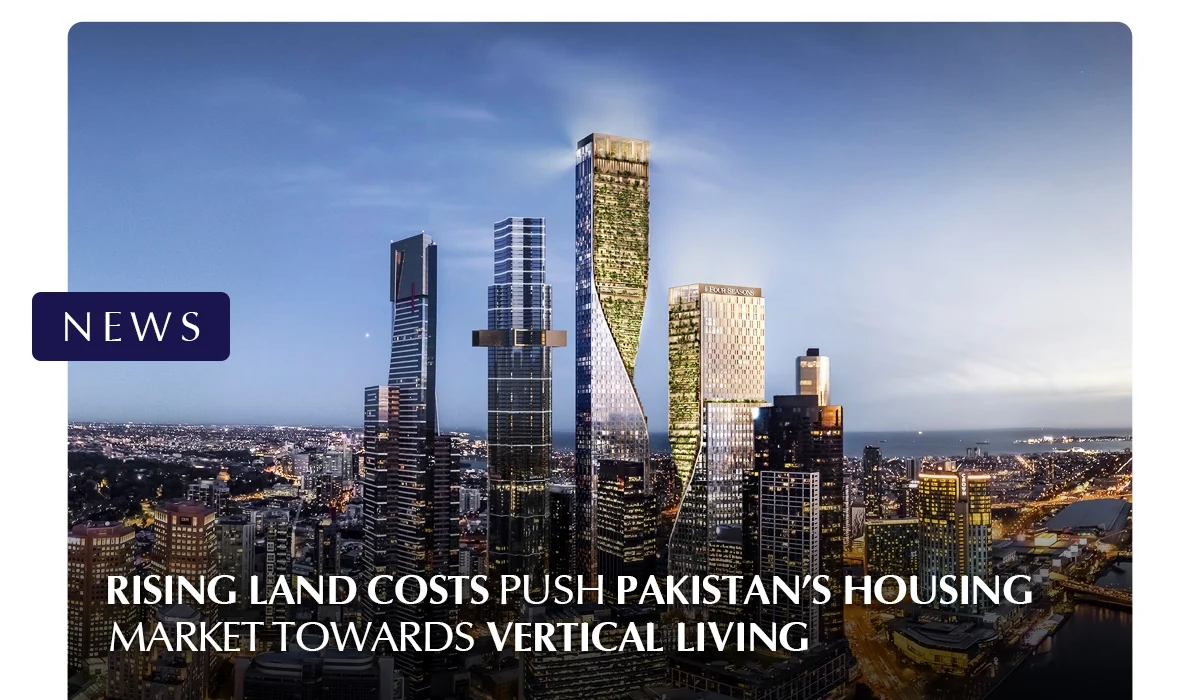

ISLAMABAD: Rising land costs, rapid urbanisation, and changing lifestyle preferences are pushing Pakistan’s housing market towards vertical living, with condominiums, apartments, and compact residential units emerging as the preferred choice for buyers and developers, real estate experts said.
Pakistan is currently facing an estimated housing shortage of 10 to 12 million residential units, a gap that continues to widen each year due to population growth and increasing urban migration. Industry specialists warn that this persistent supply-demand imbalance is reshaping the real estate landscape, particularly in major cities such as Lahore, Karachi, and Islamabad, where land scarcity has driven prices sharply higher.
Speaking to Business Recorder, real estate expert Shahzad Akbar Janjua said accelerating urbanisation, shrinking household sizes, and evolving buyer behaviour are key factors behind the rising demand for apartments, condominiums, and townhouses.
“Urbanisation is accelerating, household sizes are shrinking, and younger families want their own homes earlier than before,” Janjua said, adding that despite economic slowdowns, real estate remains Pakistan’s most trusted long-term investment, offering security and protection against inflation.
Janjua noted that rising land acquisition costs, higher construction material prices, and inflation in labour and development inputs have significantly increased property prices, particularly in urban centres. This trend has made traditional large homes unaffordable for most middle-income families, pushing buyers towards vertical living and compact apartment-style housing.
“The greatest housing shortfall is now in mid-sized, compact units such as apartments, condominiums, and townhouses,” he said. “Without consistent development of these formats, the urban housing deficit will continue to grow.”
Another real estate expert, Ahmed Saljouk, said Pakistan’s property market is experiencing renewed momentum because housing demand has outpaced supply for several years. He explained that affordability, land optimisation, and changing lifestyle needs are driving the shift towards apartment living and community-based condominium complexes.
“Large plots are no longer viable for most buyers, while compact units offer better price accessibility,” Saljouk said. “Vertical developments allow developers to integrate security, utilities, maintenance services, and green spaces more efficiently.”
He added that horizontal urban expansion requires large, contiguous land parcels that are increasingly scarce and expensive near city centres. Such expansion also places heavy pressure on infrastructure, roads, and utilities, making high-rise apartments and condominiums a more practical and sustainable solution.
“Modern buyers prioritise convenience, connectivity, and maintenance-friendly living—qualities that apartments and condominiums deliver far better than traditional sprawl-based housing schemes,” Saljouk said.
Experts believe that improved connectivity, new residential corridors, and the growing availability of affordable apartments, condominiums, and compact housing will continue to drive Pakistan’s real estate investment towards vertical living as a long-term response to rising land prices and the country’s housing shortage.
For more real estate news and investment insights, visit Chakor Ventures.
