
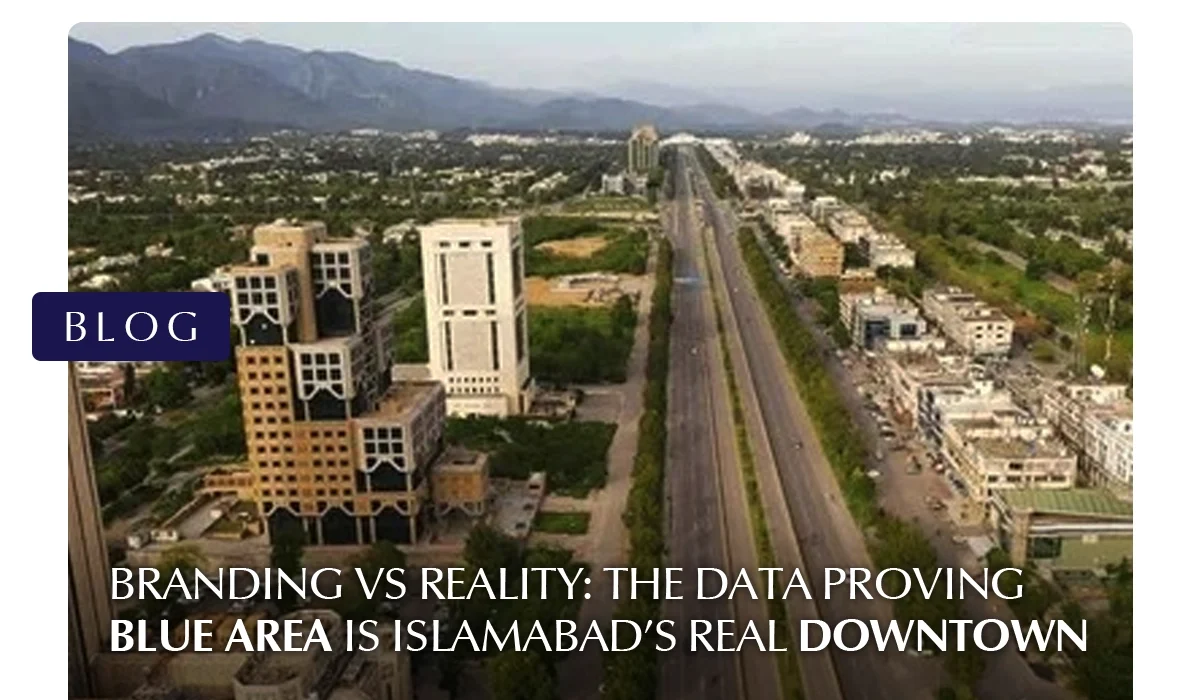

Islamabad’s commercial landscape is often described using the word “downtown Islamabad,” yet the city has never had an officially designated central business district. As urban expansion accelerated and new mixed-use developments emerged, multiple areas began marketing themselves as downtowns, creating confusion between real estate branding and economic reality.
In the absence of a formally planned CBD, perception has increasingly replaced evidence in shaping market narratives. This blog cuts through that ambiguity by relying strictly on multi-year commercial real estate data from 2018 to 2024, comparing long-term value trends, price-per-square-foot behaviour, and market stability across Islamabad’s major commercial zones to examine how actual downtown centrality is formed and sustained.
| Indicator | Blue Area | New Blue Area | Gulberg | Park View City |
| Price per Sq. Ft (2024) | ~PKR 500,000 | Growing | ~PKR 90,000 | ~PKR 81,000 |
| Long-Term Growth | +196% (2018–24) | Positive (Since 2020) | Moderate | Moderate |
| 6-Month Momentum | +22% | +4% | −8% | +6% |
| Market Stability | Very High | Medium | Low | Medium |
| Commercial Density | Highest | Rising | Low | Low |
| Growth Driver | Commercial Core | Core Extension | Residential-led | Residential-led |
| CBD Qualification | Yes | Emerging Extension | No | No |
Islamabad’s Commercial Evolution and the Absence of a Planned CBD
Sector-Based Planning Without a Central Core
The original Islamabad master plan followed a low-density, sector-based layout. Commercial activity was distributed across local-sector markets rather than concentrated in a single central business district. Administrative and commercial functions were also spatially separated.
Population Growth Beyond Early Projections
Over time, Islamabad urban growth far exceeded early planning assumptions. The city’s population crossed two million, sharply increasing demand for housing and services. This growth placed pressure on land and infrastructure across the metropolitan area.
Rapid Expansion of the Built-Up Area
Islamabad’s built-up area expanded from about 58 km² in 2000 to nearly 256 km² by 2020. This represents more than a fourfold increase in urbanised land. Most of this growth occurred through horizontal expansion rather than vertical development.
Residential-Led Sprawl and Mixed-Use Development
Large-scale residential projects led the city’s outward expansion. Commercial and office spaces followed mainly to serve local residential demand. These areas functioned as mixed-use zones rather than high-density commercial centres.
How Downtown Islamabad Confusion Emerged
With no formally planned CBD, multiple areas began presenting themselves as downtown Islamabad. Real estate branding filled the gap left by planning ambiguity. This created confusion between perceived centrality and actual economic function within Islamabad’s commercial development.
Why Blue Area Became Islamabad’s Commercial Spine?
Central Position Along Jinnah Avenue
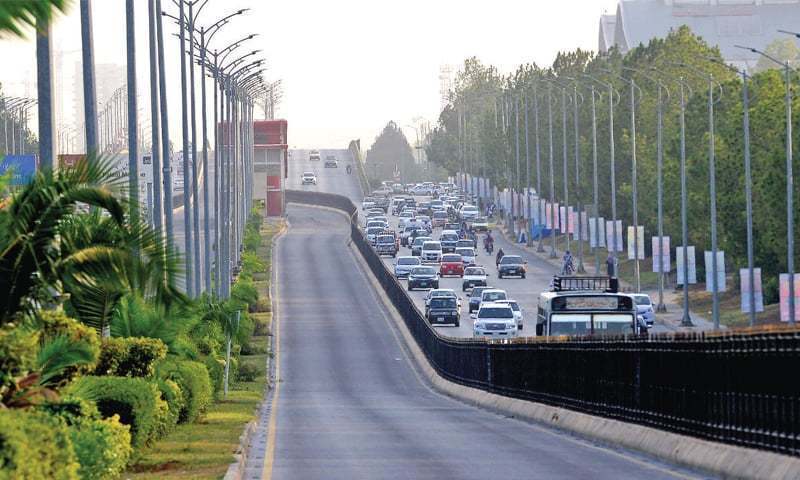
The Blue Area Islamabad history is inseparable from its strategic location along Jinnah Avenue. This corridor functions as Islamabad’s primary east–west axis, linking major residential sectors with administrative and institutional zones.
- Located on Islamabad’s main arterial road
- Direct connectivity to key sectors and civic areas
- High visibility and accessibility for businesses
Planned Commercial Strip to Functional Core
Blue Area was originally designed as a mid-rise, mixed-use commercial strip. Over time, however, market demand reshaped its role. As Islamabad expanded, dispersed sector markets proved insufficient for large-scale corporate activity.
- Initial mid-rise zoning
- Gradual market-led densification
- Shift from dispersed markets to centralised offices
Concentration of Corporate Headquarters
One of the defining features of Blue Area is the clustering of Islamabad corporate offices. Major national and multinational firms established headquarters in the area due to its centrality and prestige.
This concentration generated agglomeration benefits, attracting more firms and reinforcing commercial depth.
- Presence of financial, telecom, and service-sector firms
- High corporate visibility and institutional clustering
- Strong demand for premium office space
Proximity to Administrative and Government Institutions
Blue Area’s rise was reinforced by its closeness to key government and administrative centres. Ministries, regulatory bodies, and public-sector offices are located in adjacent zones. This proximity supports frequent interaction between corporate and institutional actors.
- Easy access to government offices
- Strategic for policy, finance, and corporate coordination
Infrastructure, Transit, and Market Convergence
| Factor | Impact on Commercial Centrality |
| Wide boulevards | Supports high traffic and visibility |
| Public transport corridors | Enhances accessibility and footfall |
| Traffic convergence | Increases market activity and liquidity |
Evolution Into a High-Value Commercial Core
Over time, limited land supply and rising demand transformed Blue Area into Islamabad’s highest-value commercial zone. Mid-rise structures gave way to high-density, vertical development. This evolution cemented Blue Area as the city’s primary commercial spine rather than just another business district.
Long-Term Commercial Property Trends (2018–2024)
Analysing Islamabad commercial property price trends over multiple years provides a clearer picture of true market strength. Long-term trends reveal whether value growth is structural or driven by short-lived speculation. Between 2018 and 2024, distinct patterns emerged across Islamabad’s major commercial areas.
Blue Area: Sustained and Compounding Growth
Blue Area demonstrated the strongest long-term performance in the city.
- Price per sq. ft increased by approximately 196%
- From ~PKR 130,000 in 2018
- To ~PKR 385,000 in 2024
- Growth followed a steady, compounding trajectory
- No sharp spikes or sudden corrections were observed
This pattern indicates persistent demand, limited land supply, and strong commercial fundamentals. Such stability is characteristic of mature downtown Islamabad markets rather than emerging or speculative zones.
Index Growth and Market Depth
In addition to rising prices, Blue Area’s commercial index nearly tripled over the same period.
- Index growth reflects:
- Appreciation
- Transactional activity
- Market stability
- Rising index values signal depth and liquidity
- Confirms that Blue Area real estate growth is structurally driven
Comparison With Peripheral Commercial Areas
| Area | Growth Pattern | Primary Driver | Market Behavior |
| Blue Area | Compounding, consistent | Commercial core demand | Stable, resilient |
| Gulberg | Uneven growth | Horizontal expansion | Post-speculative correction |
| Park View City | Accelerated phases | Residential demand | Cycle-sensitive |
Compounding Growth vs Speculative Spikes
Long-term Islamabad land value appreciation reflects economic centrality. Sustained growth indicates enduring demand and institutional presence. Short-term spikes, however, often result from speculation, marketing, or development announcements.
Between 2018 and 2024, Blue Area consistently outperformed peripheral markets. Its growth was gradual, predictable, and resilient, traits that distinguish a true commercial core from areas driven by temporary hype.
Short-Term Market Momentum and Liquidity Signals
While long-term trends show structural strength, Islamabad real estate momentum over shorter timeframes reveals real-time market sentiment. Six-month, one-year, and two-year growth rates indicate liquidity, buyer urgency, and confidence. These indicators help distinguish stable commercial cores from cycle-sensitive developments.
Blue Area Downtown Islamabad: Strong Momentum in a Mature Market
Blue Area stands out sharply in short-term performance.
- 6-month growth: ~22%
- 1-year growth: ~52%
- 2-year growth: ~102%
Such acceleration in an already high-value market is rare. Mature commercial districts typically show slower short-term movement due to pricing stability. In Blue Area’s case, strong Blue Area property demand reflects high liquidity, limited supply, and sustained interest from end-users and institutional buyers.
This level of momentum signals not speculation, but confidence in long-term commercial relevance.
Performance of Other Commercial Areas
| Area | 6-Month Trend | 1-Year Trend | Market Signal |
| Blue Area | +22% | +52% | High liquidity, strong demand |
| New Blue Area | +4% | +15% | Early-stage consolidation |
| Gulberg | −8% | −14% | Market correction |
| Park View City | +6% | +39% | Residential-cycle driven |
2024 Snapshot | Downtown Islamabad
Citywide averages often hide important variations within commercial districts. A block-level comparison provides a clearer view of where value, demand, and liquidity are most concentrated. In 2024, data from key commercial blocks highlights the sharp hierarchy within Price per square foot Islamabad markets.
Blue Area Block C: Peak Commercial Value
Blue Area Block C stands at the top of Islamabad’s commercial market.
- Price per sq. ft: ~PKR 500,000
- 3-month growth: ~15%
- 1-year growth: ~63%
- Commercial index: ~558
These figures place Block C firmly as the Islamabad most expensive commercial area. High quarterly growth at such elevated price levels signals intense demand, limited supply, and strong transactional liquidity.
Comparative Snapshot of Key Commercial Blocks
| Area | Price per Sq. Ft | 3-Month Change | 1-Year Change | Index |
| Blue Area – Block C | ~PKR 500k | +15% | +63% | 558 |
| Gulberg Civic Centre | ~PKR 90k | +3% | −4% | 172 |
| Park View Downtown Islamabad | ~PKR 81k | +6% | +26% | 123 |
Why Peripheral “Downtown Islamabad” Don’t Behave Like Downtowns
- Residential-led appreciation dominates growth
- Commercial activity serves nearby residential communities rather than the citywide economy.
- Price increases follow housing cycles, not commercial absorption.
- Horizontal expansion replaces density
- Peripheral zones expand outward through new land development.
- Land supply remains relatively flexible, limiting long-term value pressure.
- True downtown Islamabad rely on vertical consolidation due to land scarcity.
- Greater exposure to speculative corrections
- Rapid price increases are often driven by marketing and speculation.
- Gulberg experienced negative momentum following earlier gains.
- Speculative markets lose liquidity quickly when sentiment shifts.
- Rapid price increases are often driven by marketing and speculation.
- Lack of institutional and corporate clustering
- Peripheral areas do not host dense clusters of corporate headquarters.
- Financial institutions and major offices are limited.
- Agglomeration benefits remain weak or absent.
- Function as local service markets
- Most businesses cater to the surrounding residential populations.
- Economic activity is localised rather than metropolitan in scale.
- Despite branding, these areas do not operate as true downtown Islamabad mixed-use developments.
Blue Area vs New Blue Area | Downtown Islamabad
| Aspect | Blue Area (Core) | New Blue Area (Extension) |
| Role in the city | Established commercial core and CBD | Planned extension of the core |
| Development stage | Mature, fully consolidated | Early-stage consolidation |
| Value behavior | High and stable land values | Gradual upward value trajectory |
| Growth pattern | Long-term compounding appreciation | Mirrors early growth phase of Blue Area |
| Market maturity | Deep liquidity and strong demand | Emerging demand, limited liquidity |
| Corporate presence | Dense concentration of major offices | Institutional presence developing |
| Planning intent | Organic evolution into a CBD | Purpose-built Blue Area extension |
| Policy alignment | Supports existing commercial centrality | Aligned with Islamabad vertical development |
| Relationship | Core commercial nucleus | Functional continuation, not a competitor |
Criteria-Based CBD Qualification Scorecard | Downtown Islamabad
| CBD Criterion | Blue Area | Peripheral Commercial Areas |
| Historical centrality | Long-standing commercial nucleus since early city development | Recently developed through outward expansion |
| Land value dominance | Highest price per square foot in the city | Significantly lower and cycle-sensitive |
| Corporate density | Dense clustering of national and multinational offices | Scattered, small-scale commercial presence |
| Administrative presence | Close proximity to major ministries and institutions | Limited or indirect access |
| Transit centrality | Located on Jinnah Avenue with major traffic convergence | Dependent on local access routes |
| Vertical development leadership | High-rise and high-density commercial zoning | Predominantly low- to mid-rise development |
What This Means for Investors, Developers, and Policymakers
Islamabad’s commercial data does more than explain where downtown Islamabad is. It clarifies how different stakeholders should respond to the city’s evolving commercial hierarchy. The implications vary by role, but all point toward the continued importance of the central commercial corridor.
For Investors: Liquidity and Risk Profile
From an Islamabad commercial investment perspective, Blue Area offers a fundamentally different risk–return profile than peripheral markets. Its long-term appreciation, high transaction volume, and short-term momentum indicate strong liquidity.
- High buyer depth reduces exit risk.
- Price stability limits downside volatility.
- End-users, not speculation, drive demand
This makes Blue Area investment potential more suitable for capital preservation and steady returns than for quick speculative gains.
For Developers: Vertical Opportunity Zones
Developers face a clear choice between horizontal expansion and vertical optimisation. Blue Area and its extension favour density-driven development due to land scarcity and sustained demand.
| Factor | Central Corridor | Peripheral Areas |
| Growth model | Vertical densification | Horizontal expansion |
| Demand driver | Commercial absorption | Residential spillover |
| Value creation | Per sq. ft optimisation | Per plot expansion |
Vertical commercial projects align more closely with proven market behaviour in the core.
For Policymakers: Densification vs Sprawl
An effective Islamabad urban policy must balance growth with efficiency. Strengthening the central commercial spine reduces infrastructure duplication and transportation strain. Densification within established corridors supports sustainable urban form.
Conclusion | Downtown Islamabad
Commercial data clearly shows that actual downtown Islamabad centrality is built through sustained value, density, and institutional concentration, not branding. Across both long-term and short-term indicators, Blue Area consistently outperforms all other locations. As the city continues to grow, strengthening this established core remains the most efficient and economically sound path forward.
This article is based on data fetched from this published article: Commercial Centrality in Islamabad: A Data-Driven Evaluation of Blue Area as the City’s Functional Downtown. For more information on interesting and informative topics, visit Chakor Ventures.

BBC-featured Content Specialist with a sharp eye for search intent and a proven ability to turn content into a growth engine. I leverage cutting-edge digital marketing tools to craft strategies that fuel organic traffic, amplify brand growth, and own the local SEO landscape, particularly across the competitive real estate market. I help brands dominate search rankings and convert visibility into measurable business success.
