CategoriesNews

RUDA launches Vocational Training Centre and school to empower Maskan-e-Ravi residents

LAHORE: The Ravi Urban Development Authority (RUDA) has launched a Vocational Training Centre and a Lower Primary School at the Maskan-e-Ravi Low-Cost Housing Project, aiming to empower local communities.

The inauguration ceremony, held on Thursday, was attended by RUDA Chief Operating Officer (COO) Mansoor Ahmed Janjua, who highlighted the significance of the project. The initiative is part of RUDA’s broader vision to provide essential services and opportunities to underserved communities. The housing project, which includes 100 residential units, aims to offer a comfortable living environment alongside educational and vocational support.

The Vocational Training Centre, developed in collaboration with the Punjab Vocational Training Council (PVTC), is designed to equip local women with practical skills, such as sewing and tailoring, thereby creating new employment opportunities and fostering economic independence. RUDA Director of Special Initiatives, Fatima Ali Khan, emphasized the centre’s role in empowering women and providing them with tools to build a sustainable livelihood.

This initiative is aligned with the vision of Punjab Chief Minister Maryam Nawaz Sharif, who has been supportive of efforts to uplift marginalized communities. The collaboration between RUDA, PVTC, and other stakeholders is expected to serve as a model for integrated community development.

Earlier this year, on January 13, 2025, the Maskan-e-Ravi Housing Scheme was inaugurated by Chief Minister Maryam Nawaz Sharif, marking a significant step toward providing affordable housing for the needy and deserving families in the region.

CategoriesNews

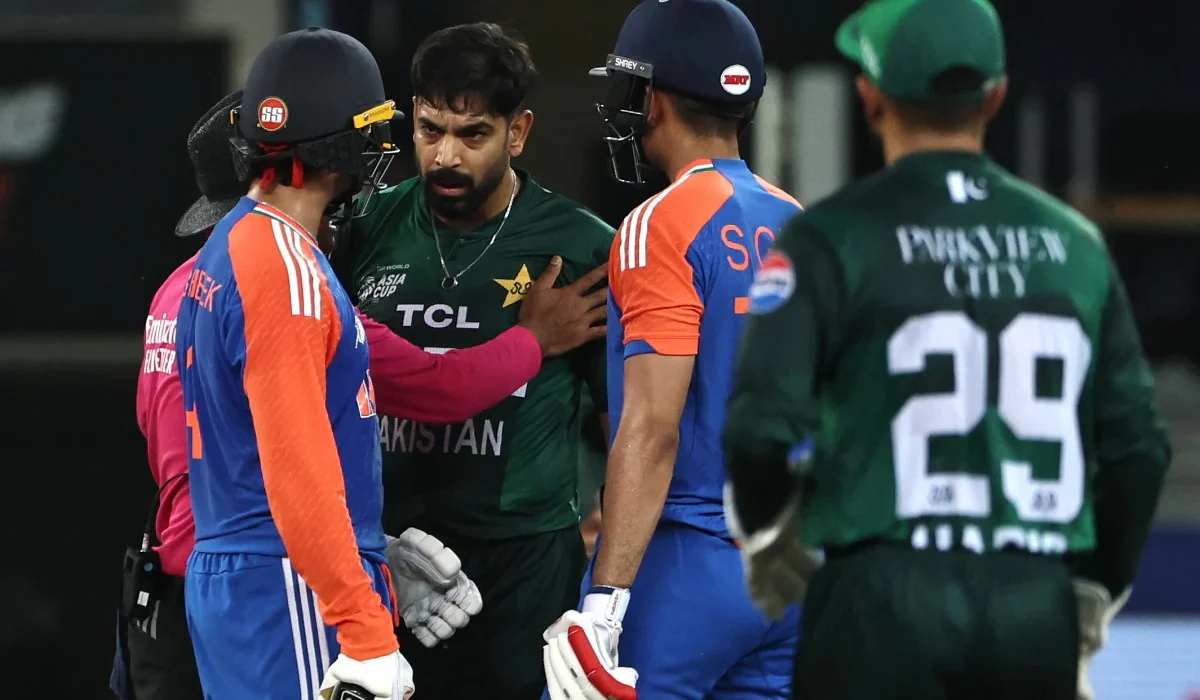
Pakistan vs India: Against All Odds, A Historic Asia Cup Final After 41 Years!

Once again, it’s Pakistan vs India, and this time, it’s for the FINAL MATCH. Cricket fans all around the world are excited to see these age-old rivals in the finals. It’s going to be a historic event, as this is the first time in 41 years of Asia Cup history that these two teams will meet in the final.

Throughout Asia Cup 2025, both teams have clashed twice, with India claiming victory on both occasions. However, this time, things aren’t as predictable as they might seem. 

Against all odds, Pakistan has managed to reach the final, and here’s how they got there.

Group Stage Results

Team Opponent Result
India Pakistan India won by 7 wickets
India Oman India won by 21 runs
India UAE India won by 9 wickets
Pakistan Bangladesh Pakistan won by 6 wickets
Pakistan Hong Kong Pakistan won by 4 wickets
Pakistan Afghanistan Pakistan won by 6 wickets

In the Super Four, team Pakistan and team India both continued to impress

Super Four Results

Team Opponent Result
India Pakistan India won by 6 wickets
India Sri Lanka Tie (India won Super Over)
Pakistan Sri Lanka Pakistan won by 5 wickets
Pakistan Bangladesh Pakistan won by 11 runs
India Pakistan Tie (India won Super Over)

India finished the Super Four top of the table with 6 points, while Pakistan secured their place in the final with 4 points, finishing second.

Key Players to Watch

Abhishek Sharma has been in outstanding form for India, setting a record for the most runs in a single Asia Cup T20 edition, and his consistency will be vital in the final. 

For Pakistan, Haris Rauf has been a key bowler, with his pace and knack for breaking partnerships playing a crucial role. 

As both teams prepare for the historic final, all eyes will be on this thrilling showdown. Will India continue their dominance, or will Pakistan create an upset?

CategoriesArchitecture

A Complete Guide to Minar-e-Pakistan | Architectural Marvel & Historical Landmark

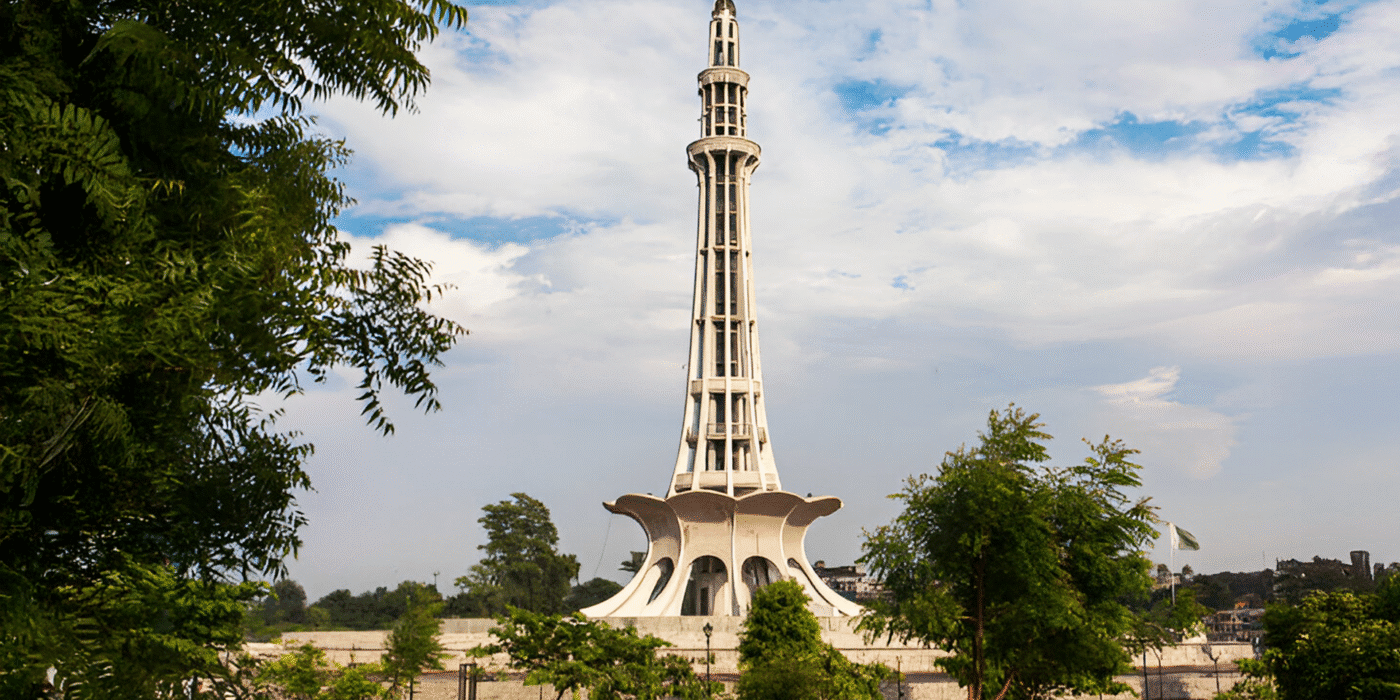
Rising majestically in the heart of Lahore, Minar-e-Pakistan is a symbol of the nation’s identity and historical struggle, it continues to captivate visitors with its towering presence and cultural significance. From its impressive architecture to its role in shaping Pakistan’s history, Minar-e-Pakistan stands as a landmark worth exploring. Keep reading to discover its history, design, symbolism, and tourist appeal.

Minar-e-Pakistan History
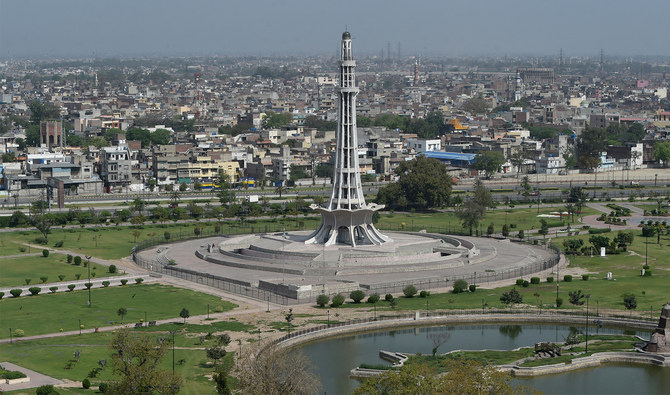
aerial view of minar-e-pakistan and the green space around

The Minar-e-Pakistan is one of the most iconic landmarks in Lahore, representing the country’s struggle for independence and national identity.

The monument stands on the site where the All-India Muslim League passed the Lahore Resolution on March 23, 1940, demanding a separate homeland for Muslims in the Indian subcontinent.

This pivotal resolution eventually led to the creation of Pakistan in 1947, making the site historically and politically significant.

Mughal and Colonial Context

Although the monument was constructed in the 1960s, the site itself holds centuries of historical and cultural significance, linking Lahore’s rich Mughal heritage with Pakistan’s modern national identity. It reflects the architectural and cultural continuity of the region:

  • Lahore, as a Mughal stronghold, was historically a center for religious, political, and cultural developments.
  • The monument’s location near Greater Iqbal Park and Lahore Fort ties it to a lineage of imperial and civic landmarks. 
  • Minar-e-Pakistan symbolizes the struggle, aspirations, and sacrifices of Muslims during the Pakistan Movement, serving as a constant reminder of the nation’s founding ideals.

Construction and Design Leadership | Minar-e-Pakistan

  • The monument was designed by Nasreddin Murat-Khan, a renowned architect, blending Islamic, Mughal, and modern design elements.
  • Construction took place between 1960 and 1968, employing reinforced concrete, marble, and stone to ensure both durability and aesthetic appeal.
  • The design incorporates symbolic elements representing the phases of the independence movement:
    1. Base platforms: Represent humble beginnings and the early struggles of Muslims in the subcontinent.
    2. Intermediate platforms: Depict the movement’s growing momentum and determination.
    3. Upper polished marble platform: Signifies the ultimate success and achievement of Pakistan’s independence.

Political and Cultural Role | Minar-e-Pakistan

Over the decades, Minar-e-Pakistan has been more than a historical monument; it has become a vibrant civic and cultural symbol:

  • Hosts national celebrations, including Pakistan Day (March 23) ceremonies.
  • Venue for political rallies, cultural events, and public gatherings, reflecting its ongoing relevance in national life.
  • Acts as a symbol of unity, pride, and historical continuity, connecting modern Pakistanis to their heritage.

Through its rich history, symbolic design, and enduring cultural presence, Minar-e-Pakistan stands as both a monument to the past and a beacon of national identity, drawing visitors, historians, and citizens alike to reflect on Pakistan’s journey.

Architecture and Design of Minar-e-Pakistan
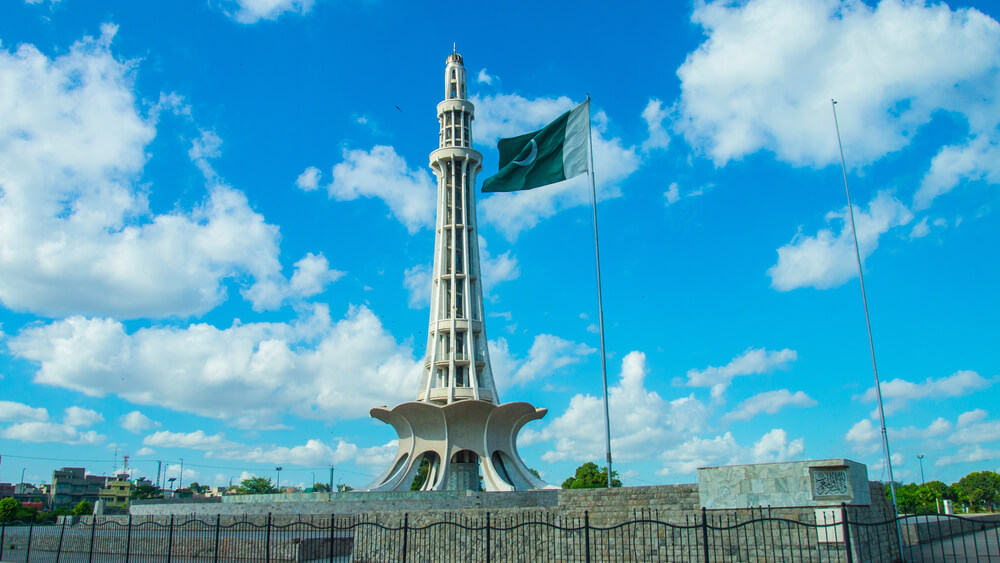
minar-e-pakistan

The architecture of Minar-e-Pakistan is a remarkable fusion of Islamic, Mughal, and modern styles, reflecting both the heritage of the region and the aspirations of a new nation.

Designed not only as a monumental structure but also as a symbol of the Pakistan Movement, it balances grand scale with intricate symbolic storytelling, making it one of Lahore’s most iconic landmarks.

Base and Symbolic Platforms | Minar-e-Pakistan
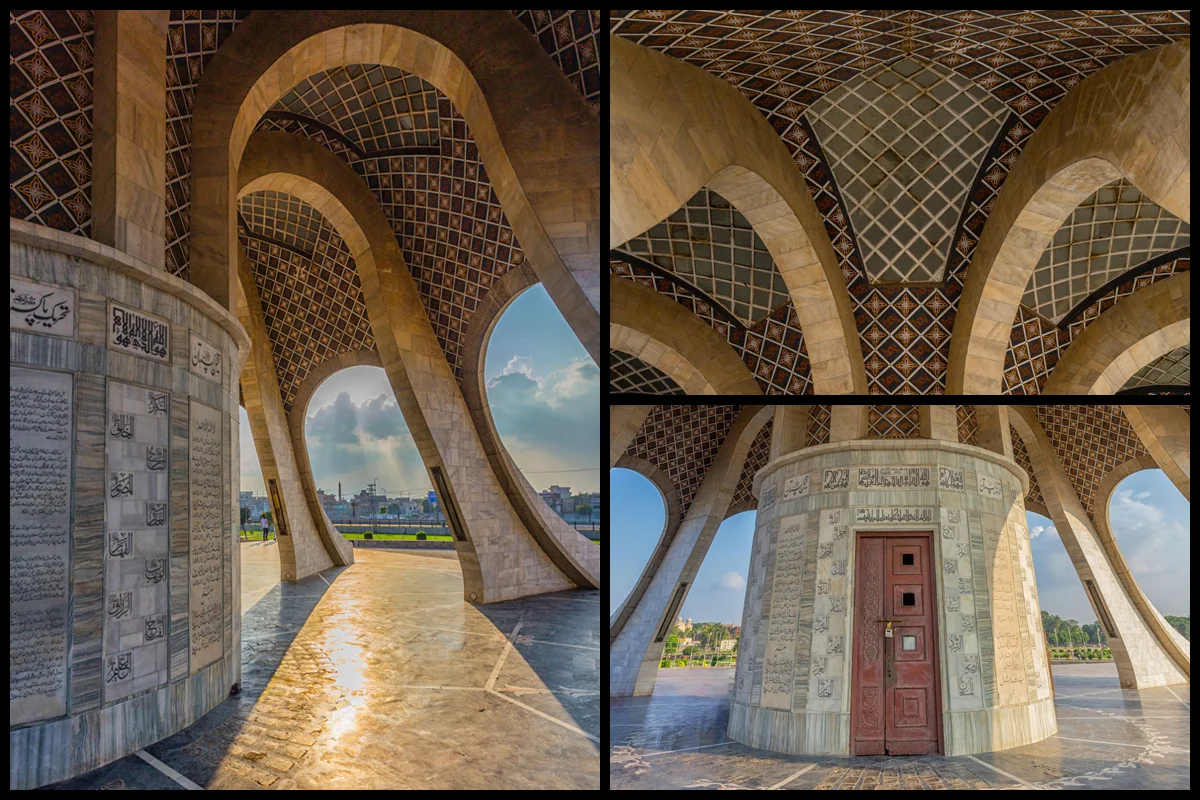
collage of interior views of minar-e-pakistan

The base of Minar-e-Pakistan is uniquely shaped like an eight-petal flower, symbolizing growth, prosperity, and the unfolding of a new nation. Minar-e-Pakistan has a total of eight floors that visitors can access via stairs or a lift. The monument is built on four symbolic platforms, each representing a stage in the struggle for independence:

  • Uncut Stones from Taxila – represent the humble beginnings and initial struggles of the Pakistan Movement.
  • Hammer-Dressed Stones – signify the challenges and hardships faced by the movement.
  • Chiseled Stones – depict the momentum gained as the struggle progressed.
  • Polished White Marble – symbolizes the success and establishment of Pakistan, representing purity, achievement, and national pride.

These platforms not only enhance the monument’s symbolic meaning but also guide visitors through a visual narrative of Pakistan’s independence journey.

Materials and Craftsmanship | Minar-e-Pakistan
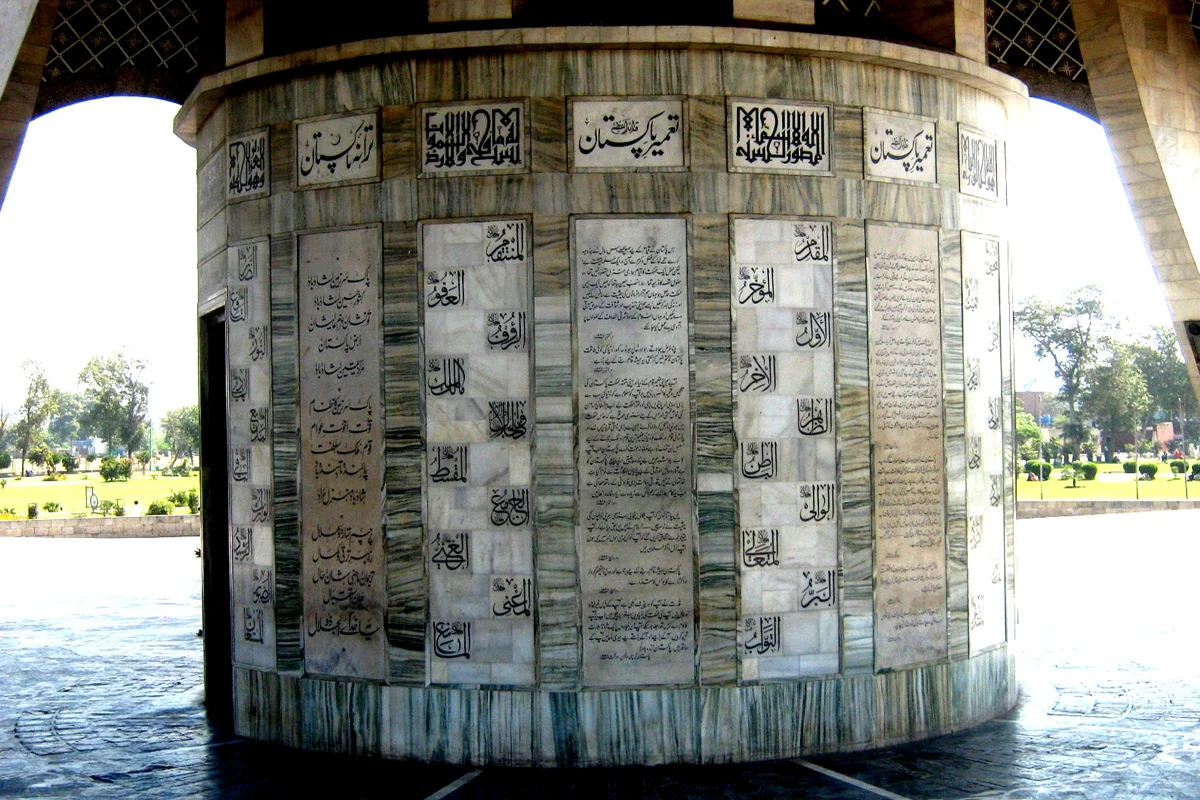
calligraphy on minar-e-pakistan pillar

Minar-e-Pakistan is constructed using reinforced concrete to ensure structural stability and longevity. The monument is finished with marble and stone, giving it a timeless aesthetic appeal while protecting it from weathering.

  • Inscriptions: The walls feature intricate calligraphy and inscriptions in Urdu, Bengali, and English. These include:
    • Excerpts from speeches by Muhammad Ali Jinnah and Allama Iqbal.
    • Verses from the Qur’an, emphasizing spiritual and cultural heritage.
    • Portions of the national anthem, reinforcing its patriotic significance.

The combination of materials and craftsmanship ensures that Minar-e-Pakistan is not only visually stunning but also a durable symbol of national pride.

Structural Features
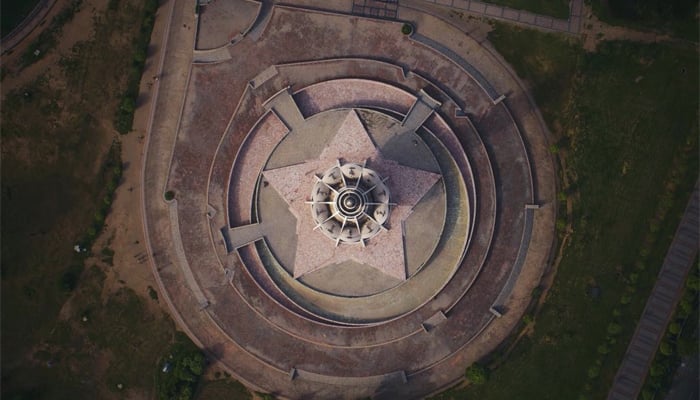
Top view of minar-e-pakistan lahore

  • Height: Standing at 70 meters, the minar dominates Lahore’s skyline and is visible from across Greater Iqbal Park.
  • Design Elements: A harmonious blend of curved, geometric, and floral motifs reflects both Mughal influences and modern architectural principles.
  • Platforms and Terraces: Visitors can explore multiple levels, offering panoramic views of the surrounding park, Badshahi Mosque, and Lahore Fort, allowing them to fully appreciate the monument’s scale and artistry.

The architecture of Minar-e-Pakistan goes beyond aesthetics; it serves as a symbolic and functional landmark, blending history, culture, and engineering ingenuity in one monumental structure.

Cultural and Political Significance

The Minar-e-Pakistan is not just an architectural marvel; it stands as a living symbol of Pakistan’s identity, history, and aspirations. Beyond its structural beauty, the monument embodies the struggle, vision, and unity that led to the creation of Pakistan.

Historical Importance

  • The minar marks the exact site where the All-India Muslim League passed the Lahore Resolution on March 23, 1940, demanding a separate homeland for Muslims.
  • This historic event was pivotal for Pakistan’s independence in 1947, making the monument a physical reminder of the nation’s foundation.

Role in National Celebrations

  • The monument serves as the primary venue for Pakistan Day celebrations, attracting thousands of citizens and officials each year.
  • It hosts political rallies, cultural festivals, and public gatherings, reinforcing its status as a center of civic and national life.
  • During special occasions, the surrounding Greater Iqbal Park becomes a hub for patriotic events and communal activities.

Symbol of Unity and National Pride

  • Minar-e-Pakistan represents the resilience, determination, and aspirations of the Muslim community in the subcontinent.
  • Its design, inscriptions, and symbolic platforms remind citizens and visitors of the sacrifices made during the Pakistan Movement.
  • As a cultural landmark, it continues to inspire national pride, historical awareness, and civic responsibility.

Through its historical context, ceremonial role, and symbolic meaning, Minar-e-Pakistan remains one of Pakistan’s most significant cultural and political icons, bridging past struggles with contemporary national identity.

Tourism and Visitor Information
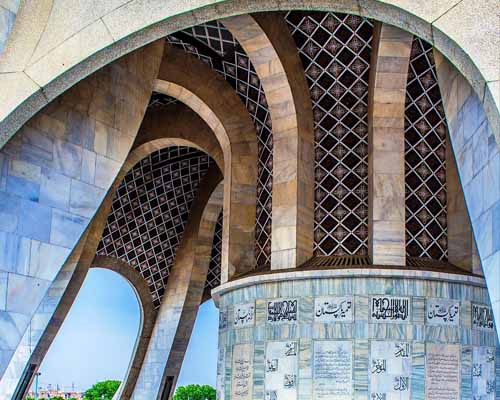
minar-e-pakistan lahore interior view

The Minar-e-Pakistan is one of Lahore’s most iconic landmarks, attracting a diverse range of visitors including local residents, students, history enthusiasts, and international tourists. Its towering presence, cultural significance, and beautiful surroundings make it a must-visit destination in the city.

Location and Accessibility

  • Situated in the heart of Greater Iqbal Park, Lahore, the monument is surrounded by lush green spaces, walking trails, and recreational areas.
  • Easily reachable via public transport, taxis, or private vehicles, with ample parking facilities nearby.
  • Well-connected to major roads and pedestrian pathways, making it accessible for both casual visitors and organized tour groups.

Best Time to Visit

  • Early Morning: Ideal for a quiet and reflective experience, with cooler temperatures and minimal crowds.
  • Sunset: Perfect for photography, as the red sandstone and marble façade glows under natural light, creating stunning visual effects.

Nearby Attractions
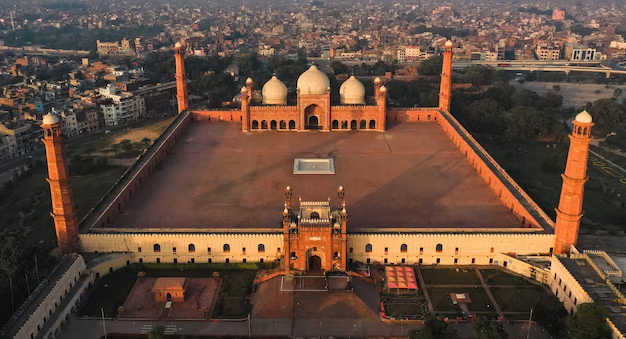
aerial shot of badshahi masjid

Visiting Minar-e-Pakistan can be combined with several historical and cultural landmarks in Lahore:

  • Badshahi Mosque – a majestic Mughal-era mosque located adjacent to the park.
  • Lahore Fort – a UNESCO World Heritage site, offering historical insights and architectural splendor.
  • Fort Road Food Street – experience authentic Lahori cuisine with spectacular views of the monument.

Mughal Construction Legacy

Although constructed in the 1960s, Minar-e-Pakistan draws significant inspiration from Mughal architectural principles, reflecting the grandeur, symmetry, and decorative excellence characteristic of the empire. Its design demonstrates how historical architectural styles can be adapted into modern national monuments while preserving symbolic significance.

Key Architectural Features Inspired by the Mughals
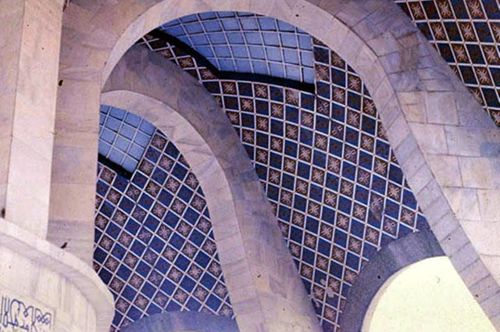
  • Grand Scale and Monumental Presence: The towering height of 70 meters and the expansive base create a sense of dominance and visual impact, typical of Mughal monumental structures.
  • Symmetry and Balance: The minar’s layout maintains perfect proportionality and geometric harmony, echoing the Mughal emphasis on balanced and orderly design.
  • Decorative Detailing: Features such as floral motifs, geometric patterns, and intricate inscriptions reflect Mughal artistry and Islamic design sensibilities.

Influence on Later Structures

  • Minar-e-Pakistan has inspired design elements in subsequent Pakistani national monuments, incorporating similar symmetry, vertical prominence, and decorative inlays.
  • Its planning of platforms, terraces, and landscaped surroundings has set benchmarks for modern civic and public architecture, demonstrating effective integration of aesthetic appeal and functional accessibility.
  • The monument represents the continuity of Islamic and Mughal architectural principles in contemporary Pakistani civic design, bridging historical heritage with modern symbolism.

Conservation Efforts

To preserve its historical, cultural, and structural significance, Minar-e-Pakistan has undergone several restoration and maintenance initiatives over the decades.

UNESCO Recognition

Added to the UNESCO Tentative List in 1993, acknowledging its global cultural and historical importance.

Restoration and Maintenance Programs

  • Managed by Punjab heritage authorities, these programs ensure that the monument remains structurally sound and visually intact for visitors.
  • Restoration focuses on:
    • Preserving intricate marble inlays and inscriptions, including Quranic verses and historic speeches.
    • Maintaining the stability of platforms, terraces, and the base, ensuring safety for visitors.
    • Enhancing accessibility for tourists, including ramps and designated pathways, without compromising the monument’s aesthetics.

Through these efforts, Minar-e-Pakistan continues to stand as a symbol of national pride, blending historical architectural inspiration with modern preservation techniques. It remains a living monument, educating and inspiring visitors while safeguarding Pakistan’s rich cultural heritage.

For more information on similar content like Symbolism in design, visit Chakor blogs. 

FAQs

What’s Minar-e-Pakistan Timing?

Minar-e-Pakistan is typically open from 8:00 AM to 10:00 PM daily for visitors.


Where is Minar-e-Pakistan Located?

Minar-e-Pakistan is located in Greater Iqbal Park, Lahore, Pakistan.

When was Minar-e-Pakistan Built?

Construction of Minar-e-Pakistan began in 1960 and was completed in 1968.

How Many Floors of Minar-e-Pakistan are There?

The monument consists of four symbolic platforms, each representing different phases of the independence movement.


What’s Minar-e-Pakistan Park Name?

Minar-e-Pakistan is situated within Greater Iqbal Park, one of Lahore’s largest urban parks.

Who Built Minar-e-Pakistan?

Minar-e-Pakistan was constructed by the Pakistani government under the supervision of architect Nasreddin Murat-Khan.

Height of Minar-e-Pakistan in Feet?

The height of Minar-e-Pakistan is approximately 230 feet (70 meters).

Architect of Minar-e-Pakistan?

The architect of Minar-e-Pakistan was Nasreddin Murat-Khan, who designed the monument to symbolize Pakistan’s independence.


 

CategoriesNews

CDA to Approve Only Energy-Efficient Building Plans Under New Regulations

ISLAMABAD: City managers have decided to strictly enforce energy-efficient building codes in the capital, making adherence to the National Energy Conservation Building Codes 2023 mandatory for all upcoming construction projects.

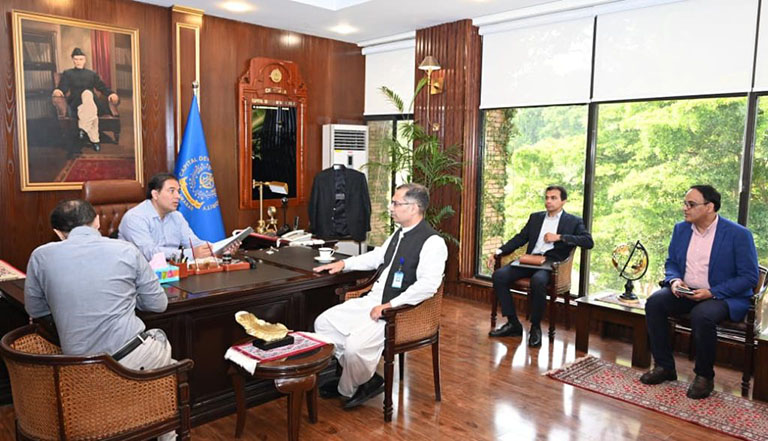
At a meeting held at CDA Headquarters on Tuesday, chaired by CDA Chairman Muhammad Ali Randhawa and attended by National Energy Efficiency and Conservation Authority (NEECA) Managing Director Sardar Moazzam along with CDA board members, officials reviewed the adoption and implementation of the new codes and by-laws of the Pakistan Engineering Council.

Under the plan, building owners will be required to use energy-efficient materials and install low-voltage, energy-saving electrical systems. New building plans will not receive approval unless they comply with the updated standards. CDA has already issued a notification for their enforcement.

Officials noted that compliance will not only improve energy conservation but also reduce electricity costs for citizens. The meeting also discussed the establishment of electric vehicle (EV) charging stations across the city, including at petrol pumps, government facilities, and commercial areas.

NEECA informed participants that it has developed software tools such as the Building Performance Database, ECBC Compliance Tool, and Residential Load Factor Tool to monitor implementation. Training programmes are also being conducted in relevant institutions.

CDA has directed the creation of a financial model to gradually bring older residential and commercial buildings into compliance, with phased implementation after financial reviews. Meanwhile, NEECA announced that electricity would be supplied to registered EV charging stations at subsidised rates, and CDA’s electric feeder buses would be registered with NEECA.

The meeting concluded with consensus on energy conservation, strict enforcement of energy-efficient building codes, and expanding EV charging infrastructure in Islamabad, in line with the prime minister’s vision of sustainable urban development.

CategoriesArchitecture

A Comprehensive Guide to Badshahi Masjid Lahore (2025)

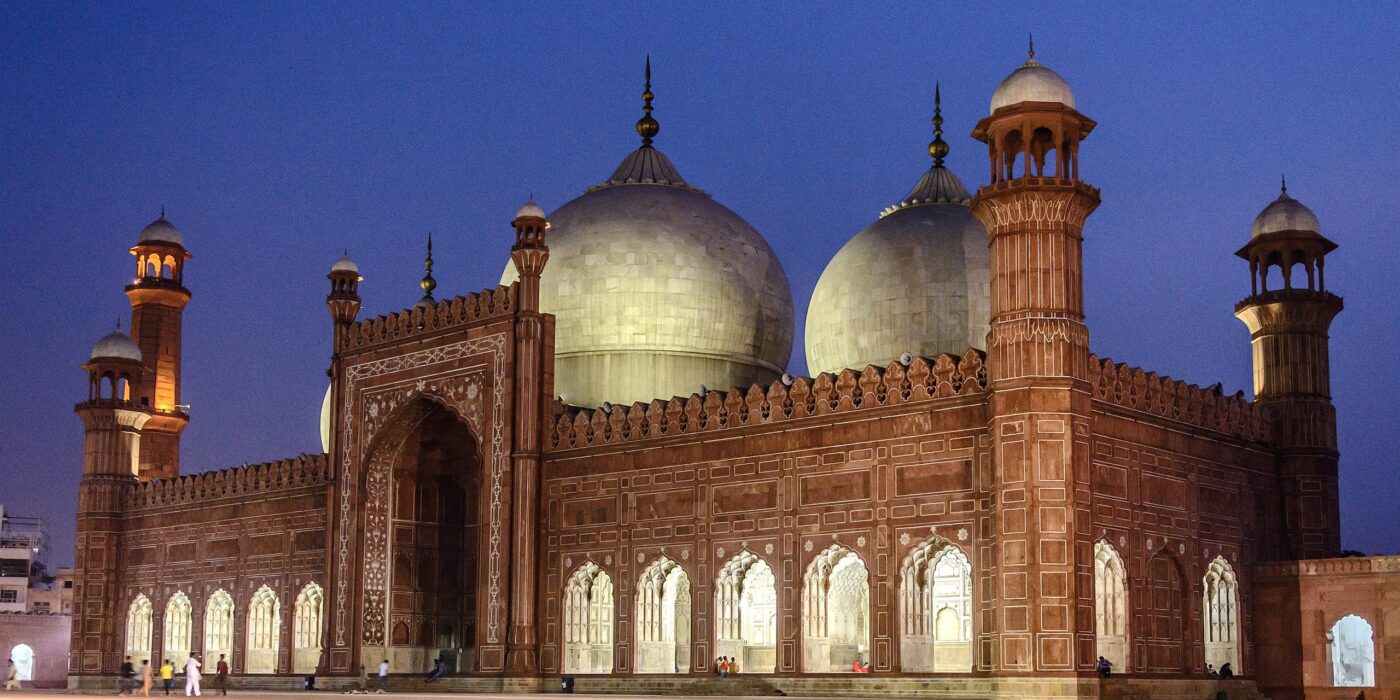
Standing as a symbol of grandeur and Mughal legacy, the Badshahi Masjid in Lahore is one of the most iconic landmarks in Pakistan. Renowned for its majestic scale, intricate artistry, and historical significance, it draws visitors from around the world. Beyond its architectural beauty, the mosque represents centuries of cultural and religious heritage. In this guide, we delve deep and explore the historical, architectural, and touristic aspects of Badshahi Mosque, Lahore.

Key Facts | Badshahi Masjid

Attribute Details
Name Badshahi Masjid 
Location Walled City of Lahore, Punjab, Pakistan
Commissioned By Mughal Emperor Aurangzeb Alamgir
Construction Period 1671 – 1673
Architect / Supervisor Muzaffar Hussain (Fidai Khan Koka)
Materials Used Red sandstone and white marble
Prayer Hall Capacity ~10,000 inside; ~100,000 in courtyard
Courtyard Area 276,000 sq. ft
Minarets Four large minarets (226 ft) + four smaller corner minarets
Domes Three large domes (central dome largest)
UNESCO Tentative Listing Added in 1993
Adjacent Attractions Lahore Fort, Alamgiri Gate, Hazuri Bagh, Fort Road Food Street

Badshahi Masjid History

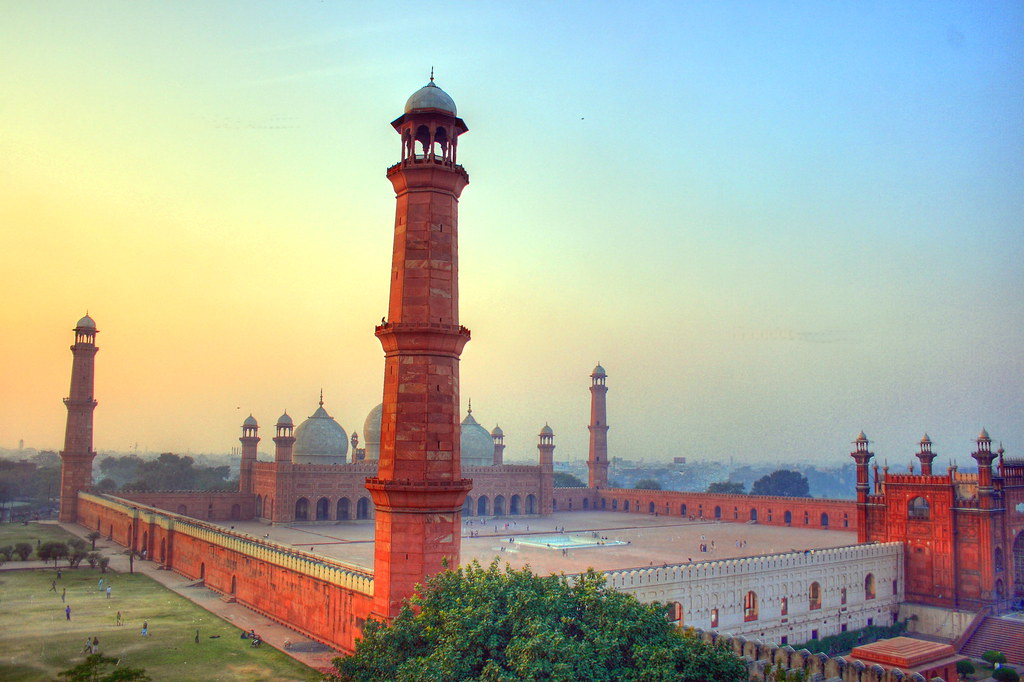
Aerial view of badshahi masjid Lahore

The Badshahi masjid, also known as the “Emperor’s Mosque,” is one of the most iconic landmarks of Lahore and a testament to Mughal architectural grandeur.

Commissioned by Emperor Aurangzeb Alamgir in 1671 and completed in 1673, it was designed to symbolize Mughal power and celebrate Aurangzeb’s military victories.

Mughal Era (1671–1707)

  • Built to commemorate military campaigns, particularly against the Marathas.
  • Strategically located adjacent to Lahore Fort, reflecting Mughal emphasis on grandeur and symmetry.
  • Construction supervision: Overseen by Muzaffar Hussain (Fidai Khan Koka), Aurangzeb’s foster brother and Lahore’s governor.
  • Designed with massive scale and intricate ornamentation, including marble inlay and calligraphy.

Sikh Era (1799–1849)

  • The Badshahi Masjid was repurposed as a military garrison.
  • Courtyard used as stables; surrounding chambers served as barracks.
  • Maintained structural integrity but lost much of its religious function during this period.

British Era (1849–1947)

  • Continued military use under British rule.
  • Restoration efforts began in 1852 to protect architectural features.
  • Gradually returned to the Muslim community for worship, balancing preservation with functional use.

Post-Independence Pakistan (1947–Present)

  • Extensive conservation and restoration projects undertaken:
    • Repairs to red sandstone and white marble façades.
    • Restoration of intricate calligraphy and decorative motifs.
    • Maintenance of the Badshahi Masjid’s vast courtyard, capable of holding over 100,000 worshippers.
  • Today, the mosque serves both as a place of worship and a major cultural and tourist attraction.

Architecture and Design of Badshahi Masjid

aerial view of badshahi mosque lahore

The Badshahi Masjid stands as a testament to the pinnacle of Mughal architectural mastery, showcasing symmetry, grandeur, and meticulous artistry.

Its design was carefully planned to reflect imperial authority while providing a functional space for thousands of worshippers.

Mughal Construction Emblem

The badshahi masjid lahore embodies classic Mughal architectural principles, emphasizing balance, proportion, and intricate decorative work.

Its layout reflects perfect symmetry, and every element, from arches to domes, was designed to convey magnificence and spiritual serenity.

Materials Used

Constructed primarily from red sandstone with white marble inlays, the mosque combines durability with aesthetic appeal. The materials were chosen not only for their strength but also to highlight ornamental features and calligraphy across the complex.

Prayer Hall

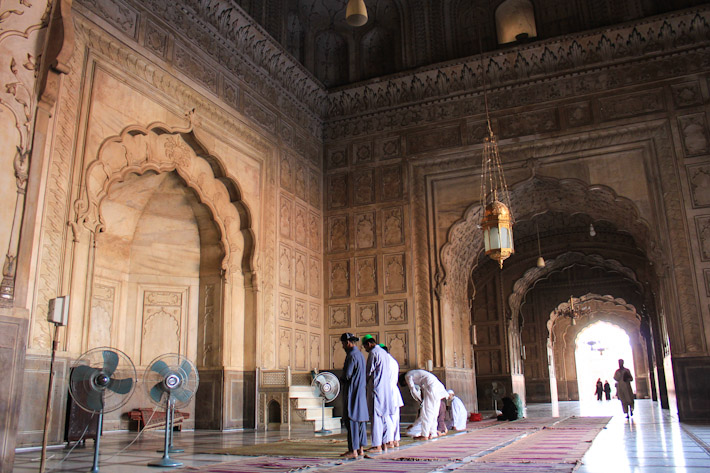
People praying in the prayer hall of badshahi mosque lahore

The prayer hall is the heart of the mosque, accommodating thousands of worshippers. It is adorned with:

  • Floral motifs carved in marble and plaster
  • Islamic calligraphy featuring Quranic inscriptions
  • Geometric patterns reflecting Mughal artistry
    The design allows ample natural light and ventilation, creating a serene environment for prayer.

Domes and Minarets

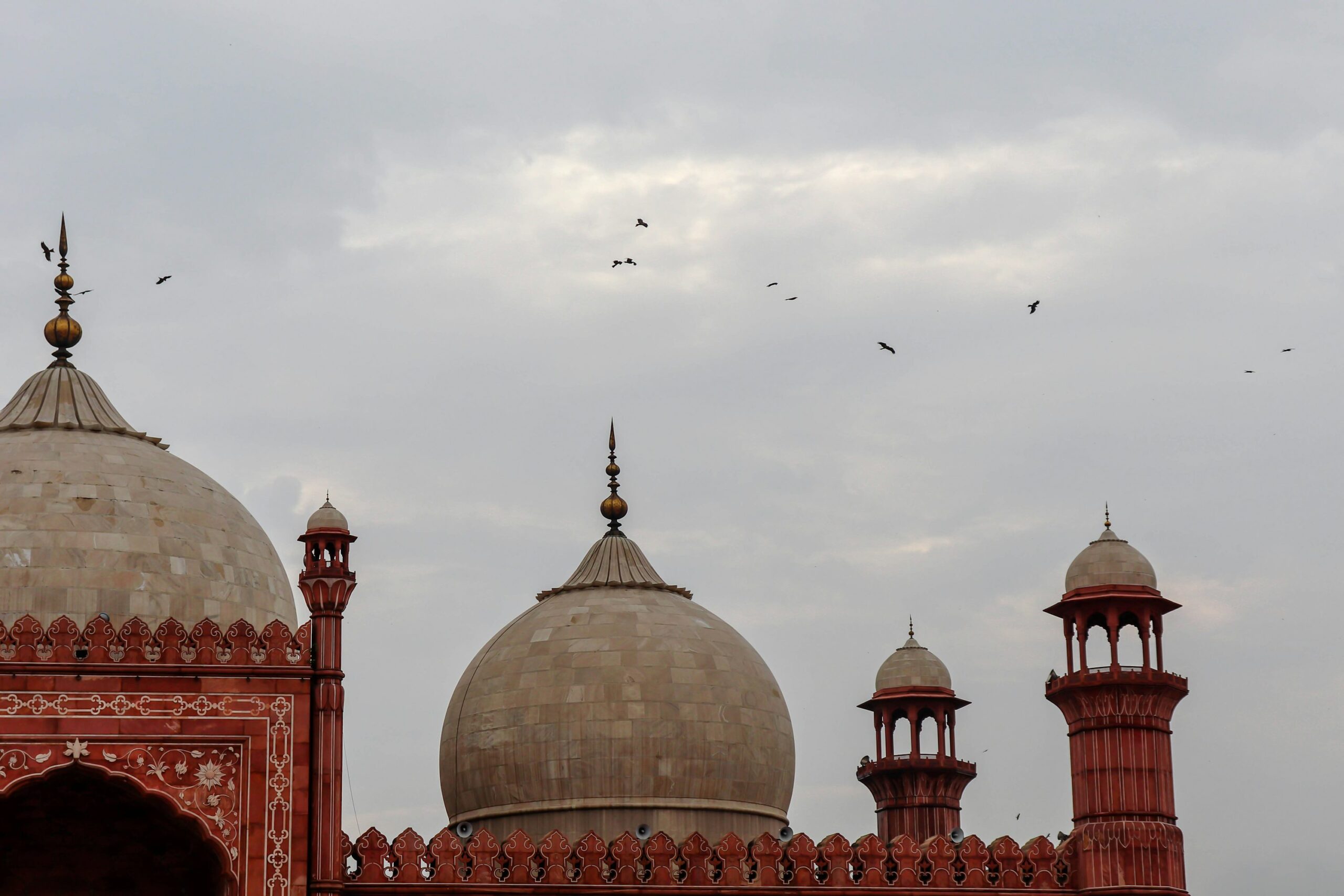
image of domes and minarets of badshahi masjid lahore

Crowning the mosque are three large domes, with the central dome being the tallest. At each corner rise four towering minarets, approximately 226 feet (69 meters) high.

These minarets enhance the mosque’s vertical grandeur while serving traditional functional purposes such as the call to prayer.

Courtyard

The mosque’s expansive courtyard can accommodate up to 100,000 worshippers, making it ideal for Eid congregations and Friday prayers.

It is surrounded by arcades and perimeter walls adorned with decorative motifs, emphasizing the scale and majesty of the complex.

Adjacent Structures

  • Alamgiri Gate: a grand entrance that complements the mosque’s architectural splendor.
  • Perimeter walls and surrounding arcades: feature intricate designs, maintaining visual harmony with the main mosque.

Tourism and Visitor Information

The Badshahi Mosque is situated in the heart of Lahore’s Walled City, directly adjacent to the historic Lahore Fort. Its central location makes it a must-visit landmark for tourists exploring the city’s rich cultural heritage.

For photography enthusiasts, the best times to visit are early morning and during sunset, when natural lighting highlights the mosque’s red sandstone and marble façade, offering breathtaking views.

Nearby Attractions

exterior view of baradari huzuri bagh lahore

  • Hazuri Bagh: a beautifully manicured garden located between the mosque and the fort.
  • Fort Road Food Street: offers local cuisine with a panoramic view of the mosque.
  • Lahore Fort: another UNESCO World Heritage Site, showcasing Mughal architecture.

Accessibility and Entry Tips

  • Easily accessible via public transport or private vehicles.
  • Entry is generally free, but visitors are expected to observe mosque etiquette (modest dress, removal of shoes).
  • Guided tours are available to provide historical and architectural insights.

The Badshahi Mosque plays a vital role in cultural heritage tourism, attracting thousands of local and international visitors annually. Its grandeur and historical significance make it a key destination for anyone exploring Mughal-era architecture in Pakistan.

Mughal Construction Legacy

The Badshahi Mosque represents the last major mosque constructed during the Mughal era in the Indian subcontinent, reflecting the empire’s architectural zenith.

Its design emphasizes grand scale, meticulous precision, and elaborate decorative elements, characteristics typical of late Mughal architecture.

Architectural Influence

  • The mosque has inspired later mosque designs across South Asia, particularly in Pakistan and northern India.
  • Its courtyard layout, towering minarets, and central dome became a reference point for subsequent religious structures.

Mughal Innovations

  • Courtyard Planning: designed to accommodate tens of thousands of worshippers while maintaining symmetry and accessibility.
  • Minaret Height and Placement: strategically positioned for aesthetic balance and functional use.
  • Dome Engineering: large central dome flanked by smaller domes, showcasing advanced Mughal construction techniques.

Through its architectural innovations and artistic mastery, the Badshahi Mosque remains a symbol of Mughal ingenuity, combining functionality, aesthetics, and imperial authority in one monumental structure.

Comparison with Other Mughal Mosques

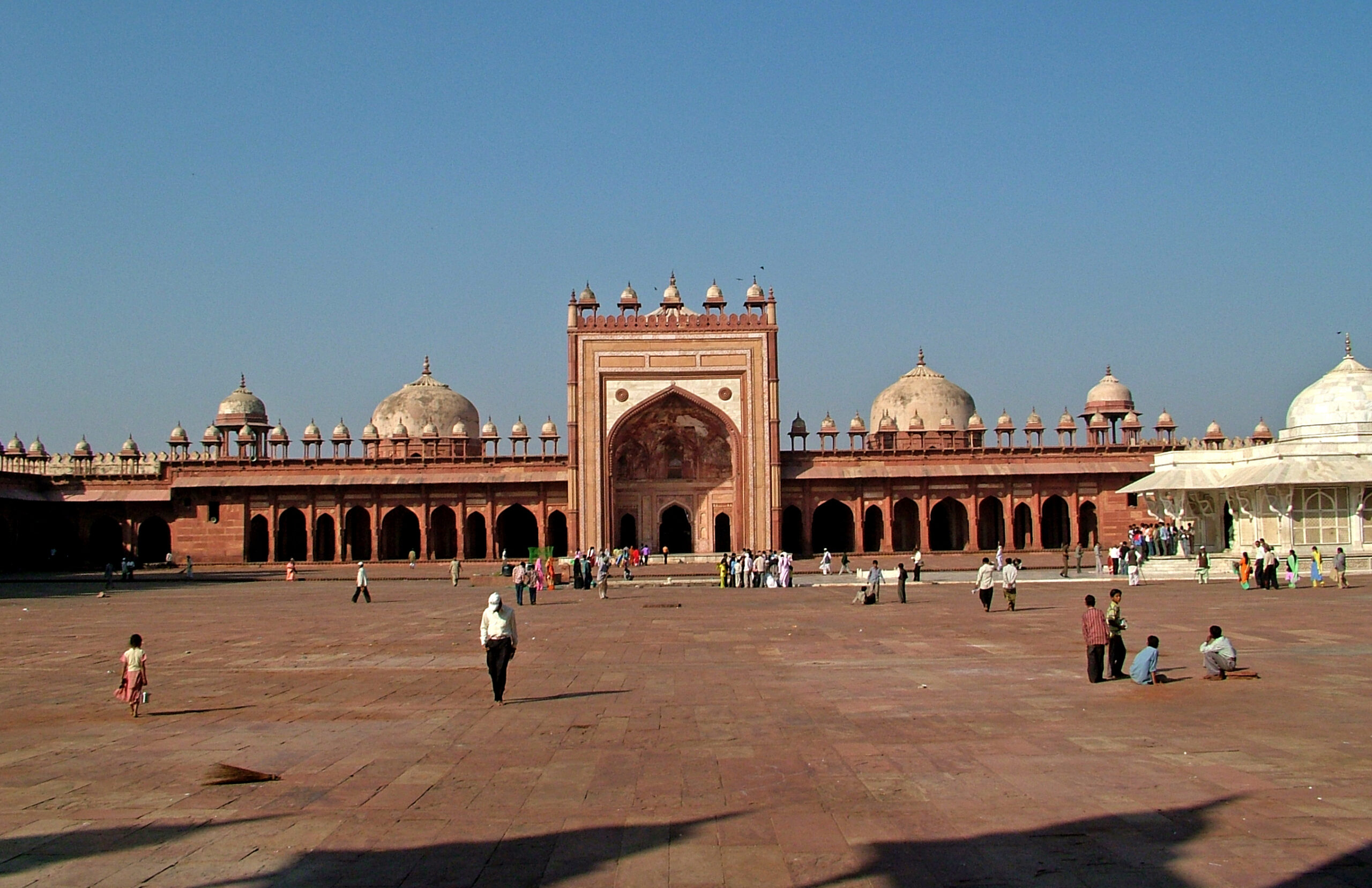
Fatehpur Sikri Mosque exterior view

The Badshahi Mosque is often compared with other iconic Mughal-era mosques, such as Jama Masjid in Delhi, Fatehpur Sikri Mosque, and Wazir Khan Mosque in Lahore, highlighting both similarities and unique features.

Similarities:

  • Materials: Like many Mughal mosques, Badshahi Mosque uses red sandstone with white marble inlays, reflecting the Mughal preference for contrast and elegance.
  • Symmetry and Design: Mughal architecture emphasizes perfect proportionality, and all these mosques demonstrate meticulous planning in layout, dome placement, and minaret alignment.
  • Courtyard Size: Expansive courtyards are a hallmark of Mughal mosques, designed to accommodate thousands of worshippers during congregational prayers.

Unique Features of Badshahi Mosque:

  • Scale: Badshahi Mosque has one of the largest courtyards in the world, accommodating up to 100,000 worshippers, surpassing most other contemporary Mughal mosques.
  • Dome and Minaret Design: The mosque boasts three massive domes, with the central dome being the largest, flanked by four corner minarets that rise 226 feet high, creating a striking skyline.
  • Decorative Excellence: Its intricate marble inlay, floral motifs, and calligraphy are more extensive and elaborate than many other Mughal mosques.
  • Cultural Significance: Badshahi Mosque serves as a cultural emblem of Lahore which itself is the cultural hub, representing Mughal grandeur at its zenith.

Through these unique features, the Badshahi Mosque stands not just as a place of worship but also as a symbol of Mughal architectural mastery and innovation in the Indian subcontinent.

Conservation Efforts and UNESCO Status

The Badshahi Mosque is not only an architectural landmark but also a cultural heritage site requiring ongoing preservation.

UNESCO Recognition:

  • In 1993, the mosque was added to Pakistan’s Tentative List for UNESCO World Heritage Site consideration, highlighting its global cultural and historical significance.

Conservation and Maintenance Programs:

  • Structural Preservation: Restoration works focus on maintaining the integrity of minarets, domes, and perimeter walls, ensuring they withstand environmental stress and aging.
  • Artistic Preservation: Efforts are made to conserve intricate marble inlays, calligraphy, and floral motifs, which are essential to the mosque’s Mughal identity.
  • Public Engagement: Punjab Tourism and heritage authorities coordinate with cultural organizations to provide guided tours, educational programs, and visitor facilities, promoting awareness of its historical importance.
  • Regular Maintenance: Continuous upkeep includes cleaning, repairs, and structural assessments to preserve both aesthetic beauty and functional safety for worshippers and tourists.

These efforts ensure that the Badshahi Mosque Lahore remains a living monument, retaining its splendor for future generations while accommodating thousands of visitors annually.

FAQs

  1. When was the Badshahi Mosque built?
    It was commissioned in 1671 by Emperor Aurangzeb and completed in 1673, during the height of the Mughal Empire.
  2. Who commissioned and supervised its construction?
    Aurangzeb Alamgir commissioned the mosque, and construction was overseen by Muzaffar Hussain (Fidai Khan Koka), Aurangzeb’s foster brother and governor of Lahore.
  3. What materials were used in its construction?
    The mosque was built with red sandstone and white marble, with elaborate marble inlays, calligraphy, and decorative motifs adorning both interior and exterior surfaces.
  4. How many worshippers can it accommodate?
    The prayer hall and vast courtyard together accommodate over 100,000 worshippers, making it one of the largest mosque complexes globally.
  5. What are the visiting hours and entry requirements?
    Visitors can enter daily, with modest attire and shoe removal required. Guided tours are available to provide historical and architectural insights.
  6. Why is it considered a Mughal architectural masterpiece?
    The mosque exemplifies grand scale, perfect symmetry, and intricate artistry, combining engineering ingenuity with aesthetic excellence characteristic of late Mughal architecture.
  7. Who built Badshahi Masjid?
    Badshahi Masjid built by Mughal Emperor Aurangzeb Alamgir in 1673.

For more information on similar blogs like Deforestation in Pakistan, visit Chakor blogs.

CategoriesNews

RDA Steps Up Drive Against Illegal Societies, Encroachments

RAWALPINDI: The Rawalpindi Development Authority (RDA) has launched a large-scale crackdown against illegal housing schemes and unauthorized constructions on the instructions of its Director General, Kinza Murtaza.

During the operation, the Task Force targeted several unapproved projects. At Islamabad City Housing in Katarian, near Shinwari Hotel on Main Airport Avenue, officials demolished the boundary wall, removed manhole pipes, sealed the site office, and lodged an FIR against the scheme’s owners, Qasim Bhatti and Nasir Bhatti.

At Waddia Homes in Mouza Morgha near Askari 14, the boundary wall, guard room, main gate, and barrier were demolished, while in Wazir Town Housing Scheme, 40 illegally under-construction shops in commercial markets were taken down.

An RDA spokesperson said the drive, supervised directly by DG Kinza Murtaza, will continue to curb fraudulent schemes and protect citizens from exploitation. She stressed that strict action will be taken against land grabbers and owners of illegal projects.

The authority also advised the public to avoid investing in unauthorized housing societies and to verify approvals through the official RDA website before making transactions.

CategoriesArchitecture

A Guide on Fly Ash Bricks

Building strong, durable, and environmentally friendly structures has become a top priority in modern construction. Traditional materials like clay bricks are being complemented by innovative alternatives that offer better performance and sustainability. Among these, Fly Ash Bricks have gained significant attention due to their strength, consistency, and eco-friendly properties.

In this blog, we will explore everything you need to know about Fly Ash Bricks: their types, manufacturing process, costs, advantages and disadvantages, how they compare to regular bricks, and the latest rates in Pakistan for builders and homeowners.

What Are Fly Ash Bricks?

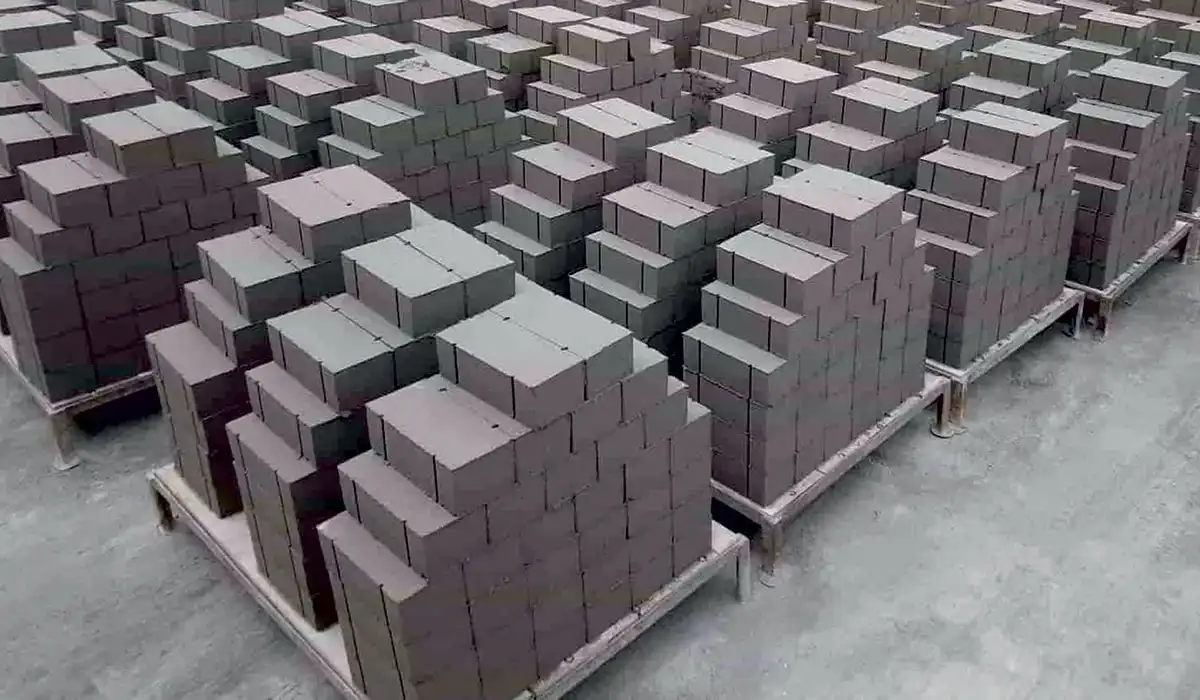
Fly Ash Bricks are high-quality building blocks made primarily from fly ash, a by product of coal-fired power plants, mixed with cement, sand, and water. Unlike conventional clay bricks, these bricks are cured instead of fired, giving them a smooth finish, uniform size, and superior strength. Depending on the application, other additives like lime or gypsum may also be used to enhance durability and workability.

what are fly ash bricks

How They Differ from Traditional Clay Bricks

Unlike clay bricks, which are made by baking clay at high temperatures, Fly Ash Bricks:

  • Are lighter in weight, reducing the overall load on structures.
  • Have higher compressive strength, making them suitable for load-bearing walls.
  • Feature uniform dimensions, which simplifies construction and reduces mortar usage.
  • Absorb less water, minimizing dampness and cracking.
  • Require less energy for production, as they do not need firing in kilns.

Environmental Benefits and Sustainability

Fly Ash Bricks are considered an eco-friendly construction material because:

  • They recycle industrial waste, reducing fly ash disposal into landfills.
  • They conserve topsoil, as they do not rely on clay extraction.
  • They reduce greenhouse gas emissions, since no firing is involved.
  • They support sustainable construction practices, promoting long-term environmental responsibility.

By combining strength, durability, and sustainability, Fly Ash Bricks have become a preferred alternative to traditional bricks for builders and homeowners alike.

Types of Fly Ash Bricks

Fly Ash Bricks are versatile and come in multiple types, each tailored to meet specific construction requirements. Choosing the right type can improve durability, efficiency, and cost-effectiveness of your project.

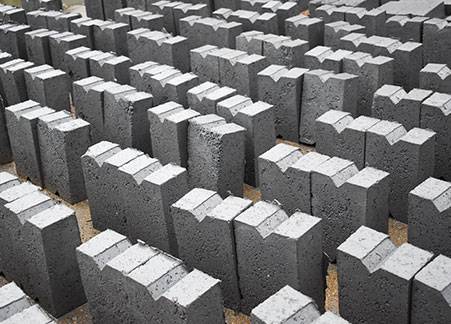
Solid Fly Ash Bricks

Solid Fly Ash Bricks are the most commonly used type for general construction due to their strength and density. They are ideal for walls and structures that require maximum stability and load-bearing capacity.

solid fly ash bricks

Characteristics:

  • Dense and robust with high compressive strength.
  • Offers excellent durability and uniformity.
  • Provides good thermal insulation for walls.

Applications:

  • Load-bearing walls in residential and commercial buildings.
  • Boundary walls and fencing.
  • General masonry work where strength and durability are key.

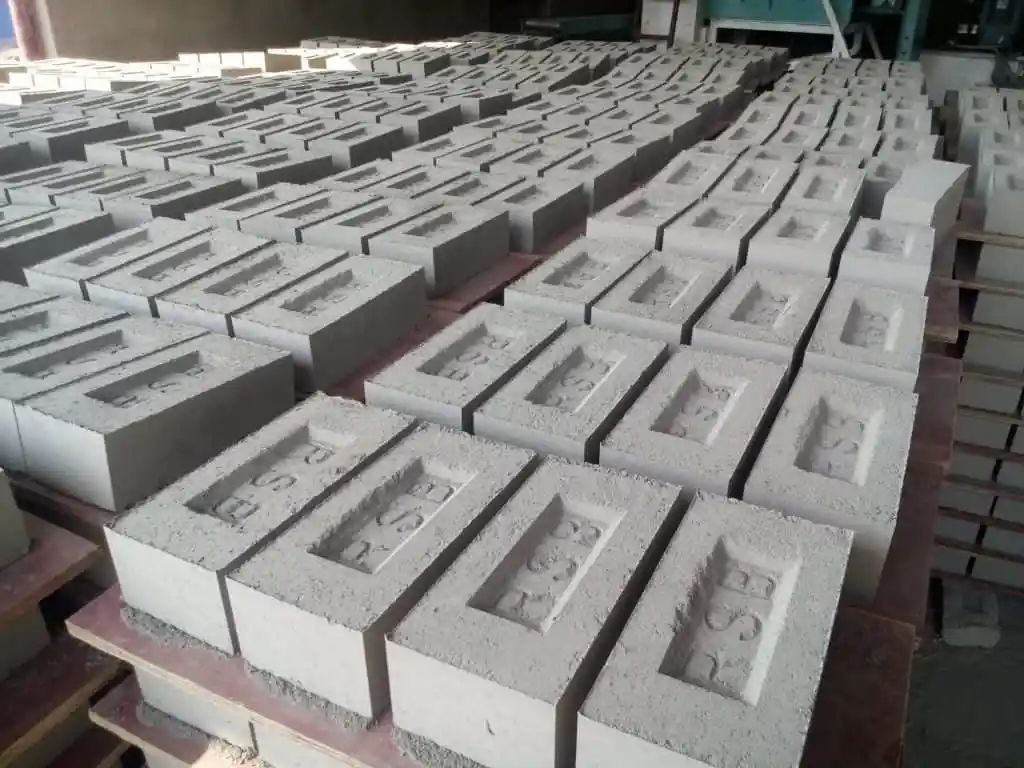
Hollow Fly Ash Bricks

Hollow Fly Ash Bricks are designed with air cavities to reduce weight and improve insulation. They are suitable for constructions where reducing structural load and enhancing energy efficiency is important.

Characteristics:

  • Lighter than solid bricks due to hollow cavities.
  • Reduces overall structure weight, saving on foundation costs.
  • Offers better thermal insulation because of trapped air pockets.

Applications:

  • Partition walls and non-load-bearing structures.
  • Multi-story residential buildings where weight reduction is important.
  • Interior walls for improved energy efficiency.

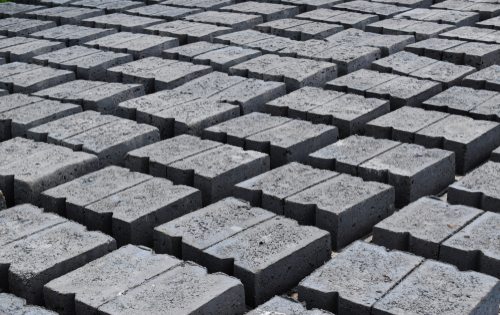
High-Density Fly Ash Bricks

High-Density Fly Ash Bricks are made for heavy-duty construction. Their increased density and strength make them ideal for industrial and large infrastructure projects.

high density fly ash bricks

Characteristics:

  • Manufactured with higher fly ash and cement content, resulting in very high compressive strength.
  • Provides enhanced durability and resistance to weathering.
  • Suitable for heavy-duty construction.

Applications:

  • Industrial buildings and warehouses.
  • Bridges and retaining walls.
  • Foundations requiring high-load-bearing capacity.

Specialty Fly Ash Bricks

Specialty Fly Ash Bricks are designed to meet specific functional needs beyond standard construction. They include variants for fire resistance, soundproofing, and lightweight structures.

specialty fly ash bricks

Characteristics:

  • Fire-resistant bricks: withstand high temperatures.
  • Soundproof bricks: reduce noise transmission.
  • Lightweight bricks: ideal for high-rise buildings.
  • Can be produced in both solid and hollow forms.

Applications:

  • Fire-resistant bricks: kitchens, industrial zones, and chemical plants.
  • Soundproof bricks: offices, theaters, and residential complexes in noisy areas.
  • Lightweight bricks: multi-story residential and commercial buildings where structural load reduction is required.

Fly Ash Brick Price List (As of September 2025)

Brick Type Price per Brick Price per 1,000 Bricks  Price per 3,000 Bricks  Notes
Fly Ash Brick ₨ 18 ₨ 18,000 ₨ 54,000 Standard size: 9″ x 4.5″ x 3″; eco-friendly and durable. Niazi bricks

Buyers need to keep in mind that these prices are based on the standard size of 9″ x 4.5″ x 3″ and may vary depending on location, quantity, and delivery charges.

Manufacturing of Fly Ash Bricks

Fly Ash Bricks are made from a combination of fly ash, cement, sand, and water. Additional additives like lime or gypsum may be used in specific mixes to enhance strength, workability, and durability. Fly ash, a byproduct of coal-fired power plants, is the primary component, giving the bricks their eco-friendly credentials.

Step-by-Step Manufacturing Process

  1. Mixing: Fly ash, cement, sand, and water are measured in precise proportions and thoroughly mixed to form a consistent slurry.
  2. Molding: The mixture is poured into molds to form bricks of standard dimensions. Some molds create hollow bricks to reduce weight.
  3. Compaction: Bricks are compressed either manually or using a hydraulic press to achieve desired density.
  4. Curing: Molded bricks are cured under controlled conditions, typically for 7–14 days, to achieve maximum strength without firing.

Manual vs Machine-Made Bricks

  • Manual Bricks: Produced using hand molds; suitable for small-scale production.
  • Machine-Made Bricks: Manufactured using hydraulic presses or brick-making machines; offer consistent size, strength, and faster production rates, ideal for large projects.

Quality Control Measures

  • Uniform size and shape inspection
  • Compressive strength testing to ensure structural suitability
  • Water absorption tests to ensure durability
    Visual inspection for surface defects or cracks

Manufacturing Cost

The main cost components include fly ash, cement, sand, and water. Cement is typically the most significant contributor to total production cost.

Labor and Machine Costs

  • Labor costs vary depending on manual or machine production.
  • Machine-made bricks require investment in hydraulic presses, molds, and maintenance, which increases initial setup cost.

Factors Affecting Production Cost in Pakistan

  • Regional availability of raw materials
  • Transportation costs to construction sites
  • Local energy costs for production facilities
  • Scale of production and automation level

Economical Considerations for Small vs Large-Scale Production

  • Small-scale units: Lower setup costs but higher per-brick labor expenses.
  • Large-scale units: Higher initial investment but lower production cost per brick and consistent quality.

Difference Between Fly Ash Bricks and Regular Clay Bricks

Feature Fly Ash Bricks Traditional Clay Bricks
Strength and Durability Higher compressive strength; load-bearing walls supported Moderate strength; may crack over time
Weight and Thermal Insulation Lighter; better insulation Heavier; moderate insulation
Water Absorption & Moisture Resistance Low absorption; reduces dampness Higher absorption; more prone to moisture issues
Environmental Impact Eco-friendly; uses industrial waste; conserves topsoil Requires clay extraction; energy-intensive firing
Cost-Effectiveness Slightly higher upfront cost but saves on mortar, plaster, and maintenance Lower upfront cost but more maintenance over time

Advantages and Disadvantages of Fly Ash Bricks

Advantages

  • Lightweight and easier to handle
  • High compressive strength and durability
  • Eco-friendly; recycles industrial waste
  • Uniform size reduces mortar and plaster usage
  • Fire-resistant and termite-proof

Disadvantages

  • Limited availability in some regions
  • Slightly higher initial cost compared to clay bricks
  • Requires proper curing to achieve full strength

This was all about fly ash bricks. For more information on similar content such as green buildings, visit Chakor blogs.

FAQs

What are Fly Ash Bricks and how are they made?

ly Ash Bricks are eco-friendly bricks made from fly ash, cement, sand, and water. They are molded and cured instead of fired, resulting in strong, uniform bricks suitable for modern construction.

Are Fly Ash Bricks stronger than traditional bricks?

Yes, they generally have higher compressive strength and durability compared to standard clay bricks, making them suitable for load-bearing walls.

Can they be used for load-bearing walls?

Absolutely. Solid and high-density Fly Ash Bricks are designed for load-bearing applications in both residential and commercial buildings.

How much does a 50 kg bag cost in Pakistan?

Fly Ash Bricks are sold individually or in bulk; a single brick costs around ₨ 18–22, while 1,000 bricks can cost between ₨ 18,000 and ₨ 22,000, depending on supplier and region.

Where can I buy Fly Ash Bricks in Pakistan?

They are available from suppliers like Niazi Bricks, Zarea, Bajisitan, Flyash.pk, and Ultratech Cement, with regional delivery options for large construction projects.

CategoriesNews

Gas Pipeline Replacement in Islamabad Accelerated Ahead of Winter

ISLAMABAD: CDA and SNGPL have agreed to fast-track replacement of old gas pipelines in G-6 and Blue Area, aiming to complete work before winter. The new network will prevent leakages, improve pressure, and ensure uninterrupted supply, with strict action against illegal connections.

Chairman CDA  and Chief Commissioner Islamabad, Muhammad Ali Randhawa, met with Sui Northern Gas Pipelines Limited (SNGPL) General Manager Adnan Ahmed on Monday to review progress on the new gas pipeline network in the capital.

The meeting, attended by senior CDA officials, discussed ongoing replacement of deteriorated pipelines in Sector G-6 and Blue Area. It was agreed that installation work would resume without delay to ensure uninterrupted gas supply before winter.

Randhawa directed that the project be completed ahead of the cold season to prevent shortages, while ensuring consumers face no inconvenience during the replacement process. He also instructed SNGPL to provide early gas connections to the Gandhara Citizen Center in F-9 and to halt supply to illegal and unauthorized constructions.

SNGPL officials said a strategy was being implemented to improve gas pressure across the city, with all measures to be finalized before winter. Both CDA and SNGPL reaffirmed their commitment to working together for improved public services.

CategoriesNews

More than 70 percent of Rawalpindi Ring Road project completed

RAWALPINDI: The Rawalpindi Development Authority (RDA) announced that more than 70 percent of work on the Rawalpindi Ring Road (RRR) project has been completed, marking a major milestone in one of the region’s most significant infrastructure schemes.

The project is designed to serve as an economic corridor, with plans to establish logistics and education centres, a health city, a dry port, business hubs, industrial zones, transport terminals, wholesale markets, recreational parks, and residential communities along both sides of the route.

At a recent meeting on the Ring Road Economic Zones chaired by RDA Director General Kinza Murtaza, officials reviewed progress and upcoming development prospects. Speaking at the session, Murtaza said the project would not only ease traffic congestion in Rawalpindi and Islamabad but also deliver a cleaner, healthier, and safer urban environment.

She further noted that the initiative is expected to stimulate regional economic growth, generate employment, and improve civic facilities, assuring stakeholders that construction would be completed on an accelerated timeline.

CategoriesNews

Experts Urge Urgent Investment as 90% of Pakistan’s Minerals Remain Unexplored

KARACHI: Pakistan’s mining sector could see its revenues triple to $6–8 billion annually by 2030 if the country harnesses its vast mineral wealth, industry leaders said at the Natural Resources and Energy Summit 2025 on Wednesday.

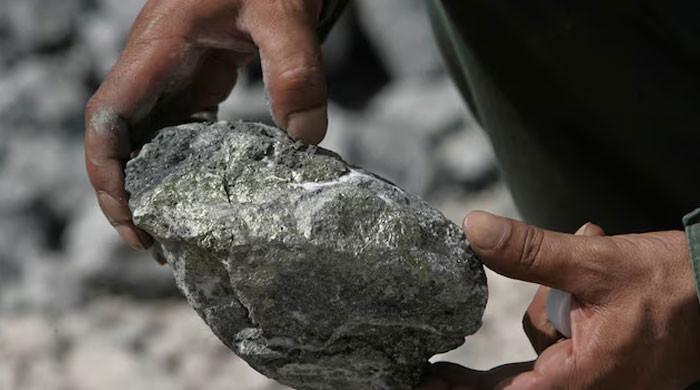
Delivering the keynote, Shamsuddin A. Shaikh, CEO of National Resources Ltd (NRL), noted that Pakistan contributes only 0.15 percent to global mineral output and around 2–3 percent to its own GDP, despite being located on one of the richest mineral belts in the world. He said of the 92 known minerals in the country, nearly 90 percent remain unexplored.

Shaikh warned that delaying action would allow foreign companies to take the lead, urging Pakistani investors to form joint ventures and partnerships to capture opportunities. “This is the time for local companies to create wealth and jobs at home,” he stressed.

He outlined key projects already in motion, including Reko Diq, which is projected to generate $4–5 billion annually, Siah Diq ($1–2 billion), Thar coal expansion ($200 million), and barite, lead, and zinc projects ($100 million). Additional copper and gold exploration in Balochistan’s Chagai region, he said, could bring in $5–10 billion more annually after 2030.

Highlighting the social dimension, Shaikh said responsible mining could transform communities through job creation, better housing, and improved access to healthcare and education. “Mining is not just about minerals—it’s about uplifting lives and eradicating poverty,” he remarked.

Experts at the summit cautioned that the sector’s growth depends on stronger governance, regulatory consistency, and skilled human resources. They also pointed to climate challenges and policy uncertainty as risks, stressing that technology and innovation, including artificial intelligence, will be key enablers.

Bringing together policymakers, investors, and international experts, the summit positioned mining and energy as critical to Pakistan’s economic future. Concluding his address, Shaikh urged decisive action from both government and industry: “This is Pakistan’s moment. With the right policies and investments, mining can become a $10 billion-plus industry, driving growth, stability, and national pride.