
Faisal Mosque history is unique and immersive, thanks to the cultural involvement of the Saudi Arab prince. The prince not only financially supported the building of this religious architect, but his personal keen interest mattered a lot. This mosque is the seventh largest among the numerous mosques in South Asia and around the globe.
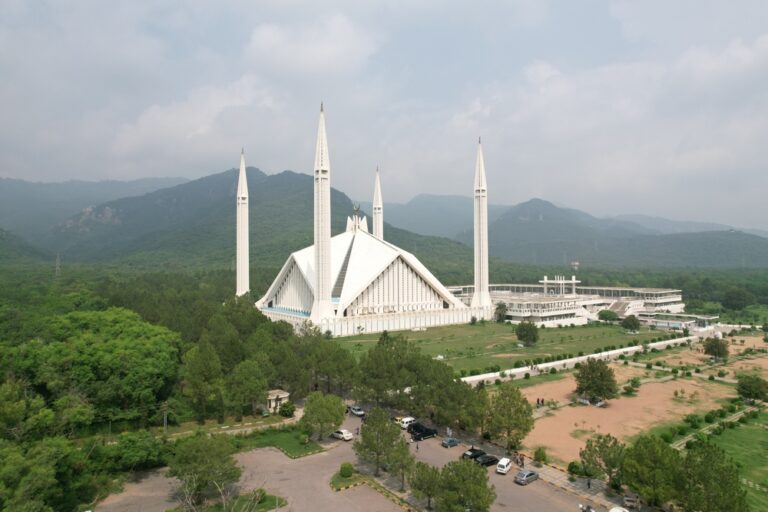
The Faisal Mosque history is too rich. It is not just a mosque symbolized by political or social association with the Saudi Princes; this mosque has a special spiritual, emotional, and historical context that binds it to the country’s heritage, culture, and Islamic ideology.
The Faisal Mosque history dates back to 1986, the year of the inauguration and completion of the architectural marvel designed by the Turkish architect Vedat Dalokay. The mosque is named after the Saudi Arab king Faisal. It is a blend of contemporary and modern features that depict the tent-like structure.
The architect chosen to proceed with the design faced fierce competition. Among 17 countries’ architects who submitted 43 proposals for construction designs, a Turkish designer’s masterpiece won the contest, and today, we have the unconventional yet peculiarly fine design of the Faisal Mosque. The total cost of the project is estimated to be over SAR 13 crore, paid by the Saudi Arabian government.
The Faisal Mosque is admired, praised, and visited not just for religious purposes but also by tourists around the world who enjoy its scenic, architectural beauty and a close look at its iconic design.
The Faisal Mosque history is deeply rooted and connected with Pakistan’s modern era. It came into existence after Saudi King Faisal proposed building a mosque as a token of exchange of cultural values and brotherhood strengthening.
The Faisal Mosque history has a vast record of events happening nationally within the surrounding mosque, as it is not an ordinary place. Still, it has a significant affiliation with Pakistan’s Islamic identity.
Furthermore, let us figure out how vital this mosque’s history has been.
Why is the mosque named after the King of Saudi Arabia?
Numerous questions answer that it is a collaboration between two countries to merge their cultural heritage on a single platform and strengthen friendly terms.
Architecture of Faisal Mosque
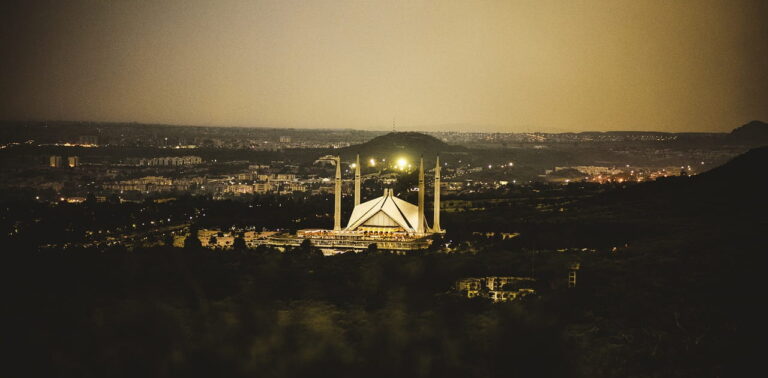
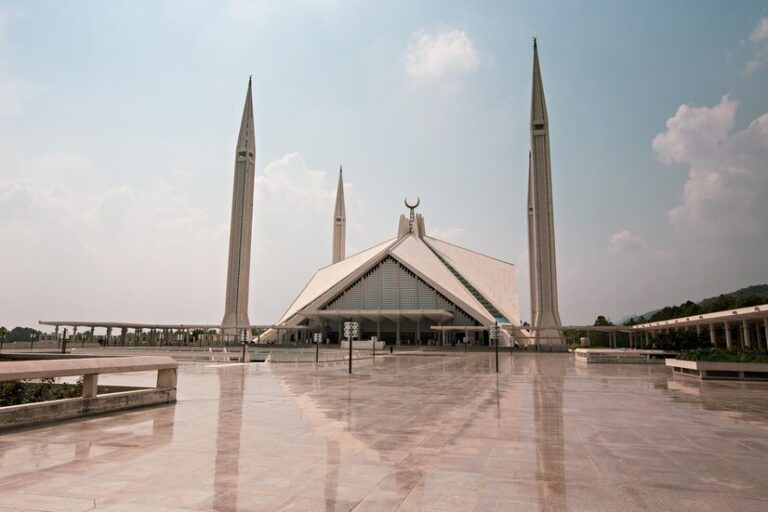
The architecture of Faisal Mosque tells an untold story with its extraordinary contemporary design and traditional blend of Islamic elements. The Turkish designer has included modern features that angle the design differently from conventional domes and arches. Its most strikingly new feature is a tent-like shape inspired by Bedouin’s Bedouin desert tents. It is supported by four towering minarets, each 88 meters high. The mosque’s prayer hall can accommodate around 3 Lac people at a time.
Faisal Mosque History Architecture
Faisal Mosque Architecture is built entirely with white marble covering it. Apart from the round dome, the minarets of Faisal Mosque are about 259 ft tall with a circumference of 10×10 meters. Even the area around it is particularly remarkable. It gives a breathtaking view with greenery in the courtyards, entrances, and fountains.
While tourists enter the mosque, they will find a circular pond that leads to a larger pond and the staircase for the main prayer hall. The total area covered by Faisal Mosque is around 10 kanal, and its interiors are stunning.
Shah Faisal Mosque Pakistan
Why is this mosque referred to as Shah Faisal by people?
The mosque is commonly referred to as Shah Faisal Mosque because it was a generous donation from the late King Faisal bin Abdul-Aziz of Saudi Arabia.
Hence, to honor the king, his name is given.
Within the Shah Faisal Mosque is the best interior design inspired by Turkish art, as there is a grand chandelier of Turkish origin in the 40-meter-high main prayer hall. It is not the only beautiful art; even the walls are featured with heart-soothing and blissful calligraphy work by renowned Pakistani artist Sadequain.
A remarkable sculpture of the Holy Quran is also situated in the main hall.
Shah Faisal Mosque Location
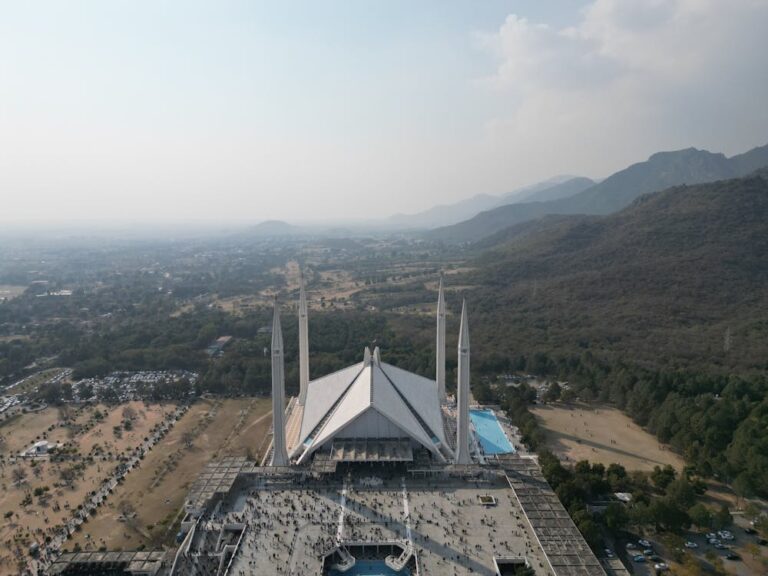
Shah Faisal Mosque is located in the national capital of Islamabad; it is situated at Shah Faisal Avenue in Sector E-8 of Islamabad. Additionally, it is built on elevated terrain at the foothills of the Margalla Hills.
You can conveniently view several spots from Shah Faisal mosque, such as Daman-e-Koh, one of the famous picnic spots in Islamabad. Moreover, if you want to discover the best view, then why wait? Just go ahead and visit the Shah Faisal Mosque now. Let us further discover the basic intricacies by learning other fascinating facts about the Shah Faisal Mosque in Pakistan below.
Famous Mosque in Pakistan
This famous mosque in Pakistan has been a prominent historical tourist attraction due to its venue and surrounding landmarks. It is a renowned mosque maintained by CDA (Capital Development Authority). Recently, CDA has initiated to announce the budget of PKR 200 million to renovate and repair this excellent artistic piece completely.
Landmark Pakistan
Some of the essential landmarks around the Faisal Mosque in Islamabad are mentioned here.
Landmark | Distance |
Margalla Green Golf Club | 3.3 Kilometer |
Jinnah Super Market | 3.3 Kilometer |
The Centaurus Mall | 3.5 Kilometer |
Japanese Children Park | 3.8 Kilometer |
Islamabad Zoo | 3.9 Kilometer |
Fatimah Jinnah Park | 6.8 Kilometer |
Islamabad Marriot Hotel | 7.3 Kilometer |
Daman-e-Koh | 7.6 Kilometer |
Pakistan Monument | 8.2 Kilometer |
Hence, once you visit Islamabad, you will see these spontaneous spots while visiting the Faisal Mosque.
Mosque Faisal
You should visit Mosque Faisal during the cool months, especially between October and March. The temperature is milder, so visitors can enjoy exploring it without facing hot and humid conditions that are not present in summer.
Also, try to visit the Mosque Faisal on weekdays or early mornings to avoid overpopulation and large crowds. The most peaceful moments will allow you to enjoy the natural environment fully. You will cherish all these fantastic moments for the rest of your life.
Pakistan Faisal Masjid
Though there is no such ticket system for the Pakistan Faisal Masjid, some of the essential points that need to be considered are as follows.
- Visitors should remove their footwear before entering the mosque.
- Visitors shall dress appropriately and modestly.
- Women must cover their heads.
- Food consumed inside mosque is prohibited.
- Loud noise is prohibited within the mosque boundaries.
- Taking photographs in the main hall is prohibited.
- Non-Muslim tourists and visitors are not permitted in the main prayer hall.
Moreover, Faisal Mosque Pakistan stands as the biggest mosque in the country and serves as a key religious site located in the heart of Islamabad. This city hosts significant commercial activities across all industries, including real estate, education, health, and other residential real estate businesses.
Hence, do not miss an opportunity to visit South Asia’s sixth-largest mosque in the world.
